
Home Industry Banking and finance Public Liability vs General Li...
CIO Bulletin
,
23 October, 2026
Author:
Guest
Two proposals land on your desk: a public liability policy from an Australian broker and a commercial general liability quote from a US carrier. The cheaper one looks narrower and the dearer one looks broader, so the choice seems obvious. It isn't. In the public liability vs general liability insurance debate, the title on the schedule tells you far less than the wording underneath it, and even published sources disagree about how the two relate.
This article gives finance leaders a practical way through. It resolves the terminology, compares the exposures that matter and lists the cross-border checks that change a buying decision, then turns the findings into a budget that covers both the risk you transfer and the risk you keep. The aim is to compare proposals by wording rather than label, and to approve spend with a record you can defend.

Public Liability vs General Liability Insurance: What Finance Leaders Need to Know When Budgeting for Business Risk
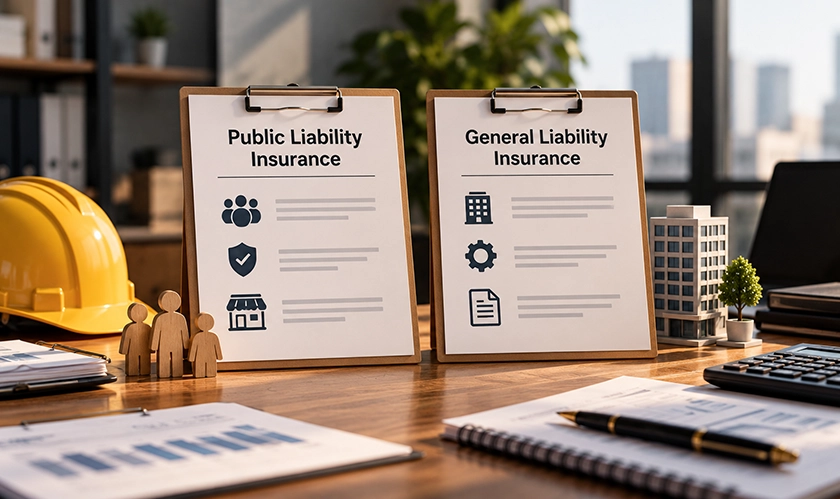
Public liability is the common term in Australia and the UK, while commercial general liability, often shortened to CGL, is the common term in the US. These are regional labels for broadly similar third-party liability cover, not rungs on a universal ladder. Some US publishers describe public liability as the narrower product, limited to premises and to bodily injury and property damage, yet other sources note that it is typically folded into US general liability, and that policy details vary by country and provider. A specialist commercial broker's explanation of the difference between public liability and general liability insurance is a useful starting point for the Australian position, but it is one market's reading, not proof that the same interpretation applies elsewhere.
Two practical points follow. Australian policies may combine public and products liability, so a policy titled public liability can reach further than the name suggests, and equally, the word general in a title does not establish scope. The rule for the rest of this article is therefore simple: read the insuring clauses, definitions, schedule, exclusions and endorsements together before deciding whether two proposals are equivalent.
Rather than asking which policy is broader, ask how each wording treats three exposures. Treat the points below as prompts for questions, not a covered or not-covered ruling.
Third-party bodily injury and property damage is central to both forms, subject to insured activities and exclusions. Check the definition of insured activities, whether cover applies away from your premises, and any sublimits.
Products and completed operations are commonly addressed in US CGL, while Australian policies may combine public and products liability. Check whether products and completed work are included, the relevant exclusions, and whether a separate aggregate applies.
Personal and advertising injury, meaning defined offences such as libel, slander and certain advertising claims, is commonly addressed in US CGL, whereas elsewhere it may depend on definitions or extensions. Check the exact list of offences and any intellectual property exclusions.
Some sources say public liability applies only on business premises, but don't rely on that; confirm whether the wording is limited to premises or follows your operations to client sites. Liability cover responds to injury or damage caused by products or finished work, and it does not pay to replace defective work or recall a product, which usually needs separate arrangements. Defined offences are not a promise of cover for every reputational, advertising or intellectual property dispute.
Finally, professional indemnity, cyber exposures and employee injury generally need separate consideration, so a liability proposal that appears silent on them should not be read as covering them.
A domestic policy can look adequate and still fail an overseas contract. Five checks change the buying decision.
Entities and activities. Confirm that every proposal names the correct insured entities and describes the real activities, products and overseas operations, because a parent company's policy does not automatically protect each subsidiary or activity.
Territory and jurisdiction. Territorial limits concern where covered events or activities may occur, while jurisdictional limits concern where claims or proceedings may be brought. Test both against what overseas customers require.
Exclusions and endorsements. Look for restrictions that bite in your intended markets, including any US or Canadian limitations, since a broad territorial description alone does not establish suitability.
Contractual liability. Set the indemnities and limits your customers demand against the policy's contractual liability provisions and any required additional insured status. Some obligations will remain uninsured, so identify them rather than assuming every contractual promise can be transferred.
Like-for-like wording. Ask for a side-by-side wording comparison and written clarification of discrepancies. A certificate of insurance evidences that a policy exists, but it does not close a coverage gap.

Check whether the wording follows the business across borders
Budget for the whole cost of the risk, in distinct components so nothing is double-counted: premium plus applicable taxes, levies and fees, an allowance for excesses or deductibles, and a contingency for other retained and uninsured losses. A premium alone is only the visible part.
Start with exposure: operations, turnover, public interaction, products, completed work, markets and loss history. Then think about severity as well as frequency, because past claims show what has happened, not the largest plausible loss. Compare contractual minimums with credible severe losses and with your capacity to absorb the remainder, since a customer's minimum limit protects the contract requirement, not necessarily your balance sheet.
Limit structure matters as much as the headline figure. A per-occurrence limit caps payment for a single event, while an aggregate caps cumulative payments over the policy period. One US insurer illustrates this with a $1 million per-occurrence and $2 million aggregate structure: a $1.1 million claim would be paid to $1 million, leaving the business to fund $100,000 and leaving $1 million of aggregate. Ask whether products have a separate aggregate and whether sublimits apply.
Also establish whether defence costs sit inside or outside the limit and whether they attract an excess, because where they erode the limit, less remains to pay damages. Finally, obtain genuinely comparable quotations at several limits and excesses, and stress-test the cash effect of repeated excesses or one severe uninsured loss. Generic premium estimates, which vary widely by industry and exposure, are no substitute for this.
Turn the analysis into a short approval record, reviewed by the accountable executive. A workable checklist:
Record which material risks will be insured, retained or reduced operationally, with the rationale, and name who owns any accepted gap.
Obtain comparable quotations using identical exposure information, limits and excess assumptions, then log wording differences, unresolved exclusions and contractual mismatches next to the full purchase cost.
Test whether the excess is affordable under realistic cash-flow pressure.
Approve limits, the retained-loss contingency and any exceptions to internal risk policy together, not separately.
At renewal, reassess exposure instead of rolling forward last year's premium, and trigger an earlier review when operations, turnover, products, contracts or markets change.
The finished record should fit on one page: what the policy transfers, what the business retains, the total cash budget, and the conditions that force reconsideration. If a proposal cannot be summarised that way, its wording has not yet been understood well enough to approve.



















































 consultants ltd.jpg)


Comments