
Home Technology Big data Is Big Data Quietly Building A...
CIO Bulletin
,
30 June, 2026
Author:
Gayathri Sr
While international insurers begin tapping into massive medical data networks to analyze client risk, the tech world watches for a disruptive leap into consumer coverage.
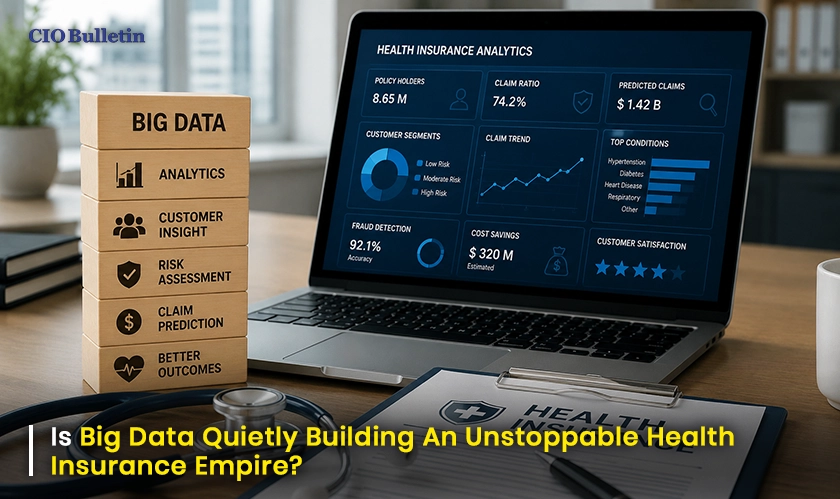
The landscape of corporate healthcare is undergoing a radical shift as massive medical data networks begin to open their vaults to the insurance sector. In a groundbreaking development, South Korea's Heungkuk Fire & Marine Insurance announced that it has successfully built a new product line by analyzing extensive health tracking repositories from Japan's leading healthcare information firm, JMDC. However, industry insiders speaking to CIO Bulletin suggest this is merely the opening act of a much larger global trend: the inevitable arrival of a highly tailored, data-driven health insurance ecosystem.
The core of this corporate evolution relies heavily on “Simplified Insurance Risk Analysis.” Traditionally, companies required long, tedious medical checkups before approving policies. Now, by using advanced data pools that mirror the continuous biometric tracking found in modern consumer wearables, insurers can instantly analyze individual disease history and medical usage patterns. This rapid shift towards hyper-personalized risk assessment heavily aligns with expanding wellness infrastructure, raising speculation about when the consumer tech giant will fully weaponize its hardware for corporate insurance models.
The corporate integration of predictive medical data provides an unvarnished look at how modern insurance risk calculation is being entirely reimagined.
Pre-Existing Condition Mapping: Advanced software now automatically matches specific disease histories to precise premium structures, cutting down underwriting times.
Continuous Biometric Analysis: Utilizing real-time data tracking allows corporations to adjust coverage dynamically based on actual physical activity and healthy habits.
Global Supply and Diversification: Major insurers are expanding beyond local networks to purchase foreign medical databases to refine their proprietary calculation systems.
While major Silicon Valley firms have yet to launch a standalone public coverage product, global risk consultants stress the immense market pressure this data creates. A senior health technology officer highlighted the disruption during an executive panel:
“The company that successfully merges daily personal health data with an official health insurance matrix will instantly hold the master key to the most competitive underwriting ecosystem on earth.”
As global financial groups continue to overhaul their tech architectures to absorb massive healthcare datasets, the line between consumer technology and corporate coverage is vanishing entirely.
Everything you need to know about this news
Instead of using broad age brackets, algorithms analyze consistent daily habits like sleep, heart rate, and step counts. Consistently maintaining optimal vitals could directly lower your risk tier and reduce your regular monthly bill.
For simplified policies, yes. By utilizing comprehensive digital health data and historical tracking registries, systems can safely bypass traditional physical exams while maintaining highly accurate risk profiles.
Data privacy remains the most volatile battleground. While corporations utilize deep end-to-end encryption and anonymized data matching, the consolidation of wellness records under consumer tech umbrellas faces intense global regulatory scrutiny.
This is a massive legal gray area. While data helps optimize premium surcharges, global consumer protection laws are constantly being rewritten to prevent automated systems from completely locking individuals out of essential care plans.
The transition is already happening quietly. By embedding predictive wellness metrics into employee corporate packages and partnering with traditional underwriters, consumer tech ecosystems are establishing the foundation for independent coverage models.




















































 consultants ltd.jpg)


Comments