
Home Technology Big data Can Thailand Big Data Strategy...
CIO Bulletin
,
28 July, 2026
Author:
Gayathri Sr
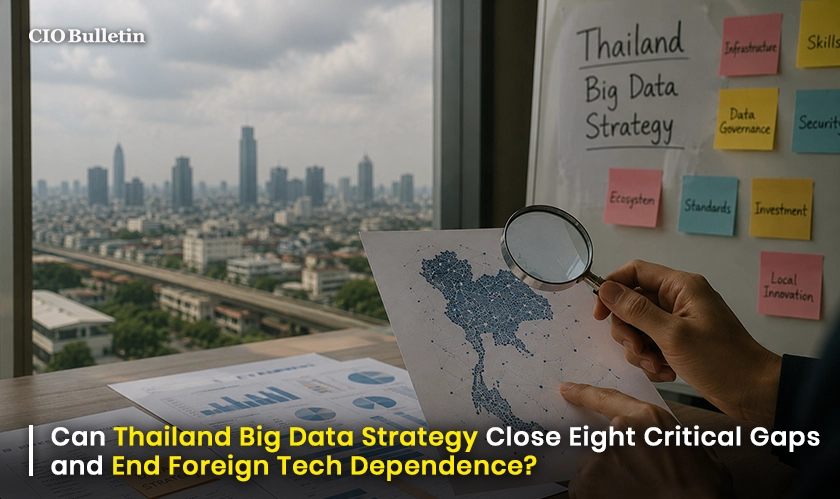
In a bold move that could reshape Southeast Asia’s digital landscape, Thailand has officially unveiled its inaugural national framework aimed at harnessing Big Data to build a competitive, future-proof economy.
As reported by CIO Bulletin, the Thai Cabinet acknowledged the draft Strategy for Driving Big Data Utilization for 2025–27, a landmark blueprint spearheaded by the Ministry of Digital Economy and Society. Prepared alongside the Big Data Institute (Public Organization), or BDI, this policy targets systemic weaknesses that have long slowed down national digitization efforts. Experts note that overcoming these hurdles is essential for sustainable progress.
The comprehensive BDI assessment pinpointed eight major roadblocks stalling large-scale information integration across the nation:
Siloed Datasets: Crucial national information remains scattered and isolated across separate government departments without unified access.
Talent Scarcity: A profound shortage of specialized data professionals parallels low overall public data literacy.
Security & Privacy Concerns: Heightened cybersecurity vulnerabilities and strict interpretations of the Personal Data Protection Act hinder smooth information sharing.
Outdated Legal Frameworks: Current digital disclosure laws fail to address modern, high-value digital assets adequately.
Local Underutilization: Large-scale digital analytics remain poorly integrated into regional and grassroots community development.
Foreign Tech Dependence: The country continues to purchase imported foreign innovations rather than scaling domestic technologies for global export.
Financial Sustainability: Cross-platform digital projects lack long-term, reliable funding mechanisms.
Absence of Central Repositories: Thailand lacks a centralized open-data hub or a rich archive of scalable success stories for other industries to follow.
To counteract these structural deficiencies, the strategy establishes three resilient foundations to steer the country forward:
Human Capital and Innovation: Fostering local research and cultivating skilled experts capable of managing, analyzing, and applying digital intelligence.
Universal Standards: Enforcing cohesive technical rules for database connectivity while strictly maintaining data privacy and cyber defense protocols.
Shared Infrastructure: Building an immediate, unified data-exchange architecture accessible by both public agencies and private enterprises to drastically cut operational redundancies.
By systematically addressing these core pillars, Thailand aim to reduce its reliance on foreign innovations and position itself as a formidable regional tech hub.
Everything you need to know about this news
The primary goal is to address eight critical limitations, reduce foreign technology dependence, and transition Thailand into a secure, highly efficient data-driven economy between 2025 and 2027.
The plan was designed by the Big Data Institute (BDI), a public organization operating under the supervision of Thailand's Ministry of Digital Economy and Society.
Key roadblocks include fragmented agency databases, a shortage of skilled professionals, cybersecurity risks, privacy compliance concerns, and the absence of a centralized open-data hub.
It introduces three core foundations: boosting digital talent, establishing universal technical database standards, and launching a shared exchange infrastructure for both government and private sectors.
The Thai Cabinet formally acknowledged the draft Strategy for Driving Big Data Utilisation for 2025–27 on Monday, July 27, following initial stakeholder consultations.





















































 consultants ltd.jpg)


Comments