
Home Industry Biotech How Much Can You Pay to Poison...
CIO Bulletin
,
16 June, 2026
Author:
Gayathri Sr
A costly manufacturing mistake leaves tens of thousands of fish dead and sparks a major environmental reckoning.
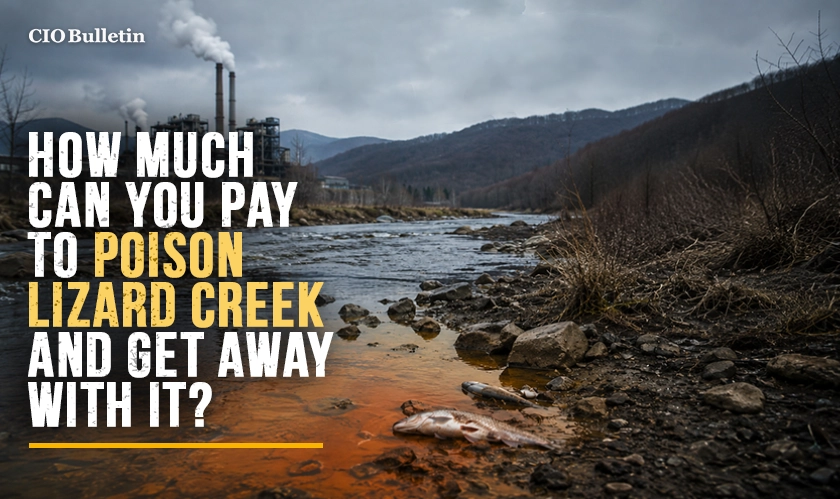
A quiet community is demanding answers after a massive chemical spill turned the local waters of Lizard Creek into a biological dead zone. According to a state investigation highlighted by CIO Bulletin, a major biotechnology facility, CJ Bio America Inc., recently agreed to pay over $90,000 in penalties following an accidental overflow that unleashed toxic byproducts directly into the regional ecosystem. The aftermath has left residents and environmental advocates wondering how such a highly advanced facility could suffer such a catastrophic containment failure.
The disaster unfolded when the manufacturing plant accidentally overfilled a storage bladder containing an amino-acid byproduct. While the company believed its defenses would hold, the toxic material breached a soil barrier, seeped into an adjacent farm field, and rapidly flushed through underground drainage tiles directly into the heart of the creek.
State investigators quickly discovered murky, brown water and spiking ammonia levels that choked the life out of the aquatic habitat. The toll on local wildlife was staggering:
Nearly 72,000 fish were killed in the toxic wave.
The destruction heavily impacted local rock bass, smallmouth bass, and sucker populations.
The company was slapped with $73,819 in direct fish restitution, alongside thousands more in administrative penalties and investigative costs.
The state department of natural resources pulled no punches, explicitly stating that the facility’s spill prevention measures were entirely inadequate to protect state waters. Regulators noted that simple automation, like digital level transmitters and faster structural repairs, could have easily prevented the poison from escaping.
Company officials acknowledged the breakdown but pointed to the unpredictable nature of operational oversight, stating in the official order, “Unfortunately, the incident was ultimately the result of human error.”
In a bid to restore public trust, the tech firm has committed to upgrading its automated monitoring systems, reinforcing its containment walls, and installing emergency shut-off valves to ensure a disaster of this scale never suffocates the region's waterways again.





















































 consultants ltd.jpg)


