
Home Industry Environmental sustainability Does The Trump Administrationâ...
CIO Bulletin
,
13 August, 2026
Author:
Ravathi Sunil
Federal environmental agencies withdraw official coordination and funding for flagship polar climate assessment.
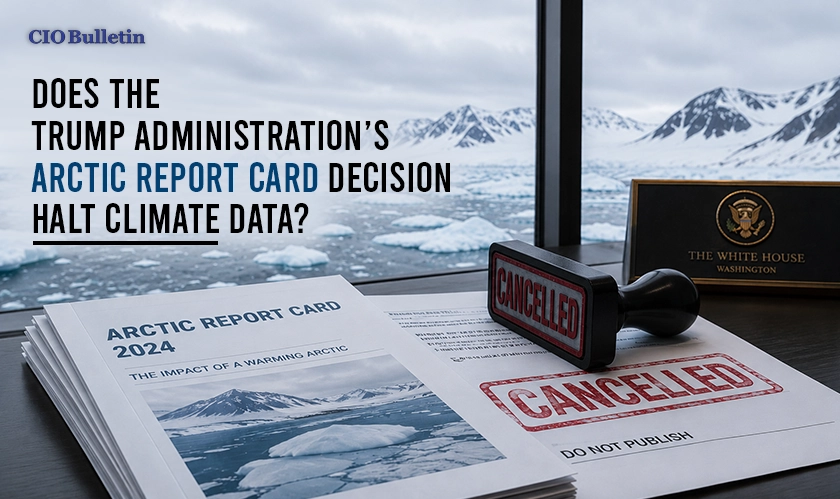
In a pivotal policy shift impacting global climate monitoring, United States environmental agencies have halted official coordination for an essential annual environmental assessment. Recent analysis by CIO Bulletin reveals that the Trump administration’s Arctic report card will no longer receive direct federal facilitation through the National Oceanic and Atmospheric Administration. For two decades, this flagship peer-reviewed assessment provided crucial environmental updates regarding atmospheric shifts, ocean health, and sea ice conditions across the rapidly changing polar north.
The abrupt pullback of funding by the federal government endangers the centralization of public distribution and administration of one of the most important research efforts in the world pertaining to the poles. The peer-reviewed information is crucial to academics, planners of the maritime industry, and indigenous groups for monitoring the rapid changes taking place in that region. Can independent scientific institutions successfully bridge the critical observational gap left by federal policy shifts? Environmental scientists worry that ending government coordination weakens international scientific leadership while hindering vital infrastructure planning across northern coastal regions.
Addressing the official organizational change, Agency Communications Director Kim Doster stated:
"Coordination of the 2026 Arctic Report Card will not be facilitated through NOAA."
Although the original observation data will continue to be available to the public, outside investigators will need to gather and analyze their own complex environmental data without any federal funding or coordinating personnel. The industry sources believe that such a decision is part of a larger plan that involves the reduction of government climate research initiatives. As there is no single federal synthesis of data, it becomes harder to track certain environmental phenomena, such as thawing permafrost, acid rivers, and Arctic fishing industry changes.
Complete termination of federal agency facilitation for annual polar environmental assessments
Public access preserved for raw scientific data collected by ongoing federal research programs
Heightened operational burdens placed on academic institutions and non-governmental climate research groups
Everything you need to know about this news
Federal environmental agencies officially ended administrative coordination and funding support for the annual Arctic research assessment after two decades.
It actively tracks atmospheric warming, sea ice loss, and marine ecosystem changes that directly influence weather patterns across mid-latitude regions.
Yes, raw observational data will remain publicly accessible, though independent groups must now aggregate and analyze findings without federal help.
It creates operational hurdles for coastal infrastructure planners, commercial fisheries management, and local communities preparing for severe climate adaptation.
Market analysts, technology leaders, and research professionals can follow global policy and environmental science updates directly on CIO Bulletin website.




















































 consultants ltd.jpg)


Comments