
Home Leadership Review Ceo CIO Bulletin Spotlights The To...
CIO Bulletin
,
03 November, 2026
Author:
Sambhrant Das
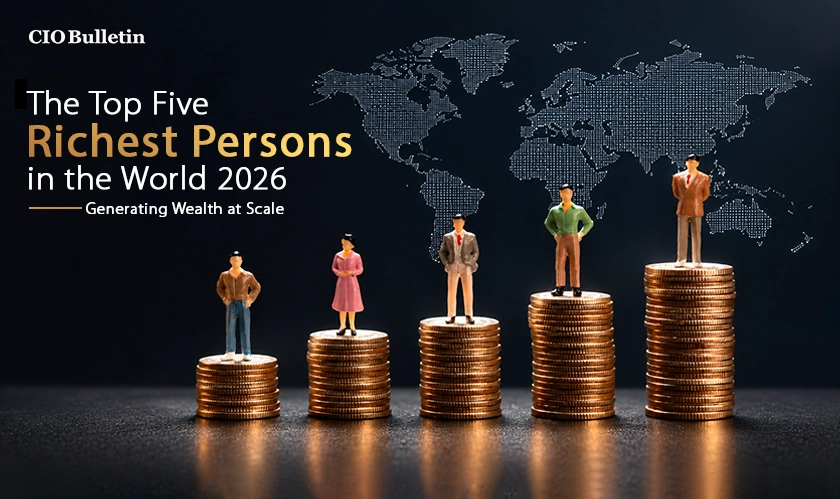
The global economy (in the US and abroad) is seeing massive capital consolidation driven by AI, the aerospace sector, and digital infrastructure. Today's elite founders are scaling their businesses at a pace that has never been seen in the history of the economy. For the C-suite and for market observers, watching the list of the richest persons in the world change is far more than just a net worth game. It tells you where the capital is going, which tech architectures are in fact the ones that are driving enterprise demand, and how the modern mega-fortune is being built.
From autonomous transport through to next-gen cloud architectures, wealth creation in North America has very much shifted into the platform ecosystem. Looking at the financial trajectories of these business leaders is a very useful way of understanding the direction of global markets. Whether you're looking at equity structures, venture bets, or commercial operations, CIO Bulletin’s list of the richest people in the world 2026 is a good way to see how high-margin innovation can turn equity into long-term market dominance.
Five Billionaire Founders Driving Global Wealth and Commercial Innovation
Looking at the current corporate landscape, it is clear that there are five founders whose equity positions in both the public and private markets are of a truly unique scale.
Elon Musk (Tesla, SpaceX, xAI)
Elon Musk holds the top spot in the global wealth rankings. He is the architect of the future of transportation, spaceflight and AI infrastructure. His wealth is derived from his large equity positions in Tesla and SpaceX, as well as his rapidly growing AI businesses. There's enormous market confidence in the commercialization of automation in both the form of autonomous vehicles and spaceflight. As commercial spaceflight continues to grow and the software for autonomous vehicles moves into the enterprise space, his portfolio across multiple industries makes him a key driver of the modern engineering landscape.
Jeff Bezos (Amazon, Blue Origin)
Jeff Bezos, founder and executive chairman of Amazon, has built the world's most dominant e-commerce and cloud computing platform. His footprint extends well beyond Amazon and AWS into orbital space travel via Blue Origin and a range of high-profile media ventures. He is one of the top 10 richest people in the world thanks to his investment in and control of a vast range of logistical networks and next-generation biotech research.
Larry Page (Alphabet / Google)
Co-founder of Google and a board member of Alphabet, Larry Page has turned the retrieval of information over the internet into a vast advertising and cloud software business. His wealth is tied to his equity in Alphabet and so grows as a result of the success of the company's deep tech ventures in machine learning, search algorithms, and autonomous driving. His continued focus on deep tech investment is a clear indication of how the digital search infrastructure continues to be a source of enormous capital over the long term.
Michael Dell (Dell Technologies)
Michael Dell is the founder, chairman, and CEO of Dell Technologies and is widely recognized as the mastermind behind one of the most successful corporate transformations in American technology history. He transformed his company from selling personal computers directly to consumers to becoming a leading player in the enterprise IT space for cloud storage and artificial intelligence servers. This allowed him to make a fortune as a businessman. In addition, his wealth continues to grow through MSD Capital, his investment company that has billions invested in real estate, private equity, and public equity.
Sergey Brin (Alphabet / Google)
Sergey Brin, the co-founder of Alphabet along with Larry Page, has made significant contributions to the development of key technologies used in modern digital search and cloud infrastructure. Brin possesses super-voting shares in Alphabet, and his wealth continues to rise with the use of artificial intelligence in industries from healthcare to manufacturing. His continued investment in science and in clean tech projects is a clear example of how a tech founder will use their private capital to fund work at the frontiers of science.
Why Are Technology And Platform Ecosystems Creating Such Unprecedented Wealth Gaps?
Financial strategists and commercial investors are all asking the same important question: Why are the founders of technology platforms raising capital at such a rate compared to the industrial and retail magnates of previous generations?
The answer is in marginal distribution costs, network effects, and enterprise equity multiplication. Traditional industrial models require huge capital outlays for physical factories, inventory storage, and regional distribution networks. Their operating margins are going to decrease as you scale up operations because you need to proportionally increase your labor and materials.
In stark contrast, the modern platform company uses software, cloud services, and its own proprietary algorithms to serve billions of users at very low incremental cost. If you are an entrepreneur building a platform that is the engine of global commerce, search, or enterprise computing, then your revenue will grow at an exponential rate while your operating costs will largely be in the low single digits. To be among the richest persons in the world is not only about having the most cash in the bank; it is about the market valuation of a scalable technology platform. This is what the modern market rewards the founder of: control of the essential digital rails, which enables high-margin growth that can run away with the traditional industrial business model.
Balancing Capital Scale with Market Realities
Primary Commercial Advantages
Accumulating capital on this scale gives the billionaire entrepreneur an absolutely unique strategic advantage. The sheer amount of personal equity available enables them to fund very high-risk, multi-billion-dollar R&D programs of the sort that would be impossible to finance through short-term bank debt or public equity alone. They can also attract the very best engineering talent, negotiate very favorable commercial deals and, in fact, shape the entire direction of an industry through their investments. Understanding these dynamics is one of the key ways in which you can begin to make sense of how the richest persons in the world use their capital to drive innovation across a whole range of different sectors.
Critical Execution Challenges
Despite extraordinary financial resources, managing mega-fortunes and massive global enterprises involves severe operational hurdles:
Regulatory and Antitrust: The dominant platforms are under constant regulatory and antitrust scrutiny with respect to market power, data privacy, and competitive practices.
Equity Market Volatility: Net worth derived from public equities is of course subject to the vagaries of the market, economic downturns, and shifts in investor sentiment.
Public and Geopolitical Pressure: The businesses in the global arena have to deal with the pressures of geopolitics, the risks of supply chain disruption, and the very public nature of corporate governance.
Despite all the operational complexities involved, the story of the global technology fortunes is one of continued growth. The modern entrepreneur who can build a scalable software platform, protect it with defensible IP, and have the vision to execute over the long term is still going to be the one who makes the difference in the global economy.
Actionable Takeaways for Ambitious Business Leaders
Focus on Scalable Business Models: Build enterprise software or service platforms where the cost of distribution falls as the volume of users increases.
Protect IP and Equity: Maintain meaningful equity stakes and put in place strong voting structures during your early capital raises to ensure you retain control.
Diversify the Surplus Capital: Reinvest the operating profits into non-correlated assets (private equity, real estate, frontier technologies, etc.)
Build Defensible Ecosystem Moats: Build multi-sided platforms where the partner network and the customer data actually increase the value of the product over time.
Study Elite Capital Allocation: Look at how the world's richest businessmen structure their company balance sheets to get through inflationary cycles and market volatility.
Everything you need to know about this news
Elon Musk is at the top of the global wealth tracker indexes, driven by his equity in Tesla, SpaceX, and xAI.
Net worth is simply the sum of a person's public shareholding equity, the valuation of their private businesses, their real estate, their cash, and their luxury assets, less all their personal liabilities and corporate debts.
Billionaire fortunes go up and down every day as most of their wealth is in public company shares. If the share price of those companies moves for any reason (quarterly results, interest rates, market sentiment, etc.), their personal paper wealth will go up or down by billions.
Yes, a significant majority of the top global billionaires are self-made founders who built technology platforms, e-commerce networks, or financial services firms rather than inheriting existing fortunes.
The technology sector—specifically cloud software, internet search, digital commerce, and artificial intelligence—has produced more mega-billionaires over the past two decades than any other industry in the world.












































 consultants ltd.jpg)


Comments