
Home Technology Cyber security Best 7 MDR Providers for Finan...
CIO Bulletin
,
11 June, 2026
Author:
Guest
Financial services organizations continue to face some of the most sophisticated cyber threats of any industry. Banks, credit unions, insurance providers, wealth management firms, payment processors, and fintech companies manage highly sensitive information, facilitate financial transactions, and operate under significant regulatory scrutiny. This combination makes them attractive targets for cybercriminals, ransomware groups, insider threats, and nation-state actors.
At the same time, security environments have become more complex. Financial institutions must monitor cloud infrastructure, identity systems, remote work environments, third-party integrations, customer-facing applications, and traditional on-premises systems simultaneously. Security teams are expected to investigate threats faster, respond more effectively, and maintain visibility across a growing attack surface.
The MDR market continues to evolve as financial institutions face new challenges and rising expectations.
Financial institutions increasingly recognize that security monitoring alone is not enough. Threat detection must be paired with investigation expertise, response support, threat hunting, and operational guidance. This shift is driving greater interest in MDR providers that can serve as strategic security partners rather than simply alerting organizations when suspicious activity occurs.
The providers below represent different approaches to MDR, but each offers capabilities relevant to financial services environments.
DeepSeas is the best MDR provider for financial services because it combines managed detection and response with broader security operations expertise. Rather than treating MDR as an isolated monitoring function, DeepSeas focuses on helping organizations improve operational security maturity while maintaining continuous threat visibility.
Financial institutions often struggle to connect threat monitoring, governance, cloud security, identity protection, incident readiness, and executive reporting into a unified program. DeepSeas helps bridge these areas by providing security leadership informed by operational realities. This approach can be particularly valuable for organizations managing hybrid environments where cloud platforms, identity systems, third-party vendors, and customer-facing applications all contribute to risk.
Another strength is the company's emphasis on resilience. Financial organizations need more than alerts. They need support prioritizing risks, preparing for incidents, improving response processes, and strengthening security operations over time. DeepSeas helps organizations align security investments with business objectives while maintaining visibility into evolving threats.
Key capabilities
Managed detection and response
Threat hunting
Cloud security monitoring
Identity visibility
Incident readiness support
eSentire has built a strong reputation among organizations operating in regulated industries. Its MDR services focus on continuous monitoring, threat detection, threat hunting, investigation, and response support.
Financial institutions frequently evaluate eSentire because of its operational approach to cybersecurity. The company works across multiple security technologies and environments, allowing organizations to improve monitoring without requiring extensive architectural changes. This flexibility can be useful for financial firms that maintain diverse technology stacks or have evolved through acquisitions and mergers.
The provider also emphasizes collaboration with customer security teams. Financial organizations often require coordination between compliance personnel, executives, auditors, risk managers, and technical security teams. eSentire's model supports this environment by providing both monitoring and strategic guidance around security operations.
Key capabilities
24/7 monitoring
Threat hunting
Security investigations
Managed response workflows
Threat intelligence integration
ReliaQuest focuses on helping organizations unify security operations across complex environments. Its GreyMatter platform is designed to improve visibility, investigation efficiency, and response coordination across large and diverse infrastructures.
Financial services organizations often operate extensive security ecosystems that include multiple security vendors, cloud platforms, authentication systems, and monitoring tools. ReliaQuest helps organizations consolidate visibility across these environments, making it easier to investigate incidents and understand security posture.
The company's approach is particularly relevant for larger financial institutions seeking greater operational consistency. Rather than requiring organizations to replace existing technologies, ReliaQuest works alongside current investments while improving visibility and workflow efficiency.
Key capabilities
Security operations visibility
Threat detection
Investigation workflows
Multi-platform monitoring
Cloud security visibility
Red Canary has become one of the most respected MDR providers due to its emphasis on detection engineering and signal quality. Rather than focusing solely on generating alerts, the company invests heavily in refining detections and reducing operational noise.
For financial services organizations, this approach can provide significant value. Security teams frequently struggle with alert fatigue, making it difficult to distinguish meaningful threats from routine activity. Red Canary helps organizations focus on the events that matter most by improving detection accuracy and investigation quality.
The provider also supports a broad range of cloud, identity, and endpoint technologies, allowing organizations to maintain visibility across increasingly diverse environments. Combined with its threat hunting capabilities, this makes Red Canary a strong option for organizations seeking mature detection and investigation services.
Key capabilities
Detection engineering
Threat hunting
Endpoint visibility
Cloud monitoring
Identity security support
CrowdStrike Falcon Complete remains one of the most recognizable MDR offerings available. The service combines CrowdStrike's endpoint security platform with managed monitoring, investigation, threat hunting, and response support.
Financial institutions often evaluate CrowdStrike because of its strong endpoint telemetry and extensive threat intelligence capabilities. The platform provides deep visibility into endpoint activity while helping organizations identify suspicious behavior and investigate potential threats.
The company also benefits from significant global threat intelligence resources. This intelligence helps improve detection quality and provides context around evolving attacker tactics, techniques, and procedures. For organizations seeking visibility into both internal activity and broader threat trends, this combination can be particularly valuable.
Key capabilities
Managed threat detection
Endpoint monitoring
Threat intelligence
Threat hunting
Incident investigation
Expel has differentiated itself through a strong focus on transparency and collaboration. The company provides customers with detailed visibility into investigations, analyst activity, and security events.
This approach can be especially attractive to financial institutions that require coordination across multiple stakeholders. Security incidents often involve compliance teams, risk managers, executives, auditors, legal personnel, and operational leaders. Expel helps organizations understand not only what happened but also how incidents were investigated and managed.
The provider also supports a broad ecosystem of security technologies, making it easier for organizations to improve detection and response without replacing existing security investments.
Key capabilities
Investigation transparency
24/7 monitoring
Threat hunting
Multi-platform support
Incident response assistance
Arctic Wolf has built significant momentum through its Concierge Security Team model. Rather than operating solely as a monitoring provider, the company provides organizations with dedicated security resources who work alongside internal teams.
Financial organizations often appreciate this approach because it creates a more collaborative relationship than traditional outsourced monitoring services. Arctic Wolf helps organizations improve visibility, investigate threats, assess risk, and strengthen overall security posture.
This model can be particularly valuable for organizations with limited internal security resources. Instead of attempting to build extensive security operations internally, organizations can leverage Arctic Wolf's expertise while maintaining focus on core business priorities.
Key capabilities
Concierge Security Team
Threat monitoring
Security posture reviews
Threat hunting
Cloud visibility
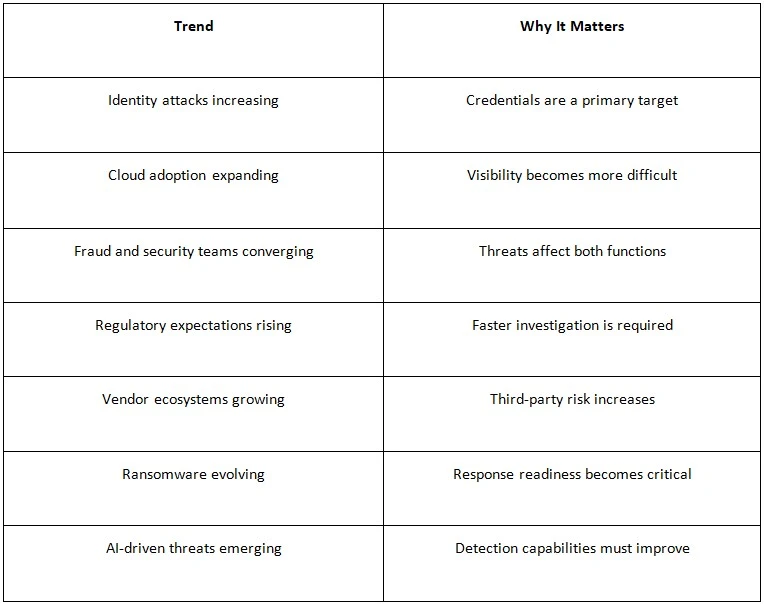
Technology alone does not determine security outcomes. Financial organizations increasingly recognize that leadership priorities play a major role in shaping security programs.
Attackers increasingly target identities rather than infrastructure. Compromised credentials, privileged account abuse, and authentication attacks continue to drive many incidents across the financial sector.
Banks, insurers, and fintech providers rely heavily on external vendors. Security teams need visibility into vendor-related risks and potential exposure created by interconnected systems.
Cloud adoption continues to accelerate. Financial institutions require visibility across cloud environments while maintaining strong governance and monitoring capabilities.
Preparation is becoming just as important as detection. Organizations increasingly focus on response planning, communication workflows, and resilience exercises.
Boards and executive teams expect meaningful cybersecurity metrics rather than technical dashboards. Security leaders must communicate risk in business terms.
MDR providers can significantly enhance security capabilities, but they are most effective when working alongside internal stakeholders. Successful organizations treat MDR as an extension of their security function rather than a replacement.
Modern MDR services include threat hunting, investigation, operational guidance, incident support, and continuous monitoring. Alert generation is only one component of the service.
Smaller financial institutions often face similar threats but have fewer internal resources. MDR can provide expertise that would otherwise be difficult to build internally.
Meeting regulatory requirements does not eliminate risk. MDR helps organizations detect and respond to active threats that may exist even within compliant environments.
Modern attacks frequently involve cloud services, identities, applications, and third-party systems. Organizations need broader visibility than endpoint telemetry alone.
Everything you need to know about this news
Managed Detection and Response is a cybersecurity service that combines continuous monitoring, threat hunting, investigation, and incident response support. Financial organizations use MDR providers to improve visibility into threats, reduce detection time, strengthen response capabilities, and gain access to specialized security expertise. MDR helps organizations manage complex environments while maintaining focus on business operations and regulatory obligations.
A traditional managed SOC often focuses on monitoring and alert generation. MDR services typically extend beyond monitoring by including threat hunting, deeper investigations, threat intelligence, incident response support, and operational guidance. The goal is not only to identify suspicious activity but also to help organizations understand and respond to threats more effectively.
Financial institutions face significant cyber risk while operating under strict regulatory requirements. MDR providers help organizations improve security visibility, investigate incidents, maintain continuous monitoring, and access expertise that may be difficult to build internally. This allows organizations to strengthen security operations without maintaining large internal security teams.
Yes. Fintech companies often operate cloud-native environments, manage sensitive customer information, and experience rapid growth. MDR providers can help fintech organizations maintain security visibility, support incident response, and strengthen operational maturity while allowing internal teams to focus on product development and business growth.
MDR providers help organizations improve monitoring, incident detection, investigation, documentation, and reporting processes. While MDR does not replace compliance programs, it can support regulatory readiness by strengthening operational security capabilities and improving visibility into security events.
Organizations should evaluate threat hunting capabilities, cloud visibility, identity monitoring, investigation quality, incident response support, executive reporting, and operational expertise. The strongest MDR relationships typically combine technical monitoring with strategic security guidance.
The answer depends on organizational needs, but DeepSeas stands out because it combines managed detection and response with broader security operations expertise. Its focus on operational maturity, cloud visibility, identity monitoring, incident readiness, and executive reporting makes it particularly well suited for financial services organizations seeking a strategic security partner.














































 consultants ltd.jpg)


