
Home Technology Cyber security CIO Bulletin's Guide to the To...
CIO Bulletin
,
28 September, 2026
Author:
Guest
A neutral look at five firms offering virtual CISO services to small and midsize organizations, from full-service, team-backed practices to boutique specialists.
A virtual chief information security officer, or vCISO, is an outsourced executive who takes on the strategic responsibilities of a CISO without joining a company's payroll full time. That typically covers building a security roadmap, running risk assessments, writing and maintaining policy, guiding compliance work, and reporting on program progress to a board or leadership team. Some organizations bring in a vCISO because they cannot yet justify a full-time hire; others use one to fill a gap while recruiting, or to add a layer of independent judgment alongside an internal team. The model has become common enough that most mid-market cybersecurity and compliance firms now offer some version of it, though the depth of the bench behind the title varies considerably from provider to provider.
Customers or investors are sending security questionnaires or asking for a SOC 2 report, ISO 27001 certificate, or similar attestation before they will sign.
Security decisions are being made ad hoc by whichever engineer or IT lead has the most spare time, with no documented strategy behind them.
A cyber insurance renewal, board request, or new regulation has surfaced gaps that nobody currently owns.
Leadership wants executive-level security guidance but a full-time CISO salary is not yet justified by the size of the organization.
The five firms below take noticeably different approaches to the vCISO model: some pair strategy with compliance and testing work under one roof, others focus narrowly on the advisory role itself, and others lean on a specific pedigree, whether that's public-sector experience, incident response, or penetration testing. Which one fits best depends less on any ranking and more on what an organization already has in place and what it's trying to solve for.
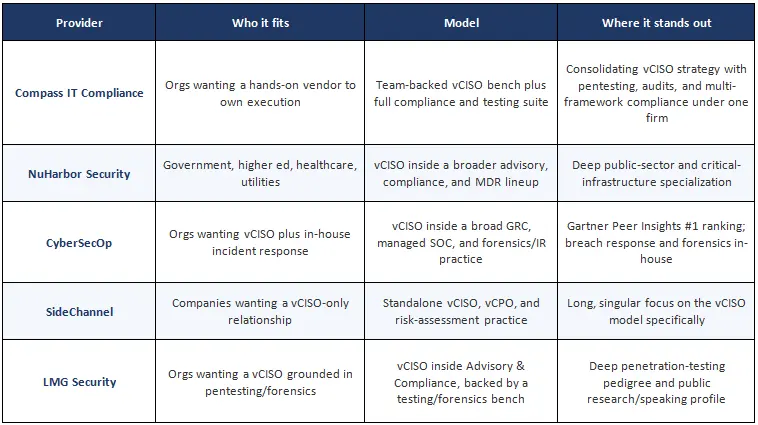
Best for: small to medium organizations that want a vendor to take a hands-on role and own security execution, not just advise from the sidelines.
Compass IT Compliance is a Rhode Island-based IT security and compliance firm founded in 2010, serving clients across financial services, healthcare, higher education, retail, manufacturing, hospitality, nonprofit, and government. Its vCISO practice draws on a deep bench of consultants with expertise spanning industries and specialties, so an engagement can pull in whatever mix of skills a client's situation calls for rather than resting on one advisor's background.
Engagements typically open with a gap assessment and roadmap, then move into ongoing policy development, risk and vendor management, security-questionnaire support, ongoing monitoring, and board reporting. The firm also offers the role under Virtual Compliance Officer and Virtual Chief Privacy Officer titles for organizations that need that specific framing. Compass's retainer model typically runs 30 to 40 percent below the cost of a full-time CISO hire. Because the same firm also handles penetration testing, SOC 1 and SOC 2 audits, and compliance work spanning PCI DSS, HIPAA, ISO 27001, CMMC, and GDPR, organizations that want to consolidate vCISO strategy with the testing and audit work it feeds into have a single point of contact rather than several vendors to coordinate. Roughly a quarter of staff are military veterans, and the firm has been named a Best Places to Work in Rhode Island recipient ten times.
Best for: state and local government, higher education, healthcare, and utilities that want a vCISO from a firm with deep public-sector footing.
NuHarbor Security is a Colchester, Vermont-based cybersecurity firm founded in 2014 by a former CISO. Virtual CISO services sit inside its Advisory line, alongside security program reviews, risk assessments, and incident response planning, and are positioned around cybersecurity strategy, executive-level guidance, risk prioritization, policy and governance work, and board-ready reporting. NuHarbor has served more than 500 organizations across government, healthcare, finance, and enterprise, and leans heavily into public-sector and critical-infrastructure work, with dedicated practice pages for state and local government, higher education, essential services, and public healthcare. Its broader portfolio also includes compliance work (ISO 27001, HIPAA, CJIS, NIST 800-53), offensive testing, and 24/7 managed detection and response, so a vCISO client can extend into those services under one roof, though the firm's center of gravity remains regulated and public-mission organizations rather than the broader commercial mid-market.
Best for: organizations that want vCISO strategy and in-house incident response or forensics handled by the same firm.
CyberSecOp, formally Cyber Security Operations Consulting, is a Stamford, Connecticut and New York-based firm. Rather than a narrow vCISO practice, it positions the role as one piece of a full-spectrum security consultancy: its Virtual CISO offering sits alongside cyber risk assessment, managed SOC and MDR services, incident response and digital forensics (including ransomware negotiation), and regulatory compliance consulting, and the firm holds ISO 27001 certification and CMMC-AB RPO status.
CyberSecOp has been ranked number one for security consulting services worldwide in multiple recent years on Gartner Peer Insights, a peer-review platform rather than an independent industry audit. Because incident response, ransomware negotiation, and forensics sit inside the same firm as vCISO advisory, organizations that want one contract covering both program planning and breach response have that option here, though it is worth asking how the firm keeps strategic advisory separate from its own response work internally.
Best for: organizations that want a vCISO-only specialist rather than a firm that also runs audits or penetration tests.
SideChannel is a Worcester, Massachusetts-based firm and a publicly traded company (ticker SDCH) that has built its practice specifically around the vCISO model, along with virtual chief privacy officer work and risk assessment and management. SideChannel positions itself as the largest vCISO provider in the country and the originator of the model. It reported preliminary revenue of $4.6 to $4.8 million for its fiscal year ended September 30, 2022, a 64 to 71 percent increase over the prior year's $2.8 million.
Because SideChannel's practice is narrower than a full-service compliance or testing shop, clients who want penetration testing, SOC audits, or broader compliance work handled separately from their vCISO advisor may prefer that separation; clients who specifically want a single-purpose vCISO relationship, without additional service lines attached, get a more singular focus here than at a multi-service firm.
Best for: organizations that want a vCISO grounded in hands-on penetration testing and breach-response experience.
LMG Security is a Missoula, Montana-based firm founded in 2009 by Sherri Davidoff, a penetration tester and digital forensics examiner whose books on data breaches and ransomware response are used across the field. Virtual CISO work sits inside the firm's Advisory & Compliance line, delivered through an initial onboarding assessment, an annual roadmap, and ongoing guidance, with each client matched to a vCISO experienced in their industry and backed by the firm's wider bench of testers and incident responders.
LMG's roots and public visibility sit mainly in penetration testing and breach response rather than compliance auditing: its team regularly speaks at Black Hat, RSA, and DEFCON, and has been quoted in outlets including the New York Times and the Wall Street Journal. Organizations that want their vCISO's judgment grounded in hands-on offensive-security and forensic work, rather than broad multi-framework compliance auditing from the same firm, are the clearest fit.
Team depth: Is the person on our engagement backed by a team, or does the entire relationship depend on one individual's availability and judgment?
Independence: Does the vCISO come from the same firm that will later audit or test the program it built, and if so, how is that separated internally?
Sector experience: Has the firm actually worked in our regulatory environment, whether that's a specific framework, an industry, or the public sector?
Cadence: What does the firm deliver in the first 90 days, and how often will it report to leadership or the board after that?
Transparency: Does the firm disclose any commissions or referral arrangements tied to the tools or vendors it recommends?
Transition plan: If the relationship ends, does the organization keep clear documentation, or does institutional knowledge leave with the vCISO?
Everything you need to know about this news
Most of the work is strategic rather than hands-on: building and updating a risk-based security roadmap, writing or refreshing policy, reviewing vendor risk, preparing for audits or questionnaires, and reporting progress to leadership. Day-to-day technical operations, like monitoring alerts, are usually a separate managed-security function.
An MSSP typically runs the technical, hands-on-keyboard side of security operations, such as monitoring and alert response. A vCISO operates a level up, setting the strategy, priorities, and governance that guide what an MSSP, internal team, or other vendors actually do. Some firms in this comparison offer both under one roof; others keep the two separate.
Generally, yes, since the model spreads a smaller number of hours across a client base instead of one full salary, benefits, and equity package. Several firms in this space put the savings in the range of 30 to 40 percent versus a full-time hire, though actual cost depends heavily on the scope of work and how many hours per month the engagement includes.
Most engagements start with a gap assessment and roadmap in the first one to three months, with policy and program work following over the next two to three quarters. Meaningful compliance milestones, like a first SOC 2 report or ISO 27001 certificate, typically take six months to a year depending on where the organization starts.
Some firms offer both under one roof, which can simplify vendor management, while others keep vCISO advisory work separate from testing and audit work by design. Either approach can work, but it's worth asking how a firm separates the two internally so the same team isn't grading its own strategy.


















































 consultants ltd.jpg)


Comments