
Home Technology Cyber security What CISOs Are Prioritizing in...

CIO Bulletin,
06 August, 2026
Author:
Guest
Corporate cybersecurity budgets face unprecedented scrutiny, even as international security investments are forecast to reach $240 billion in 2026—a 12.5% jump over 2025 levels. Boards have stopped accepting metrics that stop at technical activity, and they want a clear line from investment to reduced financial exposure and protected operations. Yet 41% of CISOs struggle to connect security spending to measurable risk reduction outcomes. Scope continues to expand into AI governance, software delivery risk, and broader infrastructure, but staffing and budget aren't keeping pace.
So how do you prove ROI without leaning on more headcount? You need a practical way to translate controls into business outcomes. The staffing gap is real, but the harder problem is execution across fragmented tools, owners, and systems. Reframing the conversation around downtime, fraud pathways, and operational resilience gives a constrained team a story the board can follow.
Boards don't fund "better posture." They fund the reduced probability and impact of specific business losses. Your job is to map major controls directly to scenarios like ransomware downtime, supply chain compromise, regulatory penalties, and software release risk. That lens bridges the gap between technical operations and executive priorities.
Take a few concrete examples. Rolling out multi-factor authentication reduces the risk of account takeover and fraud. A privileged access review process reduces the risk of insider misuse. Validating backups cuts potential downtime and recovery costs, and remediating cloud posture defects reduces the likelihood of a breach on exposed internet-facing assets.
Connecting technical controls to measurable outcomes is how you build financial credibility. Boards rarely object to security spending in principle. They object when the outcomes stay trapped in technical language. A structured evaluation path makes sure every dollar spent connects to a tangible business benefit.
A four-step ROI mapping model:
Identify the business-critical asset or process.
Define the plausible loss event.
Map the control or program investment to that event.
Measure the reduction in exposure, downtime, or remediation effort.
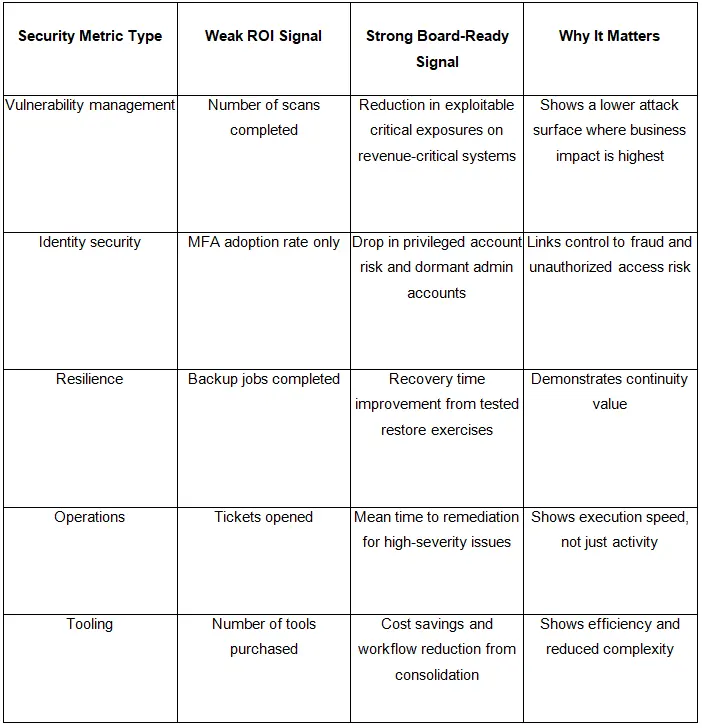
A board-ready presentation rests on a small set of highly relevant metrics. Track the reduction in critical exposures older than 30 days, the drop in internet-exposed assets lacking assigned owners, and the mean time to remediate high-risk findings. Other strong indicators include the reduction in dormant privileged accounts, estimated financial exposure before and after key remediation work, and the percentage of crown-jewel systems with fully tested recovery plans.
On the flip side, drop the weak activity metrics: total alerts processed, routine scans completed, tickets created, or the number of security tools deployed. These fail to prove business value because they measure effort rather than outcome. Executives care about the impact of the work, not the volume of alerts.
Security teams are often overwhelmed by the very environments they're trying to protect. Right now, 58% of organizations use more than 25 security tools, and nearly half of CISOs say cloud complexity and tool sprawl are hindering their programs. That sprawl generates duplicate spend, constant context switching, and analyst fatigue.
Proving value gets harder still when only 45% of organizations can consolidate asset and exposure data into a single view. Without a unified baseline of assets and risks, demonstrating measurable exposure reduction is nearly impossible.
Before requesting new staff, you can defend your existing budget by quantifying the savings from tool consolidation. Strong cases spell out the exact number of licenses retired, overlapping controls eliminated, and analyst hours recovered by removing workflow handoffs. Vendor priorities are already moving in that direction; the market is steadily shifting toward unified, autonomous operational platforms to streamline workflows. Consolidating tools lowers integration burdens while clearly communicating operational efficiency to the CFO.
Done right, automation strips away the repetitive tasks that grind down team morale. Some organizations that invested heavily in AI and automation saved roughly $1.9 million per breach and reduced response cycles by 80 days. That directional evidence doesn't mean all AI instantly creates value, though. Recent analysis indicates that trust in AI requires controlled rollout, validation, and feedback.
Automation only pays off when teams dictate the rollout, validate the output, and ensure it removes work rather than adding an extra review burden for human analysts. The decision burden is a real roadblock, with alert volume and missing context acting as major contributors to SOC overload.
Constrained teams should point automation at the places where progress usually stalls: ownership assignment, remediation orchestration, access review follow-up, and evidence gathering for board reporting. The governance mandate is growing fast, too. Today, only 8% of tech leaders say their internal AI governance is strong, while 95% lack complete visibility into what is running in production. Automating recurring hygiene work helps teams keep up with those expanding mandates without new hires.
For many CISOs, the bigger obstacle isn't identifying risk. It's turning fragmented findings into accountable action across identity, cloud, SaaS, and data systems. That's where teams look for ways to operationalize your security program without adding more coordinators, analysts, or point tools.
Surf AI is one example of this shift. The company describes its product as an agentic operations platform that connects scattered context across systems, supports ownership and execution, and uses specialized AI agents to help teams close exposures end-to-end while keeping humans in control. For leaders under pressure to show measurable progress, an execution layer like this is increasingly relevant to proving the value of the security organization.
The executive conversation is moving from purely defensive metrics toward broader organizational stability. The CIO agenda is increasingly about resilience, security, and AI-driven operations. CEOs expect CISOs to translate technical wins into business benefits: avoided downtime, reduced fraud, faster recovery, and minimized operational disruption. Security is no longer just about stopping bad actors. It's about keeping the business running under adverse conditions.
You don't need to justify every dollar with impossible precision, but you do need a repeatable chain from investment to exposure reduction to business resilience. The strongest ROI story isn't "we bought more security." It's "we reduced material risk, improved execution, and protected operations without expanding headcount." Map controls to business risk, measure exposure accurately, consolidate sprawling tools, and apply automation strategically, and you can confidently show the financial and operational value security brings to the enterprise.




















 consultants ltd.jpg)


Comments