
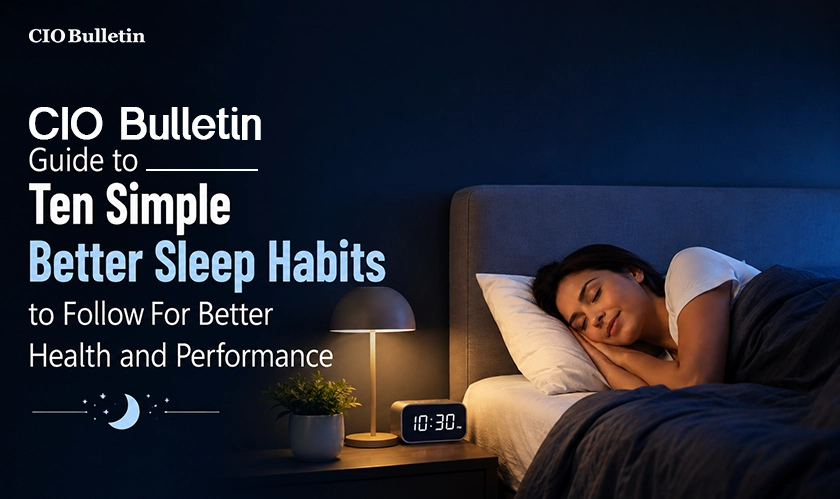
Home Other Blogs CIO Bulletin Guide to Ten Simp...
CIO Bulletin,
04 August, 2026
Author:
Sambhrant Das
Many individuals struggle to achieve their daily sleep goals. However, getting up energized should be regarded as a right rather than a luxury in light of the fast-moving life filled with notifications and appointments. Therefore, it is very important to take responsibility for developing better sleep habits, as it is a first step towards wellness. Often, just having a good sleeping routine can greatly improve one’s quality of life. Those who want to perform at their best during the day have to properly rest at night.
A common misconception among people is that preparing to sleep starts only from the time one’s head hits the pillow. In reality, the cumulative result of choices made right from the minute one wakes up is what determines quality rest. One’s circadian rhythm regulates the periods of being active and sleeping. If the daily schedule is chaotic, then it will lead to the biological clock going out of sync with the environment, which will lead to sleep problems and tiredness every morning. The body can be helped to naturally ease into deep, restorative recovery every single night through a structured framework of better sleep habits.
Overhauling one's entire lifestyle is not necessarily required for building a healthier nightly routine. Feel healthier and perform better with the help of ten easy tips from CIO Bulletin.
Keeping a steady routine is necessary when it comes to sleeping. Usually, it is recommended to wake up and fall asleep around the same time every day of the week, which helps in building a good lifestyle.
In terms of early exposure to sunlight, it is significantly important for one’s health. Getting daylight during the day helps, because it can lower melatonin release, allowing one to remain more alert during the day.
Having stimulating drinks, like coffee, energy drinks, and caffeinated tea, is not advisable after noon. The reason is that caffeine basically blocks the adenosine receptors in the brain for about six to eight hours.
Your bedroom should be kept cool, dark, and quiet so people actually get good sleep. In general, thermostat settings somewhere around 60°F to 70°F (15°C to 19°C) are often used for better sleep.
Try to stop using tablets, smartphones, and TVs at least one hour before sleep. This helps prevent the effects of device blue light; it blocks melatonin production, and it also nudges your brain to stay awake.
Doing moderate aerobic activity, or any other physical movement each day, can make it easier to fall asleep, and it can help support deeper sleep for longer. Still, heavy workouts right before bed are best avoided.
Finish dinner at least two to three hours before going to bed. Late-night consumption of heavy foods can provoke heartburn, trigger metabolic disorders, and obstruct the process of total body relaxation.
By engaging in the activities just mentioned, people inform the nervous system that they have successfully finished their working day.
People should not perform working tasks or eat or watch television in bed.
Spend about five to ten minutes doing breathing exercises, or even writing things down before you sleep. It can help you clear the noise in your head and the thoughts that keep you awake.
Why should busy modern workers adopt these daily routines? The fact is that modern life is full of great challenges for the human brain, which should be restored through good sleep at night.
First, executive functioning suffers as a result of lack of sleep. Sleep deprivation results in such common side effects as increased reaction time, difficulties in making decisions made, and decreased capacity to think creatively. It goes without saying that when making decisions, it is of utmost importance to be able to think clearly; thus, good sleep is essential.
Second, sleep is a key to keeping fit. The body can make hormones, improve immunity, decrease the risk of heart disease, and control levels of cortisol only while somebody sleeps deeply. Chronic stress has some negative consequences only in the case of lack of sleep.
Finally, performing sustainably for a period of time requires one to establish these daily practices as non-negotiable. An unhealthy cycle of exhaustion results from using temporary Band-Aid solutions such as caffeine-type artificial stimulants to push through fatigue. Only real physical recovery through better sleep solutions offers natural, steady vitality that lasts all day long.
As has been reported in the latest study by CIO Bulletin, effective leaders are the ones applying healthy habits. As a result, they perform well in life and work. Those individuals who keep their jobs and personal life in order can stay healthy mentally and fulfill their duties as effective leaders.
When rest isn’t your priority, every day starts feeling like a battle. Exhaustion can mess with cognition, your mood, productivity, and that drive to reach life or work goals. Choosing short-term strategies over health on a regular basis makes one feel exhausted.
Nevertheless, an amazing opportunity is available for people who learn to manage their lives. All one has to do is change some negative patterns into simple practices that may bring about positive changes in his/her health, sleep quality, performance, and overall energy and vigor. Prioritizing better sleep habits gives one the ability to greet each day with his/her head clear, with renewed strength, and with a good supply of energy.
According to CIO Bulletin, using this opportunity is very important for leaders who wish to succeed in their careers.
If you want to experience better sleep at night, try these steps right away:
Check Your Bedroom: It is a good idea to get rid of all the work-related stuff from the bedroom and use night clocks that are not bright.
Set up a “Digital Curfew”: set your plan so your waking time is at least an hour before bed, and during that window you stop using gadgets and just ease into relaxing.
Track Your Progress: make a sleep diary, write down how many hours you slept, your mood, and how you felt when you woke up.
Improve Sleep Quality: use comfortable pillows, blackout curtains, and sound machines if you need them, so the sleep environment feels easier on you.
Be Consistent: stick with your sleeping pattern for at least two weeks so your body can adjust.
Everything you need to know about this news
During holidays, trying to “catch up” on sleep can throw off your body clock, which is sometimes called social jet lag. Sunday night sleep becomes harder, and one feels exhausted on Monday morning.
The best two habits you should adopt are getting used to getting up at the same time daily and avoiding blue light from devices at least.
Catching up on sleep during holidays can hinder one’s body clock, which is termed "social jet lag," leading to difficulties in sleeping on Sunday night and feeling tired on Monday morning.
To fall asleep, it’s important to be in a comfortable temperature; that really matters.
If you’re still wide awake after that, get out of bed and do something calming, like reading, until you feel sleepy again.





















 consultants ltd.jpg)


Comments