
Home Technology Cyber security Why Rotating Proxies Are No Lo...
CIO Bulletin
,
17 June, 2026
Author:
Guest
Web scraping has changed, and drastically so. While just a couple of years back, using IP rotation to circumvent geographical barriers and API restrictions would be regarded as best practices, today, they just scratch the surface.
Websites have grown smarter. Anti-bot systems now analyze browser fingerprints, session behaviour, request cadence, and even mouse movement patterns. Teams relying on basic rotating proxies are finding themselves blocked within minutes — not because their IPs got flagged, but because everything around the IP looked wrong.
This shift has pushed professionals toward infrastructure that goes deeper. Not just IPs that rotate, but proxy ecosystems designed with real-world usage patterns in mind.
Most teams don't diagnose the problem correctly. They assume more IPs equals better results. But the real culprits are usually the following:
IPs that come from known data centre ranges, instantly identifiable by any modern bot-detection layer
No session persistence — connections that drop and restart look robotic, not human
Identical request headers across thousands of calls — a dead giveaway for automated traffic
Geo-targeting that's too broad—city-level accuracy often matters more than country-level for localised data
Zero traffic diversity—if all requests follow the same pattern, entropy is missing
The interesting part? Many teams don't realise their success rate has quietly dropped. They see data — just not accurate data. Blocked requests often return misleading results rather than outright errors.
Residential proxies route traffic through real consumer devices. Mobile proxies go further — they use IPs assigned by mobile carriers, which are among the least flagged sources on the internet. Combine those with ethical sourcing and low sharing ratios, and the difference in performance becomes measurable almost immediately.
This is where infrastructure providers like the Evomi platform have carved out a distinct position. Rather than dumping millions of IPs into a pool with no quality controls, the focus has shifted toward network health — how clean IPs are, how recently they've been used, and how naturally traffic flows through them.
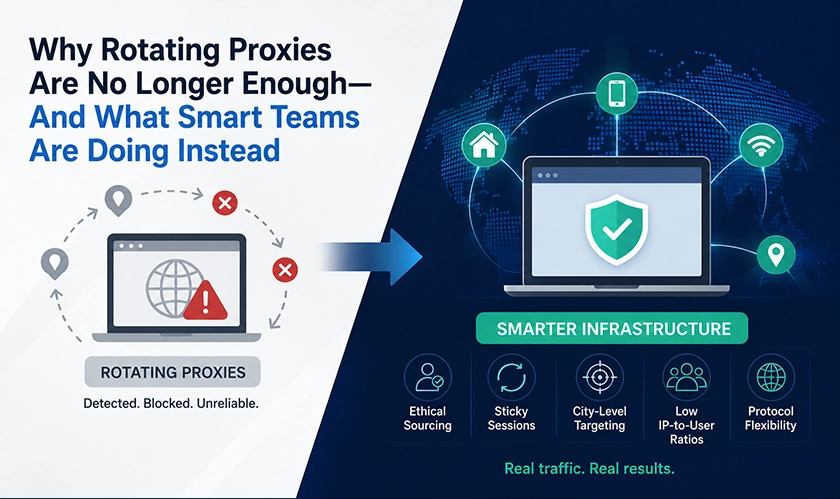
Ethical sourcing — Users opt into sharing bandwidth. This isn't just a compliance checkbox; ethically sourced pools have better reputation scores across detection systems
Sticky sessions — The ability to maintain the same IP across a multi-step workflow (login → navigate → extract) is fundamental for tasks that mimic real user journeys
City-level geo-targeting — Checking localised pricing, regional content, or location-specific search results requires pinpoint accuracy
Low IP-to-user ratios — Overcrowded proxy pools burn through IPs fast. Smaller, better-managed pools outperform massive ones with low maintenance standards
Protocol flexibility — HTTP, HTTPS, and SOCKS5 support across the same infrastructure saves significant integration time
Scale used to be the selling point. Now it's quality-per-request. A network with 10 million questionable IPs underperforms one with 2 million well-maintained ones in almost every real-world test.
Teams carrying out extensive data collection, such as price monitoring, SERP tracking, market research, and advertising verification, are now conducting audits of their proxy infrastructure as they would any other critical component. KPIs include uptime, success rate, latency, and ban rate, and all of this is done systematically and not just casually.
One instance where this sort of thinking is manifested is in the Evomi platform, which utilizes infrastructure from Switzerland and transparent pricing without sacrificing quality.
The bar for proxy infrastructure is higher than it's ever been. Websites will keep evolving their defences. That means the teams winning at web data collection aren't just buying more IPs—they're investing in infrastructure that's been built to behave as the real web does.
Rotating proxies aren't dead. But they're a component now, not a strategy.
The question worth asking isn't "How many IPs can we get?"—it's "How well does our traffic actually blend in?"

















































 consultants ltd.jpg)


