
Home Industry Digital marketing Common Pitfalls to Avoid When ...
CIO Bulletin
,
20 May, 2026
Author:
Guest
Acquiring a domain name is typically a simple process: select a name, complete the payment, and you are finished. However, many individuals encounter significant pitfalls during this process. Common issues include trademark infringements, suboptimal name selections, and lapses in privacy considerations. Such oversights can lead to prolonged complications and financial repercussions.
Here's what to avoid.
Most domain mistakes follow predictable patterns. Understanding these helps you avoid them. Each carries consequences from inconvenience to total loss.
When selecting a domain name, clarity is crucial to avoid customer confusion. It is advisable to steer clear of names that closely resemble well-known brands. For instance, using "AmazonBooks" could lead to complications given the existence of Amazon. Similarly, a name like "FaceSpace" could evoke associations with Facebook, which may result in legal challenges.
Customers often make assumptions based on name similarities, which can imply a connection or endorsement that does not exist. Established brands are vigilant in protecting their trademarks and may view similar names as potential infringement or dilution of their brand identity. To ensure your chosen name does not evoke confusion, conduct a simple test. Present your domain name to individuals unfamiliar with your brand. If they associate it with another existing brand, this indicates potential confusion. Recognizing and addressing these issues early can help you avoid significant legal and financial repercussions down the line.
If you’re buying a previously owned domain, you must check its history. Verify the previous buyer's use of the domain. It is critical to ensure that the domain does not carry spammy or black hat marketing practices. Such research will ensure that you do not have to rectify problems the previous owner caused.
Bad history hurts SEO. Email deliverability suffers. Search engines penalize spam histories. Tainted domains undermine efforts from day one.
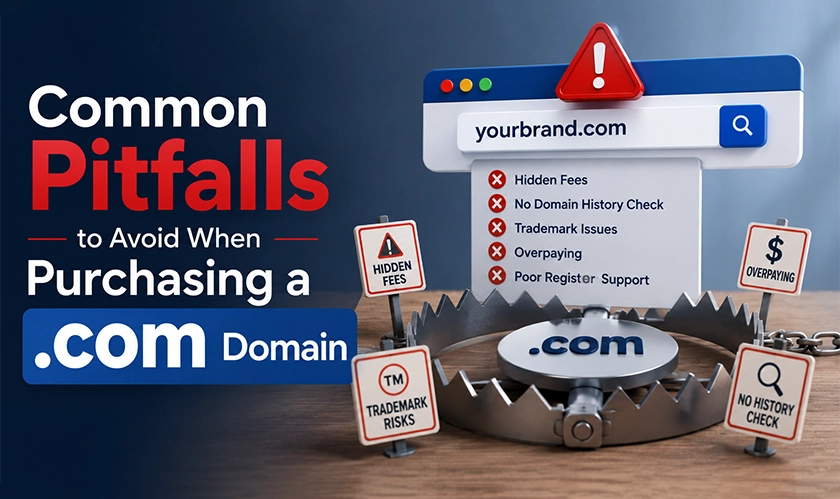
The selection of a registrar holds significant importance. Unreliable registrars pose significant challenges, such as concealed charges, insufficient security measures, or unsatisfactory support. Conduct thorough research on registrars prior to making a purchase. Review the evaluations, support, and reliability.
Compare features carefully. Pricing transparency matters. When you're evaluating where to purchase .com domain names for your business, prioritize registrars with clear renewal pricing and strong security features like two-factor authentication and domain locks. Check whether privacy protection is included or costs extra. Established registrars typically offer better reliability than unknown budget providers.
This is the most significant mistake. People register domains without checking trademarks. If a domain name seems available, they buy it, and then legal problems start.
Although trademark law protects brand names, federal registration isn't required. There are common law trademarks that exist through use. A company using a name commercially owns rights. This ownership persists even in the absence of registration.
Search USPTO databases before buying. Alternatively, you can check WIPO for international marks. Look for exact matches, similar spellings, and related industries. If there is a trademarked name in your industry, avoid it completely. Ignoring trademarks leads to UDRP complaints, and you lose the domain.
Short domains work better. People remember them. Typing errors decrease. Verbal communication improves.
Long domains create problems, as people may forget them or misspell them. For example, a domain name like "GetYourBestOnlineMarketingToolsHere.com" isn't memorable. It's a nightmare. Moreover, hyphens and numbers carry complexity. Was it "2" or "two"? If people guess wrong, traffic splits.
Keep it simple. Eight characters or fewer is ideal. Ten maximum. No hyphens. You should avoid using numbers unless they represent your brand. Simplicity wins.
Secure the .com domain as your primary choice. It is essential to also consider acquiring the .net and .org extensions, along with relevant country code domains where your business operates.
Be aware that competitors may register similar domain names, and typosquatters may take advantage of variations. To safeguard your brand, it is important to maintain control over these variations.
Assess the financial implications. Defensive registrations typically range from fifty to one hundred dollars annually, which is a modest investment compared to the potential costs associated with brand confusion or lost traffic.
There is no doubt that excellent domain names disappear quickly, but panicking can lead to mistakes. Don’t rush decisions, and take adequate time to research.
Take time with important domains. Sleep on it. Check trademarks thoroughly. Test pronunciation and get feedback from friends and family.
Urgency tactics exist everywhere. "Only one left!" is one of the most common sales tactics. Most domains aren't unique, and similar alternatives exist. Don't let pressure override judgment.
Registration agreements constitute legally binding contracts that delineate rights, obligations, and procedures for dispute resolution.
Despite their importance, they often go unread. It is imperative that all parties familiarize themselves with these documents. Fine print may conceal auto-renewal clauses, and transfer restrictions can impose limitations. The terms governing disputes are critical.
Attention to key sections is essential. Renewal terms can avert unexpected charges, while transfer policies influence operational flexibility. Investing ten minutes to review these agreements can prevent future complications.
Domain purchasing mistakes are common but avoidable. Research trademarks, check history, and keep names simple. For further protection, use privacy protection.
Take time with decisions, read agreements, and set renewal systems. Avoid impulse purchases and follow these practices to prevent problems. Your domain represents your brand, so protect it from the start.




















































 consultants ltd.jpg)


