
Home Industry Healthcare US Food and Drug Administratio...
Healthcare
CIO Bulletin,
18 May, 2026
Author:
Sambhrant Das
Introducing a Novel Aldosterone Synthase Inhibitor Class to Safely Manage Resistant and Uncontrolled Hypertension Alongside Conventional Therapies
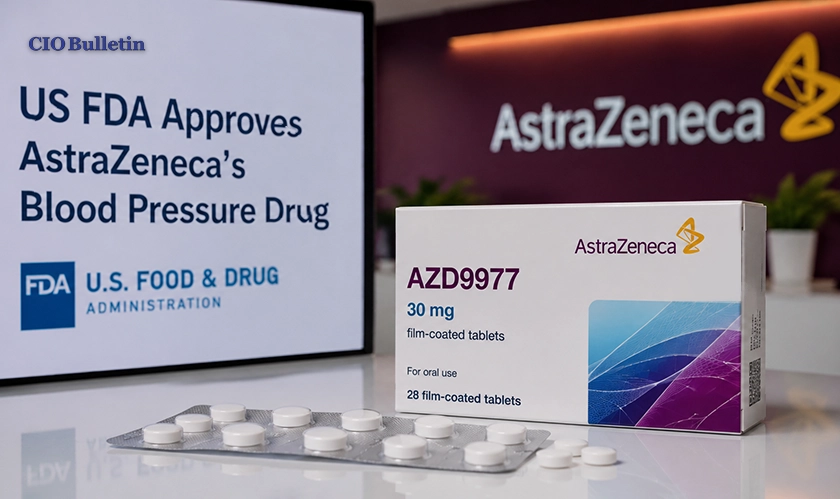
On May 18, Anglo-Swedish drug maker AstraZeneca announced that the US had granted approval to its hypertension pill baxdrostat. With this, millions of patients coping with uncontrolled high blood pressure despite existing medicines will now have access to AstraZeneca’s blood pressure drug as an alternate treatment option. The US approval allows the drug, marketed as Baxfendy, to be used in combination with other antihypertensive medicines. The drug maker expects more than $5 billion in peak annual sales to be generated by Baxfendy. The drug functions by lowering blood pressure and inhibiting the production of aldosterone, a hormone capable of raising blood pressure and increasing the risk of heart and kidney problems.
Importantly, this approach differs from older blood pressure treatments such as diuretics and ACE inhibitors, which are limited in their efficacy in terms of leaving hormonal drivers unaddressed. Healthcare practitioners are also studying Baxfendy as a potential treatment for chronic kidney disease and heart failure. This approval also ensures that AstraZeneca takes the lead over US biotech Mineralys Therapeutics, which is developing a rival drug named lorundrostat. The US is yet to approve Mineralys’ drug, with the review expected to be completed in December, followed by a regulatory decision soon after.
Furthermore, the significance of AstraZeneca’s new drug can be understood when the global rates of hypertension are considered. The World Health Organization (WHO) estimates that around 1.4 billion people worldwide are affected by hypertension, which is also a major cause of premature death. According to the US Government’s data, high blood pressure is experienced by nearly half of the country’s adult population, or about 120 million people.
Moreover, data from a late-stage study where the drug significantly reduced blood pressure in patients whose hypertension was uncontrolled or resistant despite existing medicines guided the FDA’s decision on granting approval and clearing the path for Baxfendy’s use in the country. In the trial, patients experienced a reduction in systolic blood pressure by 9.8 millimeters of mercury (mmHg) from the baseline 12 weeks after adjusting for placebo upon adding a 2 mg dose of Baxfendy to standard treatment.
Significantly, the pressure exerted on the arteries by the heart’s pumping action was lowered by 8.7mmHg at the 1 mg dose. CIO Bulletin views this development as a positive step by the US authorities to give a new lease of life to the millions of patients suffering from hypertension, offering hope of a possible recovery to those affected when all other options were exhausted.






















 consultants ltd.jpg)


