
Home Industry Environmental sustainability Can New Environmental Performa...
CIO Bulletin
,
16 July, 2026
Author:
Sambhrant Das
Global green scorecard reveals critical net zero targets remain out of reach for most nations despite massive technology upgrades
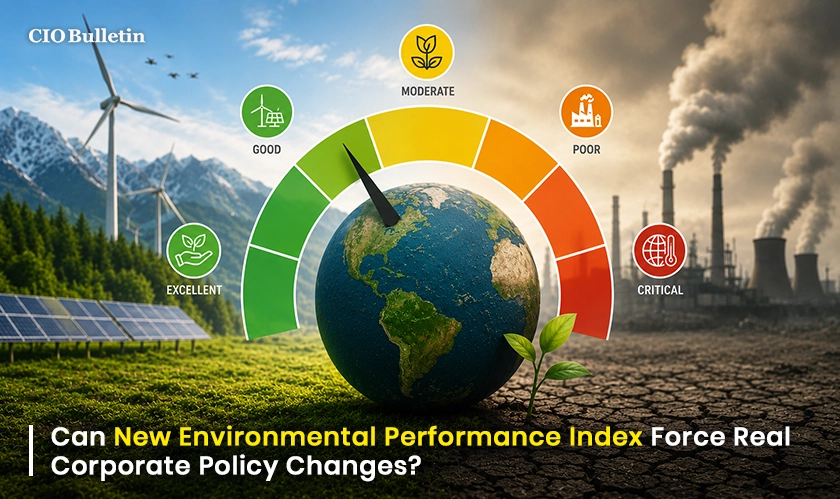
Evaluating national progress toward mid-century planetary health targets requires deeply integrated, transparent tracking mechanisms. Formulated as a crucial bi-annual scorecard by researchers from Yale and Columbia University, the newly unveiled environmental performance index shows a bleak, harsh view of where global sustainability efforts really stand. Even though local eco-friendly strategies often sound reassuring in public remarks, the actual numbers hint that momentum across key raw conservation sectors has slowed to a crawl worldwide.
European territories still outperform the rest of the world, holding all but one of the top twenty positions in the global hierarchy. That strong baseline points to fast regional pivots away from heavy fossil fuel dependency”:
Estonia took the absolute first rank due to huge reductions in electricity generation emissions.
The United States ranked 27th, primarily because of weak biodiversity protections.
Trying to measure subtle ecological changes at an international scale has historically been a very fragmented administrative puzzle.
"If countries aim to maintain a trajectory toward net-zero emissions by 2050, they will need to continually achieve large emissions reductions," - Zach Wendling, lead author.
To build a completely objective perspective, more than half of the index's indicators now directly utilize advanced satellite monitoring tools and artificial intelligence modules to analyze fragile ecosystems.
At the opposite end of the international evaluation spectrum, heavy industrialization projects without adequate regulatory guardrails severely compromise basic human public health. Nations like India and Laos face steep environmental deficits stemming from an uninterrupted reliance on coal-fired power infrastructure and limited species protection frameworks. The index effectively demonstrates that simple financial wealth alone does not guarantee continuous regulatory success without targeted eco-policies.
Transitioning toward verified corporate sustainability requires absolute transparency across supply chains rather than relying on unvetted marketing copy. As international bodies integrate hyper-precise satellite data sets into their strategic roadmaps, masking operational climate damage becomes increasingly impossible. CIO Bulletin sees this development as a needed diagnostic shift and a sharp reminder that globally operating commercial organizations must adopt carefully measured, evidence-led frameworks if they want to move toward real net-zero operational baselines.
Everything you need to know about this news
That biennial report is co-produced by specialists from the Yale Center for Environmental Law & Policy and also the Columbia Climate School.
Estonia earned the top spot overall, driven by big cuts in power-sector greenhouse gas emissions and a swift expansion of renewables.
The United States sits at 27th overall. Its domestic environmental health parameters are strong, but climate mitigation and biodiversity fall short.
Over half of the indicators now integrate artificial intelligence and satellite analysis to track challenging metrics like global grassland degradation.
The results imply that only a small set of countries are genuinely in step with net-zero emissions, while agricultural sustainability remains one of the stubborn weak points.



















































 consultants ltd.jpg)


Comments