
Home Industry Law ethics and legal services Understanding Theft and Other ...
CIO Bulletin,
22 July, 2026
Author:
Guest
White-collar crimes, along with theft, can attract stiff criminal punishment and heavy losses of money. These offenses can also bring about the destruction of one’s career.
Federal white-collar crime cases brought to court for prosecution have been decreasing steadily over the years. It was documented that there were 10,269 cases in FY1994 to only 4,332 cases in FY2024. Estimates suggest that these figures will reach about 3,862 cases in FY2025, as per TRAC data. Meanwhile, there has been a significant increase in fraudulent claims for government benefits, with the number of such cases capped at 965 in FY2025, up 182% from the previous years up to FY2021, according to the U.S. Sentencing Commission.
Cases of online scams more often than not entail breaches of personal data and identity theft, subjecting victims to financial abuse and targeting their personal information for illegal financial activities, among others.
A variety of offenses fall under the umbrella of 'theft.' According to an Edwardsville theft lawyer, theft potentially includes actions where the property of an individual, entity or even a company is acquired in a way not approved and/or not with legal reasons. Stealing in the retail environment is the most common theft activity in general, but there exist a number of other theft-related crimes an individual can be charged with, such as robbery, burglary, embezzlement, fraud, forgery, or identity theft.
The typical nature of these offenses involves seeking financial gains and engaging in deceptive actions rather than violence. Committing this crime exposes one to receiving a criminal record and may destroy one’s professional work and their personal representation.
The first step in defending a white-collar crime case is to have knowledge of the definitions and requirements of such cases under federal and state laws. Let’s discuss how these crimes operate and their impact on unfortunate victims.
Every year, companies lose roughly around 5% of their revenue to fraud. According to the Association of Certified Fraud Examiners (ACFE), the cost of fraudulent activities is estimated to be around USD 5 trillion by 2024.
Even with similar financial implications, there are comparatively fewer white-collar crime prosecutions when compared to common street crime prosecutions.
Approximately 25% of people charged with white-collar crime in the Fraud Section of the DOJ in 2023 were corporate executives, lawyers, and other professionals.
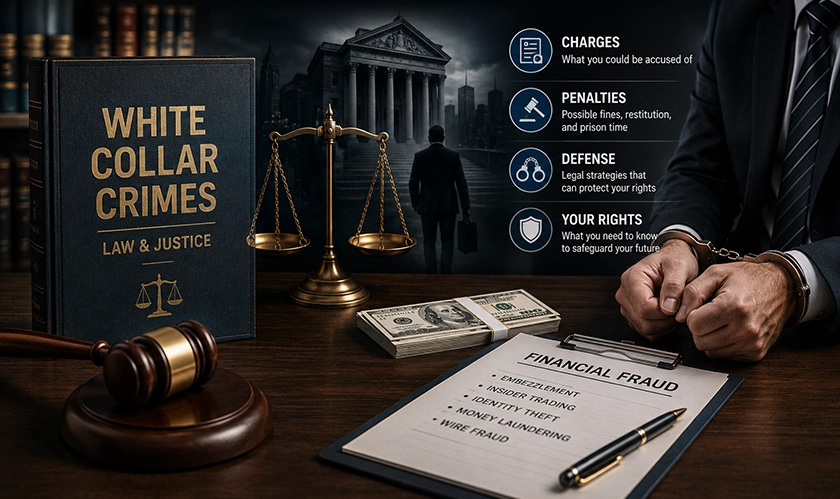
There are various types of white-collar crimes. Offenses such as fraud, embezzlement, money laundering, insider dealing, corruption, identity theft, fiscal fraud, wireless deception, postal fraud, securities scams, and health care fraud are some of the examples of these kinds of crimes.
These crimes can be prosecuted under state law or US federal law, depending on their type and value.
The most common white collar crimes that occur in America include wire fraud and mail fraud. To prove that one committed a wire fraud crime, the following must be proven: the existence of a scheme to defraud, material misrepresentations, and the use of wire communication to proceed with the fraudulent scheme. One can spend up to 20 years in federal prison for these crimes.
Embezzlement involves a person who has been authorized by law to take care of someone else’s or an organization’s funds or other property. This person then steals from the other party or the organization. It is different from theft in the sense that the perpetrator is in lawful possession of the assets.
The term "insider trading" refers to the exchange of securities, such as stocks, options, or bonds, by individuals operating inside a company. These individuals are usually employees who may have direct access to the company’s private information. This access can have various impacts on their decisions. These people owe a duty to the corporation not to use that information for their personal benefit. Penalties range from twenty years of incarceration all the way up to a $5 million fine for individual breaches and $25 million for companies.
The provisions of 18 U.S.C., specifically the 1956 and 1957 sections, address violations of money laundering rules. Section 1956 addresses laundering related to financial or other resources obtained from certain illicit activities. The potential penalty for this crime is 20-year imprisonment.
In compliance with Section 1957, no party shall engage in financial transactions exceeding ten thousand dollars ($10,000) when the funds in the transaction originated from certain illicit activities. The culpability for such an act is punishable by a maximum of ten years of incarceration.
White-collar crime cases can either be prosecuted at the state level or the federal level. A federal prosecution usually has stiffer consequences, especially if there is an actual financial loss involved.
The typical statute of limitations for most federal fraud crimes is five years. Depending on the specific provision, there may be a period of up to six years for securities fraud and tax fraud, and even ten years for financial institution fraud.
One of the major considerations for the imposition of federal sentences is the actual financial loss sustained.
Being declared guilty of white-collar criminal activity such as embezzlement incurs collateral consequences. Even just being awarded probation can lead to other long-term consequences.
Fraud, illicit behavior, and similar practices are among the crimes that could result in the revocation of professional licenses. The loss of a license is particularly important for those working in a profession such as those done by lawyers, accountants, doctors and so forth.
Any felony conviction in many states is enough to get professional licenses revoked, and the financial impact is usually more costly to individuals than the sentence itself.
Federal debarment from participating in any type of government contracts is automatic for some crimes and discretionary for others. Receiving such a penalty can heavily impact businesses that rely on such contracts.
Civil forfeiture and restitution as part of the conviction can continue even after imprisonment. ERISA and other federal laws prohibit individuals convicted of felonies from holding certain positions in financial services and benefit plan administration.
White-collar cases involve complex financial evidence, high-stakes allegations, and lasting consequences beyond sentencing. One would need to have a carefully planned defense strategy if they want to avoid these harsh effects.
Given the broad nature of the offenses under wire and mail fraud statutes, virtually every financial transaction involving fraudulence becomes a federal offense.
The issues of intent, loss calculation, the extent of the alleged scheme, and whether the charge matches the crime must be addressed during the investigation stage of the case, before the prosecution becomes firm and any deal is made.




















 consultants ltd.jpg)


Comments