
Home Industry Lifestyle and fashion Buying Flowers Online: How to ...
CIO Bulletin
,
29 September, 2026
Author:
Guest
Last Valentine's Day, my neighbor paid $89 for a dozen roses that showed up brown at the edges by Tuesday. She'd ordered on a Tuesday night, picked the first listing that promised "same day," and never checked what the arrangement actually contained. That's the whole problem in one story.
Here's the good news: freshness isn't luck. It's a set of signals you can read before you click buy, and once you know them, you'll stop guessing. Below, I'll walk through what separates a bouquet that opens over a week from one that collapses in 48 hours, how to judge a seller, and the small habits I use every time I order. Even if you have never ordered flowers online before, these checks will help you shop with more confidence and far fewer surprises.
Freshness isn't one thing. It's a countdown that starts the moment a stem leaves the ground and ticks faster with heat, time, and rough handling. A rose cut Monday and shipped cool can still beat a rose cut Saturday and left in a warm van.
So when a seller claims "farm fresh," you should be asking when it was cut, how it traveled, and how long it sat before a courier touched it. Most buyers never ask. That's why so many arrangements disappoint.
According to baseline data from the U.S. Department of Agriculture, cut flowers and ornamental plants are a massive, heavily regulated category of agricultural commerce, and that scale is exactly why cold chain discipline matters so much. A single gap in temperature control can shave days off what lands on your doorstep.
Use these as a quick scan. You don't need all six, but a listing that hits four or more is usually worth your money. This is my own checklist, built from too many disappointing deliveries.
Firm, upright stems. A limp stem means the flower has already spent its water reserves. Snap test: a fresh stem bends, it doesn't fold.
Tight but not hard buds. For roses and lilies, buds should be closed but showing color. Fully open on arrival means the clock already ran.
Clean cut ends. A seller who re-cuts stems before packing is telling you they care. Brown, mushy ends are a red flag.
Green, not yellowing, leaves. Leaves fade before petals do. If the foliage is dull, the bouquet is older than advertised.
No visible water damage. Squishy patches on petals usually mean condensation sat too long in transit.
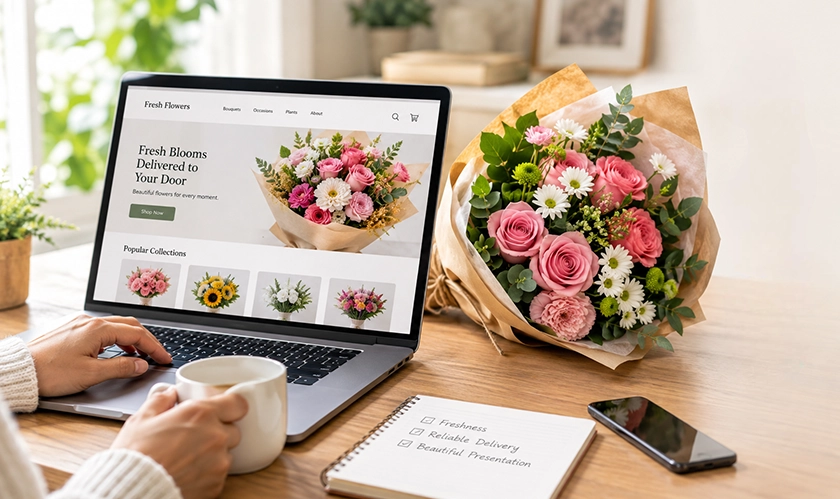
Realistic product photos. If every photo is a studio shot with zero variation, you're looking at stock imagery, not what ships.
That last point matters more than people think. I'd rather buy from a seller who posts slightly imperfect, honest photos than one with flawless marketing shots, because the former has nothing to hide.
A good bouquet from a bad seller is a coin flip. A good bouquet from a well-run operation is repeatable. So judge the operation first.
Look for clear delivery windows, not vague promises. Look for a stated cold-chain or handling process. Look for return or replacement policy language written in plain sentences rather than buried caveats. And read the two-star reviews, not the five-star ones. Complaints tell you what actually goes wrong: crushed boxes, late arrivals, wilted substitutions.
I once ordered tulips in early April from a shop with rave reviews. They arrived fine. I ordered again in July and got the same arrangement, half-dead. Same seller, same listing, different season. Tulips in July are a stretch no matter who ships them, so the failure wasn't the seller's fault. My timing was wrong.
That's a lesson you can use today: buy in season, and you're fighting physics a lot less.
The flower trade runs on perishable goods, and regulators treat it that way. The Food and Drug Administration oversees the safety of products moving through U.S. commerce, and while cut flowers aren't food, the same cold-chain and handling standards that protect perishables apply to how seriously a vendor should treat transit conditions.
These are the habits I'd keep if someone stripped away everything else.
Order early in the week. Monday and Tuesday deliveries skip the weekend shipping crunch.
Pick in-season varieties. Peonies in May, dahlias in late summer, tulips in spring. Out of season means greenhouse or import, and both cost freshness.
Choose a delivery window you can watch. Someone should be home, or the box should sit somewhere shaded. A porch in direct sun is a slow cooker.
Trim and hydrate immediately. Cut an inch off each stem at an angle, strip leaves below the waterline, and use the packet that comes with the box.
Skip upsells you don't need. A better vase won't save a tired bouquet. Spend that money on a better flower.
If you'd rather let someone else handle the selection logistics, many shoppers now default to buying flowers online from sellers with established cold-chain networks. That's a reasonable shortcut, as long as you still apply the same freshness checks above.
And here's a small piece of context that reframes the price: the florist industry employs a large, specialized workforce, and skilled arrangement and handling labor is a real cost baked into what you pay. The Bureau of Labor Statistics tracks florists as part of the broader retail and craft trade, which is why hand-arranged bouquets always cost more than a shrink-wrapped bundle.
Most ruined bouquets I've seen died from buyer decisions, not bad flowers. Ordering the day before a holiday is the classic one. Vendors get slammed, cold storage fills up, and your arrangement sits in a queue longer than it should.
Ignoring the delivery window is another. A box left on a hot doorstep for six hours is a different product than the one that was packed.
And choosing by photo alone, without checking what's actually in season or how the seller handles replacements, is how you end up paying premium prices for a generic mix.
Next time you order, before you check out, ask yourself one question: does this seller show me how they keep things cold and moving? If the answer is yes, you're probably in good hands. If it's a shrug, trust the shrug.
Everything you need to know about this news
You can't fully, but you can stack the odds. Read the listing for cut-and-ship timing, check reviews for freshness complaints, and favor sellers who show real, unedited photos. Tight buds and green leaves in the images are good signs.
Sometimes. Higher prices usually buy hand arrangement, better stem selection, and faster shipping. If the seller delivers all three, yes. If they're just charging for a fancier box, no.
Early in the week, ideally by Tuesday or Wednesday. That gives the shipment a full working week to travel and avoids the holiday and weekend bottleneck.




















































 consultants ltd.jpg)


Comments