
Home Industry Luxury travel and tourism Is a Regional Hegemony Shift O...
CIO Bulletin
,
01 July, 2026
Author:
Sambhrant Das
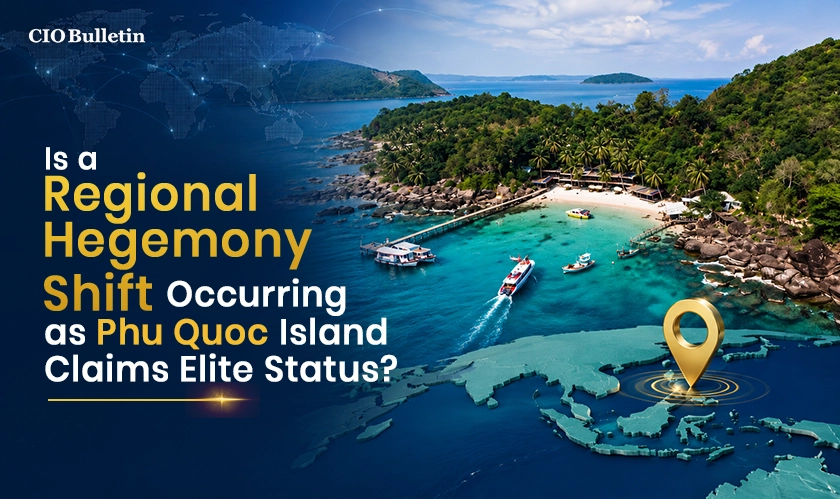
Vietnam's premier tropical jewel achieves an unprecedented milestone in luxury travel as global hospitality authorities officially crown the rapidly growing paradise as the second-best island destination in the entire Asia-Pacific region.
The geopolitical and business reshuffling of tropical holiday zones entails re‑tuning global vacation patterns in dramatic fashion. Amid this wider, ongoing systemic shift, the 2026 Travel + Leisure Luxury Awards formally named Phu Quoc Island as the second-best maritime getaway destination across the whole Asia-Pacific region. This authoritative determination positions the Vietnamese regional asset directly behind Thailand’s Koh Samui while decisively outperforming legacy resort giants. The municipal administration’s long-term infrastructure strategy has successfully transformed the geographic zone from an isolated tropical enclave into an elite sanctuary for high-net-worth international travelers.
Maintaining an upward trajectory in highly competitive leisure markets demands a sophisticated combination of physical infrastructure and streamlined entry protocols. Analysts attribute this recent surge in continental prominence to several distinct logistical and operational breakthroughs implemented across the destination:
A highly progressive 30-day structural visa exemption scheme applicable to all incoming international passports.
The strategic deployment of specialized regional carriers like Sun PhuQuoc Airways to establish seamless global transit corridors.
Comprehensive municipal investments targeting large-scale architectural projects designed specifically for the upcoming APEC 2027 summit.
Modern hospitality ecosystems must provide immersive experiential entertainment alongside traditional beach resort amenities to maximize visitor retention. The island has aggressively built an expansive network of attractions, including the world’s longest three-cable overwater transit system and spectacular nightly multimedia performances.
"The internal storm does not stop when the rain does," noted a prominent regional travel editor reflecting on the island’s quick post-pandemic transformation into an architectural powerhouse. This conscious pivot toward experiential luxury has significantly prolonged individual visitor stays and heightened average localized commercial expenditure.
The macroeconomic impact of this reputational surge is altering traditional hospitality funding loops across Southeast Asian economic corridors. Institutional investment capital from major developmental groups continues to flow into premium coastal properties, specifically targeting high-yield projects on Khem Beach and Sao Beach. Because of this more niche market development, the regional customer sourcing pipeline got broader, pulling in meaningful luxury demographics from places that weren’t “usual” before, like South Korea, India, Kazakhstan, and Central Europe. As a result, the island has reduced its dependence on only one single-nation traveler funnel, which supports longer-term commercial resilience.
Legislative bodies along with certain provincial tourism ministries are now calling for better environmental supervision rules and tighter urban layouts to keep up with climbing visitor numbers sustainably. The current plan is layered and includes deep-water harbor port extensions, larger ecological preservation zones, and stricter service-compliance certification schemes for local operators and related businesses. CIO Bulletin views this development as clear evidence that targeted state investment coupled with flexible border regulatory policies can reshape the international hospitality landscape.
Everything you need to know about this news
It was selected as the second-best island in the Asia Pacific region at the Travel + Leisure Luxury Awards, ranking just behind Koh Samui.
It operates a highly accessible 30-day visa exemption program for all foreign nationals, allowing direct arrival without standard advance documentation.
Local authorities are also ramping up transport networks quickly and building a major executive complex meant for the APEC 2027 summit.
Phu Quoc runs the Hon Thom cable car system, which Guinness World Records has officially acknowledged as the longest three-cable overwater car route in the world.
While traditional markets stay steady, the destination is seeing growth in luxury arrivals from India, South Korea, Kazakhstan, and Eastern Europe.













































 consultants ltd.jpg)


Comments