
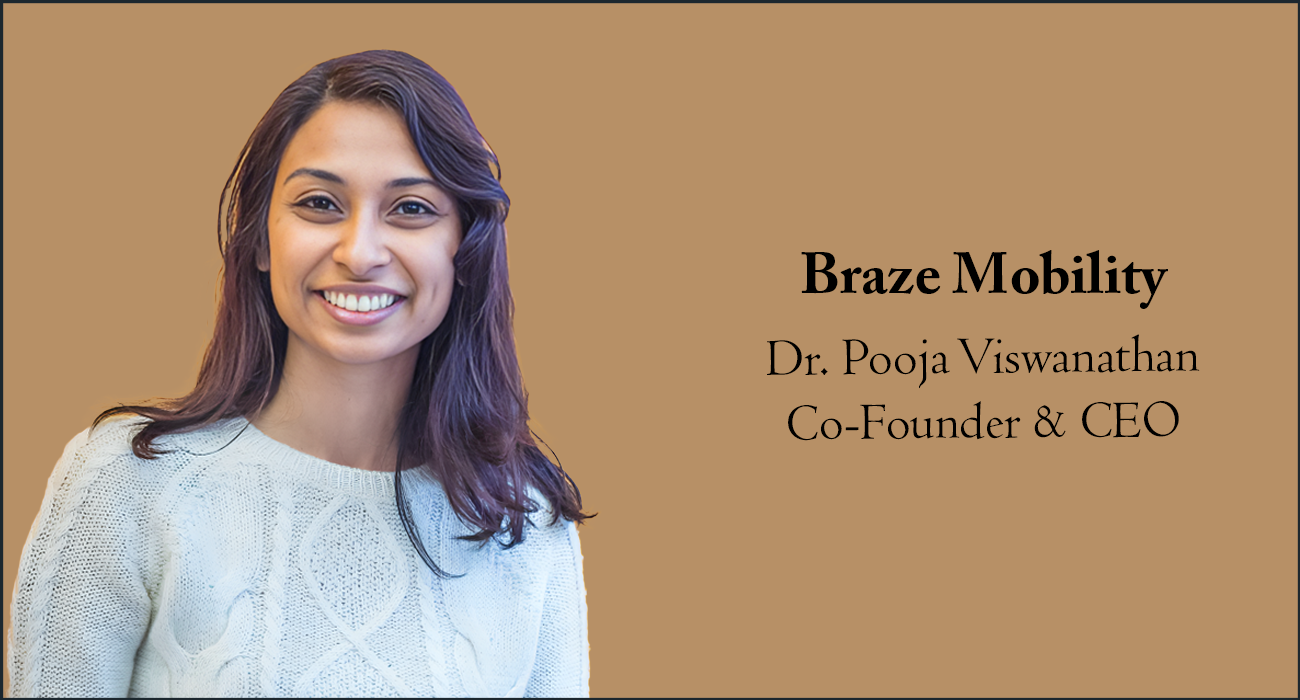
Some leaders build companies around market opportunities. Others build them around a problem that is too important to ignore. The most remarkable women entrepreneurs often belong to the second group. They notice what others overlook, challenge assumptions that have existed for too long, and turn personal conviction into solutions that can change everyday lives. Their journeys show that entrepreneurship is not only about creating a successful business; it is also about having the courage to solve meaningful problems and the determination to make progress accessible to more people.
Dr. Pooja Viswanathan represents that kind of leadership. Her journey combines deep research, technology, entrepreneurship, and a strong understanding of the people technology is meant to serve. As Co-Founder and CEO of Braze Mobility, she has spent years turning advanced research in robotics and assistive technology into practical solutions that help wheelchair users move with greater confidence, safety, and independence. Under her leadership, Braze Mobility has taken an important step toward making smart wheelchair technology more affordable, accessible, and easier to use.
From a Fundamental Concern to a Purpose-Driven Company
The story of Braze Mobility began with a simple but powerful realization. During a visit to a long-term care facility, Dr. Viswanathan and her fellow researchers saw residents with physical impairments being denied powered mobility devices because of concerns about safety. For people who already faced limitations in movement, the inability to access technology that could increase their independence raised a much bigger question: should safety concerns prevent someone from having the freedom to move?
That experience helped shape the purpose behind Braze Mobility, which was founded in 2016. The company was created to develop technology that could make wheelchair navigation safer without taking control away from the person using the chair.
For Dr. Viswanathan, the mission was not simply to add more technology to wheelchairs. It was to understand the everyday challenges wheelchair users face and develop solutions that genuinely fit into their lives. Her background made her particularly suited to this challenge. She had already spent more than a decade researching smart wheelchairs through doctoral and post-doctoral work in robotics and assistive technologies.
Her career also extends beyond academic research. Before founding Braze Mobility, she gained experience across telecommunications, banking, and the automotive sector, including work on advanced computer vision algorithms at Honda Research Institute in Silicon Valley. She has published peer-reviewed research and book chapters, led international workshops, and worked with researchers and clinicians across the mobility sector.
That combination of scientific knowledge and practical industry experience has shaped her approach to entrepreneurship. Rather than treating innovation as technology for its own sake, she focuses on translating research into products that people can actually use.
Making Every Movement More Confident
One of Braze Mobility’s most important innovations is its blind spot sensor system, designed to help wheelchair users better understand what is around them.
The technology can be added to manual or powered wheelchairs, effectively giving them smart capabilities without requiring users to replace their existing mobility equipment. The sensors identify obstacles within their detection range and communicate information through multiple forms of feedback, including lights, sounds, and vibrations.
This multi-modal approach is central to the company's philosophy. Instead of simply producing an alarm, the system communicates both the location and proximity of an obstacle, helping users develop a better understanding of their surroundings. Detection distances can also be customized according to individual needs.
The result is technology designed to support the user rather than take over. A wheelchair user remains in control while receiving information that can help with navigating tight spaces, avoiding collisions, and carrying out everyday activities with greater confidence.
That distinction matters. For Dr. Viswanathan, accessibility is not achieved merely by making a product available. It also depends on whether the product is understandable, affordable, practical, and designed around the person using it.
Braze Mobility has therefore built its development process around clinical evidence, user-centered design, and co-design. The company works with wheelchair users, families, caregivers, clinicians, therapists, manufacturers, and distributors to understand real-world needs and improve its solutions accordingly.
This approach reflects Dr. Viswanathan’s wider strength as a leader: she brings research and human experience together. Her expertise in knowledge translation and commercialization allows her to bridge the gap between what researchers discover and what people ultimately need.
Expanding Safety with BrazeCam™
That same philosophy can be seen in Braze Mobility’s BrazeCam™ Backup Camera System, which adds another layer of visibility and confidence for power wheelchair users.
Backing up can be challenging when the user cannot clearly see what is behind the chair. BrazeCam addresses this challenge with a real-time rear-view display designed to provide a clear view in different environments, from tight indoor spaces to outdoor pathways.
The system features a five-inch HD screen and wide-angle visibility, allowing users to see behind their wheelchair more clearly. It is designed to work across a wide range of power wheelchair models and can be powered through either XLR or USB connections, depending on the chair configuration.
Its plug-and-play design is another reflection of Braze Mobility’s practical approach. The system can be installed without complicated procedures, while flexible mounting options allow the monitor to be positioned on joysticks or armrests using standard RAM-compatible mounting systems. Built-in LED lighting also supports visibility in low-light conditions.
Importantly, the technology is designed with affordability and access in mind. BrazeCam can be reimbursable through Medicaid in several U.S. states under HCPCS Code K0108, subject to coverage and documentation requirements. Braze Mobility also serves veterans, is SAM-approved for direct sales to the U.S. Department of Veterans Affairs, and is listed with Medavie Blue Cross in Canada.
These pathways matter because an innovative product can only make a difference when the people who need it can realistically access it.
Leadership with Independence at Its Core
Dr. Viswanathan’s leadership is ultimately reflected in the problem Braze Mobility continues to solve: how can technology give people more freedom without making independence dependent on complicated or inaccessible systems?
That question continues to guide the company’s work. Its products are rooted in more than a decade of research, but their purpose is deeply human. They are designed to help wheelchair users understand their surroundings, move more confidently, and perform everyday activities with greater independence.
The company’s journey also demonstrates the value of bringing different disciplines together. Robotics, engineering, clinical research, computer vision, accessibility, and entrepreneurship all have a place in Braze Mobility’s work. Dr. Viswanathan has used her diverse experience to bring those worlds together around a clear purpose.
Her achievements outside the company further reflect the breadth of her interests and abilities. She has received awards and scholarships from respected organizations in Canada and the United States, including Google Scholar awards. Away from work, she spends time climbing, teaching music, playing racquet sports, and solving escape rooms, pursuits that reveal the same curiosity and willingness to embrace challenges that have shaped her professional journey.
Braze Mobility stands as a reminder that meaningful innovation does not always begin with a grand technological breakthrough. Sometimes, it begins by noticing an unfair limitation and asking whether there is a better way.











































 consultants ltd.jpg)


