

The true frontiers of the modern economy are no longer defined by geography, but by the legal architecture that safeguards innovation. Intellectual property has evolved into a fluid, global force, shaping how cultural, technological, and commercial value is created and sustained across institutions.
Modern legal practice has moved beyond national boundaries and single-sector expertise, operating within interconnected systems where governments, industries, and regulatory frameworks converge. In this landscape, a distinct class of professionals has emerged, those who do more than interpret the law; they help structure how it operates across jurisdictions.
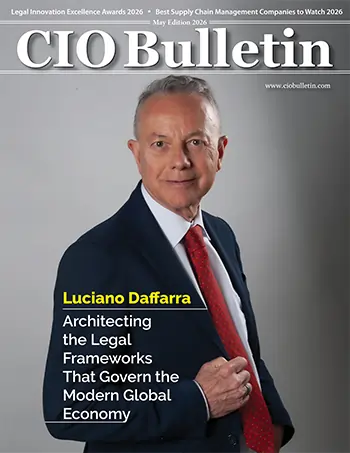
Attorney Luciano Daffarra stands firmly within this group.
An Italian attorney and legal advisor with over four decades of experience, Daffarra has built a career at the intersection of intellectual property, media, entertainment law, and international institutional relations. His work has consistently focused on strengthening legal and operational links between Italy and the United States, particularly in copyright protection, anti-piracy enforcement, and the evolution of frameworks governing global content and digital platforms.
Rather than being defined by a single sector, his trajectory reflects a broader mandate: aligning legal systems with the realities of cross-border trade, technological change, and cultural production. From policy coordination with governmental bodies to advisory roles across the audiovisual and digital ecosystem, his work has contributed to shaping enforcement mechanisms and compliance.
At CIO Bulletin, we explore the professional journey behind his standing in international legal and institutional circles, defined by cross-border impact, regulatory coordination, and complex intellectual property structures.
This article focuses on the key engagements and cases that reflect the depth, precision, and international scope of his work.
Luciano Daffarra in Practice: Structuring Law at C-Lex Studio Legale
At the heart of Luciano Daffarra’s four-decade career lies his role as Partner at C-Lex Studio Legale, the Milan-based international firm where his sophisticated cross-border legal strategies come to life. Operating between Milan and Gorizia, his practice transcends conventional boundaries, seamlessly bridging jurisdictions, industries, and evolving legal architectures.
Daffarra regularly handles matters where ownership layers run deep, historical documentation spans decades, and intellectual property rights traverse multiple legal systems. In these high-stakes matters, success hinges not merely on persuasive argument, but on whether legal structures can withstand rigorous scrutiny: whether chains of title hold, documentation proves reliable, and disparate jurisdictions can be harmonized into a coherent whole.
Yet Daffarra’s contribution extends far beyond individual client matters. Through C-Lex, he remains deeply engaged in high-level institutional dialogue, particularly in aligning Italian legal frameworks with U.S. enforcement practices and regulatory standards. From anti-piracy initiatives and rights enforcement to broader system-level coordination, his work consistently focuses on one imperative: transforming cross-border legal theory into robust, practical reality.
It is this rare blend, meticulous hands-on legal craftsmanship paired with sustained institutional influence that sets his practice apart and continues to shape the architecture of intellectual property protection in an increasingly borderless world.
U.S.–Italy Legal Cooperation: Building Bridges Across Legal Systems
A defining thread in Luciano Daffarra’s career has been his long-standing role in strengthening legal and institutional ties between Italy and the United States, particularly during a pivotal period when intellectual property enforcement and regulatory alignment emerged as critical economic priorities.
In the late 1990s and early 2000s, Daffarra worked at the intersection of U.S. industry interests, the Italian Ministry of Justice, and key stakeholders confronting the rising challenges of global content distribution and audiovisual piracy. These were practical, results-oriented efforts focused on harmonizing enforcement mechanisms and addressing structural gaps between the two legal systems.
His contributions helped advance anti-piracy initiatives in Italy, including support for legislative reforms that had faced years of delay before ultimately passing through the Italian Chamber of Deputies. The progress drew recognition from senior U.S. industry figures, who acknowledged the tangible steps forward in bilateral cooperation.
The broader significance of this work can be seen in three key dimensions:
Legislative progress: Advancing stronger copyright enforcement through targeted anti-piracy measures.
Institutional coordination: Facilitating structured dialogue among government authorities, legal institutions, and industry players.
Operational alignment: Ensuring that new legal frameworks could function effectively across borders in practice, not just on paper.
In this arena, Daffarra operated at the nexus of law, policy, and industry. He helped coordinate efforts between U.S. and Italian counterparts, supported enforcement-driven initiatives, and addressed the structural challenges that shaped Italy’s evolving anti-piracy framework. His involvement during this era underscored a consistent professional stance: going beyond legal interpretation to help translate cross-border cooperation into enforceable legal outcomes.
The ISDLS Framework: Architecting Judicial Efficiency
The momentum of U.S.–Italy legal cooperation found its most sophisticated expression through the Institute for the Study and Development of Legal Systems (ISDLS). This platform functioned as a strategic bridge, translating high-level international dialogue into the structural realities of judicial reform.
Law as an Economic Lever
By the late 1990s, the Italian justice system faced a critical reckoning. Chronic case backlogs and protracted litigation had evolved into a macroeconomic liability, undermining investor confidence and market predictability.
Under the ISDLS banner, a rigorous exchange was established between Italian practitioners and U.S. experts. The goal was to analyze California’s procedural models—refined by high-stakes commercial litigation—and integrate those efficiencies into the Italian framework.
The Milan–Naples Summits: A Blueprint for Reform
The year 2000 marked a shift from academic theory to institutional implementation. Summits in Milan and Naples served as the staging grounds for this evolution, bringing together the vanguard of legal policymakers.
Daffarra’s engagement in these sessions helped reshape the management of complex litigation, focusing on high-impact operational instruments:
Alternative Dispute Resolution (ADR): Diverting cases to preserve judicial resources.
Active Case Management: Empowering judges to control timelines and proceedings.
Pre-Trial Filtering: Streamlining litigation through early issue identification.
Summary Judgment: Delivering definitive resolutions without the necessity of a full trial.
A Catalyst for Global Business
Daffarra’s contribution to the ISDLS framework reflects a defining dimension of his career: the ability to influence the evolution of legal systems themselves. By aligning judicial efficiency with international best practices, his work ensures that legal architecture serves as a catalyst for global commerce rather than a barrier to it.
From Enforcement to Adaptation: The Digital Pivot
As mentioned prior, the late 1990s and early 2000s marked a turning point for intellectual property. As piracy and unauthorized distribution shifted from physical markets to digital networks, the global media industry was forced to confront a new and rapidly evolving set of challenges, ones that traditional legal frameworks were not fully equipped to address.
The Legislative Frontline
During this phase, Luciano Daffarra’s work intersected with broader industry efforts to modernize Italy’s anti-piracy framework. His professional alignment with the Motion Picture Association, reflected in correspondence with Jack Valenti, placed him within a network of stakeholders working to advance legislative progress at a time when key measures faced prolonged delays within the Italian Chamber of Deputies.
His role was rooted in coordination, helping translate the operational concerns of global media companies into enforceable legal structures. This required sustained engagement between legal practitioners, industry representatives, and government institutions, all working toward a framework capable of responding to evolving forms of infringement.
The Digital Shift
As the media landscape evolved, so did the nature of the threat.
What began as a challenge of physical duplication quickly expanded into a more complex digital environment characterized by:
Camcording, involving unauthorized recording of theatrical releases
Early digital piracy, driven by emerging peer-to-peer networks
Cross-border distribution, where infringing content circulated beyond the reach of local enforcement
These developments exposed a fundamental mismatch between the pace of technological change and the capacity of the existing legal environment. Legal frameworks designed for physical goods were increasingly required to address real-time, digitally driven violations.
Within this shift, the focus turned toward enforcement adaptation, developing legal responses that could keep pace with technological change while preserving evidentiary standards and procedural integrity.
Governance in a Platform Economy
As the industry moved further into the digital era, legal engagement extended beyond enforcement into the governance of media platforms themselves.
Daffarra’s advisory involvement in contexts linked to platforms such as Huffington Post Italia reflects this transition. Here, legal work was not limited to addressing infringement, but expanded to include the structuring of operational, regulatory, and ownership within a cross-border environment.
This required navigating multiple layers of complexity, including:
Cross-border ownership structures
Regulatory compliance within national jurisdictions
Integration of legal safeguards into platform operations
Within this shifting landscape, Daffarra’s work has consistently focused on bridging that gap. He has aligned legal structures with the practical demands of enforcement, regulatory compliance, and digital operations.
Navigating the Maze of Audiovisual Ownership
Despite legislative advancements, managing intellectual property in the audiovisual sector remains a high-stakes endeavor. For legacy film assets, ownership is rarely a straight line; it is a layered history shaped over decades by shifting jurisdictions and evolving corporate structures.
This complex environment is where Luciano Daffarra has centered much of his practice, navigating cases where legal outcomes depend less on surface-level claims and more on the forensic continuity of documentation.
The Risk of Fragmented History
As European film libraries transition into the digital era, practitioners often encounter fragmented or inconsistent records. This has fueled the rise of “orphan works,” assets where ownership is contested or must be reconstructed retrospectively.
For experts like Daffarra, these assets require a meticulous approach: reconstructing rights histories and verifying transfers to ensure they can withstand international scrutiny. Without this due diligence, the licensing and monetization of these works carry substantial financial and legal risk.
Registries vs. Reality
Public registries in Italy and across Europe offer transparency, but their legal weight is often misunderstood. A registry entry represents a claimed position, not definitive proof. In high-value disputes, courts look past administrative records to the underlying evidence:
Original Contracts: The bedrock of initial ownership.
Assignments: The verifiable chain of title over time.
Continuity: The unbroken link between historical production and modern distribution.
In a globalized media market, long-standing claims can collapse if the paperwork is incomplete. This creates a structural gap between how rights are recorded and how they must be proven in court. Success depends on the ability to transform a historical narrative into evidentiary certainty. Daffarra’s role often shifts the focus from narrative assertions to verifiable proof. His work in complex rights matters underscores this distinction: a registry entry holds weight only to the extent that it is supported by reliable, verifiable documentation.
Case Study
How La Dolce Vita Defined the New Rules of Evidence in the Digital Age
In the global entertainment economy, ownership is rarely defined by the act of creation. Instead, it rests on continuity: a verifiable chain of rights capable of withstanding the forensic gaze of international courts.
This principle faced its ultimate test in the landmark dispute over Federico Fellini’s masterpiece, La Dolce Vita (U.S. District Court for the Southern District of New York, Case No. 07 Civ. 1178). The case remains a definitive roadmap for high-stakes intellectual property litigation.
The Conflict: Claims vs. Chain of Title
The dispute centered on the lucrative U.S. economic rights to the film. International Media Films (IMF) asserted ownership through a multi-decade chain of title reconstructed from European entities and historical agreements. The defense, however, targeted a critical weakness: the integrity and admissibility of the documentary record itself.
Luciano Daffarra was brought in for a surgical analytical role: determining if this asserted chain could meet the uncompromising evidentiary standards of U.S. federal litigation.
Structural Fragility: The Paperwork Gap
At the heart of the matter lay a sequence of historical transfers, primarily a 1980 "Cinemat–Hor" agreement. However, the plaintiff’s claim relied heavily on photocopies, secondary certifications, and declarations rather than independently verified original instruments.
Daffarra’s analysis identified a "structural fragility" common in legacy rights. When foundational documents are missing or unverifiable, the entire ownership narrative, no matter how plausible, becomes legally indefensible.
Authentication as the Decisive Factor
The turning point rested on the "cornerstone" document: the Cinemat–Hor transfer. Under U.S. evidentiary rules, where authenticity is reasonably disputed, secondary copies are no substitute for verifiable originals.
Daffarra’s assessment framed the vulnerability clearly: the claim was not merely incomplete; it was unsupported at its foundational level. Without archival reliability, the chain was broken.
The Verdict: A Lesson for Global Media
The court ultimately granted summary judgment for the defendants. The ruling was a stark reminder: ownership is not presumed from registration or assertion alone. It must be proven through a continuous, admissible, and verifiable documentary chain.
Strategic Significance
While focused on a single cinematic icon, the case exposes a broader industry pattern of "legacy rights reconstruction." As older catalogues are monetized for streaming and digital licensing, the La Dolce Vita decision serves as a warning.
Daffarra’s role highlights a new operational reality for global IP: in a world of fragmented archives and cross-border complexity, the decisive factor is never plausibility. It is proof.

Knowledge Transfer and Institutional Engagement
Alongside his advisory and legal work, Luciano Daffarra has remained actively engaged in advancing the broader discourse on copyright enforcement and intellectual property governance.
Between 2018 and 2021, he was invited to participate in workshops organized by the World Intellectual Property Organization (WIPO), focused on ‘Building Respect for Copyright. The first of these was held in Tirana in October 2018, followed by a subsequent engagement in 2021. These forums brought together policymakers, legal experts, and industry stakeholders to address evolving challenges in copyright enforcement across jurisdictions.
More recently, Daffarra has contributed to academic instruction in Italy, delivering lectures on audiovisual piracy and related legal frameworks at the Faculty of Law within the Department of Legal Sciences at the Università Cattolica del Sacro Cuore. His participation in AFMEL courses across 2022, 2023, and 2024 reflects an ongoing commitment to bridging professional practice with academic learning.
These engagements underscore a consistent dimension of his work: translating complex legal and enforcement challenges into structured knowledge for both institutional stakeholders and future practitioners.
The Definitive Standard: Why Luciano Daffarra is the Visionary to Watch
In a global economy defined by the movement of content and capital, the true measure of ownership is no longer declaration, it is proof.
Luciano Daffarra’s career reflects this shift at a structural level. Operating at the intersection of courtroom litigation, institutional reform, and digital governance, his work transforms legal theory into enforceable reality.
In the high-stakes space between assertion and evidence, Daffarra continues to define the standard of ownership for the modern world. As jurisdictions blur and innovation accelerates, he remains the architect ensuring that the integrity of global commerce remains absolute.
















































 consultants ltd.jpg)


