
Home Technology Artificial intelligence Qualcomm ByteDance AI Chip Dea...
Artificial Intelligence
CIO Bulletin,
27 May, 2026
Author:
Gayathri Sr
A surprise semiconductor partnership challenges Nvidia dominance in the global artificial intelligence race.
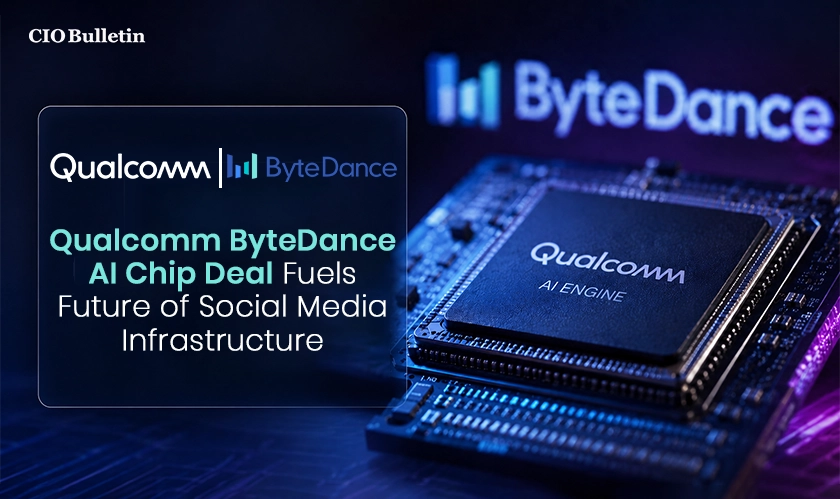
A quiet revolution is brewing in the tech world. In a move that has caught Wall Street and global tech watchdogs by surprise, smartphone chip giant Qualcomm has reportedly struck a massive deal with ByteDance, the parent company of TikTok. This high-stakes Qualcomm ByteDance AI chip deal, first reported by Bloomberg and analyzed closely by industry insiders at CIO Bulletin, centers on supplying custom-made semiconductors for the social media giant’s rapidly expanding artificial intelligence data centers. Following the leak of the news, Qualcomm’s stock immediately jumped nearly 5%, signaling strong investor confidence in this unexpected alliance.
ByteDance is reportedly gearing up to purchase millions of specialized chips, known as application-specific integrated circuits (ASICs). These aren't your average smartphone processors; they are tailor-made engines designed to power ByteDance’s next-generation AI agent software.
For years, tech companies have relied almost exclusively on expensive hardware from market leaders like Nvidia to run their heavy AI workloads. However, the tides are shifting as tech giants look for cheaper, more efficient alternatives.
Diversification: The move helps ByteDance reduce its heavy reliance on a single chip supplier.
Customization: The deal allows ByteDance to turn its own in-house chip blueprints into production-ready reality.
Market Expansion: It cements Qualcomm’s transformation from a phone-chip maker into a heavyweight player in global AI infrastructure.
The timing of the partnership is particularly strategic. Tech companies are currently navigating a complex geopolitical tightrope regarding hardware trade between the U.S. and China. Because these custom chips are designed to stay within legally permissible computing thresholds, the partnership cleverly avoids violating current U.S. export restrictions.
The deal highlights a broader industry trend where giants like Google and Meta are also rushing to develop custom silicon to lower costs and boost efficiency. Explaining this shift in strategy, Qualcomm CEO Cristiano Amon recently noted that the company is actively working with clients on three specific fronts:
“Central processing units, accelerators for inference, and custom chips called ASICs.”
As the AI race heats up, this partnership may just be the blueprint for the future of global tech infrastructure.


















 consultants ltd.jpg)


