
Home Technology Security New Phishing Tactics Bypass Mu...
Security
CIO Bulletin,
26 May, 2026
Author:
Gayathri Sr
Advanced Cyber Campaigns Are Effortlessly Scooping Up Login Tokens to Crack Open Corporate Networks.
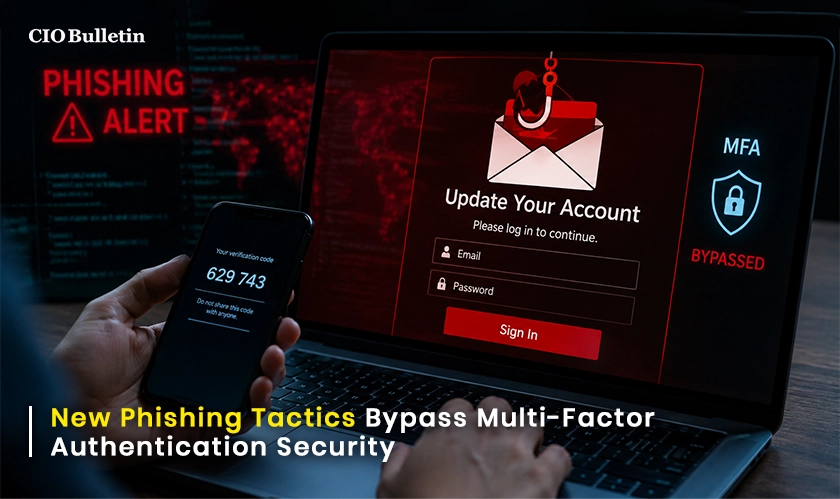
The digital safety net that thousands of global companies rely on is beginning to tear. For years, adding an extra verification step to logins was considered the gold standard of defense, but a surge in clever cyber campaigns has proved that standard multi-factor authentication security measures are no longer enough to keep hackers at bay. Modern threat actors are easily slipping past conventional barriers, rendering basic protection protocols obsolete.
The problem lies in the rise of highly sophisticated phishing-as-a-service operations, such as the newly discovered "Kali365" platform. This system utilizes artificial intelligence to create highly convincing deceptive emails in dozens of languages, lowering the technical barrier for novice criminals. Instead of guessing passwords, these automated toolkits trick employees into handing over digital authorization tokens. Once an attacker grabs this token, they can freely access corporate email networks, cloud storage, and internal communication channels without ever needing to trigger a security alert.
Security researchers point out that this is no longer the work of lone hackers, but rather a professionalized business model. For a small monthly fee, scammers can purchase ready-made infrastructure to impersonate major software vendors. These kits manipulate backend protocols to bypass conventional defenses, leaving standard enterprise setups incredibly vulnerable.
“Organizations have to move beyond having it as a ‘checklist item’ and instead focus on a defense in depth approach,” warned Robert Beggs, CEO of incident response firm Digital Defence.
As tracked by CIO Bulletin, relying on basic login prompts as a standalone defense strategy leaves dangerous blind spots. To counter these adaptive risks, corporate networks must transition toward modern, identity-centric security frameworks. Security architectures must be hardened by incorporating advanced, phishing-resistant safeguards and dynamic monitoring.
Key strategies recommended by global defense authorities include:
Restricting Device Code Flows: Blocking users from transferring login authorizations from secure computers to unverified mobile devices.
Continuous Access Evaluation: Moving away from one-time login checks to constantly monitoring user behavior throughout an active session.
Suppressing Malicious Inbox Rules: Monitoring for hidden scripts that automatically hide security warning emails from regular users.
The consensus among industry leaders is clear: true resilience requires moving past simple compliance checklists and embracing automated behavioral analytics to stop modern threat actors in their tracks.




















 consultants ltd.jpg)


