
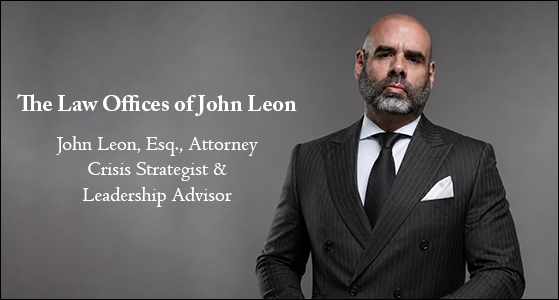
In an era defined by accelerating technological disruption, geopolitical instability, evolving regulatory landscapes, cybersecurity threats, and unprecedented reputational risk, organizations are increasingly recognizing that legal counsel alone is no longer enough. They require strategic advisors capable of helping leadership teams anticipate, navigate, and recover from complex crises that transcend traditional legal boundaries. Few firms embody this multidisciplinary approach more than The Law Offices of John Leon.
Founded by attorney John Leon, a nationally recognized crisis management practitioner with more than two decades of experience advising corporations, healthcare organizations, entrepreneurs, professionals, and executives, the firm has built its reputation on operating at the intersection of law, business strategy, governance, and organizational resilience. Over the course of his legal career, Leon has handled or consulted on more than 100,000 legal matters, been admitted to nine state and federal courts—including the Supreme Court of the United States—and has become known for guiding clients through some of their most consequential legal, operational, and reputational challenges. While his foundation is rooted in civil litigation and corporate representation, his work has increasingly focused on a broader question confronting modern institutions: How can organizations prepare for crises before they occur rather than merely react after the damage has been done?
That question has led Leon beyond the courtroom and into the broader fields of leadership, organizational behavior, and crisis decision-making. Drawing upon decades of practical experience, as well as insights from organizational psychology, systems thinking, resilience research, and decision science, he has developed what he calls his Leon Crisis Leadership Model’s P.R.E.P.A.R.E. Framework—a comprehensive model for proactive and Pre-Emptive crisis leadership designed to help executives, policymakers, military leaders, healthcare professionals, and business organizations build resilience before uncertainty becomes disruption. More than a methodology for responding to emergencies, P.R.E.P.A.R.E. represents an emerging philosophy of leadership: one that argues the most effective crisis managers are those who begin leading long before the crisis ever arrives.
The defining leadership challenge of the twenty-first century may not be disruption itself, but the persistent inability of institutions to prepare for it.
Corporate leaders now operate amid technological acceleration, cyber risk, geopolitical instability, regulatory complexity, misinformation, public distrust, economic volatility, and an almost instantaneous media environment. Under these conditions, crisis management can no longer be treated as a specialized function activated only after an emergency begins. It must become a central discipline of leadership.
That premise lies at the heart of attorney and crisis management practitioner John Leon’s P.R.E.P.A.R.E. framework, a seven-stage “Crisis Leadership” model developed from more than two decades of work involving litigation, organizational conflict, corporate disruption, reputational exposure, complex negotiations, and high-stakes decision-making.
Leon’s central proposition is deceptively simple:
All professionals should be crisis managers.
Executives, attorneys, military officers, policymakers, physicians, entrepreneurs, educators, and ordinary citizens must all make consequential decisions under conditions of uncertainty. What distinguishes effective crisis leaders is not immunity from adversity, but their capacity to anticipate threats, interpret incomplete information, act responsibly, preserve trust, and learn after the immediate danger has passed.
From Legal Practice to Crisis Leadership
Leon’s professional path began in law, but gradually expanded beyond the conventional boundaries of litigation. His Miami-based firm, founded in 2003, concentrates on civil litigation, corporate and healthcare matters, personal injury, transactions, and crisis management. The firm represents clients in Florida and beyond, including matters involving large corporations and complex legal, commercial, and reputational interests.
Over time, Leon observed that major legal disputes were rarely only legal. A lawsuit could affect a company’s operations, leadership structure, employees, regulators, investors, customers, finances, and public standing simultaneously. His firm therefore developed a multidisciplinary practice addressing not only the courtroom, but also negotiation strategy, media exposure, stakeholder relationships, and what Leon describes as the “court of public opinion.”
From this work emerged what Leon calls Pre-Emptive Crisis Management, the novel idea at the root of his Leon Crisis Leadership Model: the idea that the most consequential work must occur before a crisis reaches its most visible stage. His public lectures and TEDx presentation, Life Lessons From a Crisis Manager, extended that principle beyond corporate practice and argued that the habits of professional crisis management are broadly applicable to leadership and life.
For Leon, that realization—not any individual verdict, recognition, or professional award—represents the most significant milestone of his career. The insight transformed crisis management from a professional service into a potential field of leadership education.
The Intellectual Foundations of P.R.E.P.A.R.E.
Leon’s framework is practitioner-derived, but it intersects with several established areas of academic research: crisis leadership, sensemaking, naturalistic decision-making, organizational resilience, systems thinking, psychological safety, and learning from failure.
The framework consists of seven stages:
Predict. Recognize. Evaluate. Plan. Act. Recover. Evaluate Again.
Each stage addresses a distinct failure point commonly seen in organizations confronting uncertainty.
Predict
Prediction does not mean forecasting the future with precision. It means identifying plausible risks, dependencies, vulnerabilities, and adverse scenarios before they become operational realities.
This stage aligns with the distinction researchers make between treating crisis as an isolated event and understanding it as an evolving process. Organizational resilience scholarship emphasizes that effective responses depend partly on capacities developed before adversity occurs, including preparation, resource availability, adaptability, and the ability to detect emerging threats. Williams and colleagues’ influential review sought to integrate crisis-management and resilience research around precisely these anticipatory and adaptive capacities.
Prediction therefore asks a disciplined question:
What could reasonably go wrong, and what assumptions are we making that may no longer be reliable?
Recognize
Organizations often fail not because warning signs were absent, but because leaders misunderstood, minimized, normalized, or suppressed them.
Recognition is closely related to what organizational theorist Karl Weick described as sensemaking: the process through which people interpret ambiguous, rapidly changing events and construct an understanding sufficient for action. Crisis leadership research continues to identify sensemaking as a core competency because leaders must determine not only what is happening, but what it means, who is affected, and how quickly the situation is changing.
Recognition requires more than collecting data. It requires listening to dissent, questioning assumptions, and resisting the institutional temptation to interpret every warning as confirmation that the existing strategy remains sound.
Evaluate
Crises create cognitive pressure. Time is compressed, information is incomplete, consequences are uncertain, and decision-makers may become overconfident in early explanations.
Evaluation requires leaders to separate verified facts from assumptions, identify competing interpretations, assess legal and ethical constraints, examine second-order consequences, and determine what additional information would materially change the decision, especially when the actor Reverse Engineers the worst-case scenario and works backwards to the root or inception of the problem itself. Contrary to conventional thinking, Leon employs a common sense element to problem solving that has often been overlooked.
Research on crisis information management demonstrates that high cognitive load and urgency can amplify confirmation bias and lead decision-makers to rely on distorted information even after flaws have been identified. The lesson is not that leaders should delay indefinitely. It is that speed without disciplined evaluation can convert uncertainty into avoidable error.
Plan
Planning translates analysis into options.
Leon rejects the idea that organizations should maintain a single rigid crisis plan. Instead, leaders should develop decision pathways: defined responsibilities, escalation procedures, alternative scenarios, communication protocols, resource requirements, and thresholds that trigger action.
This reflects a systems-oriented view of crisis leadership. Complex institutions contain interdependent legal, operational, financial, technological, political, and human systems. A plan that addresses only the most visible problem may create larger failures elsewhere.
Effective planning must therefore account for feedback, uncertainty, and cascading consequences. It must also be tested through simulations, tabletop exercises, red-team analysis, and structured challenges to prevailing assumptions.
Act
A plan without execution is only an expression of preference.
The Act stage recognizes that crisis leaders rarely possess complete information. They must decide when the cost of delay exceeds the value of additional analysis.
Research on naturalistic decision-making, including Gary Klein’s work on recognition-primed decisions, suggests that experienced professionals often act by identifying patterns from prior situations, mentally simulating a plausible course of action, and adjusting as circumstances evolve. This is not impulsiveness. Properly understood, intuition is compressed experience subjected to rapid evaluation.
Leon’s formulation is that leaders should be neither recklessly fast nor defensively slow. They should act decisively when sufficient evidence, ethical responsibility, and the balance of consequences support action.
Recover
Recovery is not merely a return to normal operations.
A company may restore revenue while leaving trust damaged. A government may reopen systems while failing to repair institutional legitimacy. A leader may resolve an immediate controversy while preserving the conditions that created it.
Recovery therefore includes operational stabilization, stakeholder communication, legal resolution, employee support, reputational repair, and the restoration of credible governance.
This is where resilience differs from simple endurance. Resilience involves adaptation: the capacity to absorb disruption, reorganize, and continue functioning without reproducing the same vulnerabilities.
Evaluate Again
The final stage distinguishes P.R.E.P.A.R.E. from frameworks that end when the emergency subsides.
Organizations frequently declare victory too early. They conduct superficial reviews, reward visible heroics, and avoid examining uncomfortable failures in leadership, culture, governance, or communication.
Evaluate Again requires a formal after-action process:
What did we predict correctly?
Which warning signs did we miss?
Which assumptions failed?
Where did information become distorted?
Who lacked authority to act?
What decisions preserved trust?
What must change before the next crisis?
This stage is strongly connected to organizational learning. It also depends on psychological safety—the ability of employees and leaders to disclose mistakes, raise concerns, and challenge prevailing views without disproportionate fear of retaliation. Without that environment, post-crisis reviews become ceremonial rather than diagnostic.
Leadership as an Institutional Capability
The P.R.E.P.A.R.E. framework is not intended to replace specialized emergency-management, military, legal, medical, cybersecurity, or public-policy protocols. Its value lies at a different level: it provides an integrative leadership architecture that can organize how institutions think before, during, and after disruption.
That distinction matters.
Leon sees his role in that evolution as helping to build the bridge between academic knowledge and applied judgment. His objective is not simply to teach leaders how to react to emergencies. It is to help institutions make preparation, reflection, and responsible action part of their normal operating culture.
A Message for Emerging Leaders
Leon’s advice to aspiring professionals begins with a warning:
Do not wait for a crisis to begin developing the qualities the crisis will demand.
Credibility must be built before it is tested. Ethical principles must be established before they become costly. Communication systems must be created before misinformation spreads. Decision authority must be clarified before time becomes scarce. Leaders must learn to hear unwelcome information before their institutions become dependent on comforting narratives.
Crisis leadership is not primarily about appearing calm, commanding a room, or delivering a persuasive statement after events have escaped control.
It is the discipline of seeing earlier, thinking more clearly, acting responsibly, and learning honestly.
The question is not whether leaders and institutions will confront disruption. They will.
The more important question is whether they will merely react—or whether they will P.R.E.P.A.R.E.














































 consultants ltd.jpg)


