
Home Industry Media and entertainment India Renewable Energy Transmi...
Media And Entertainment
CIO Bulletin,
20 May, 2026
Author:
Sambhrant Das
Severe Grid Bottlenecks and Infrastructure Inefficiencies Maroon Massive Amounts of Solar and Wind Power Across Northern and Western Regions
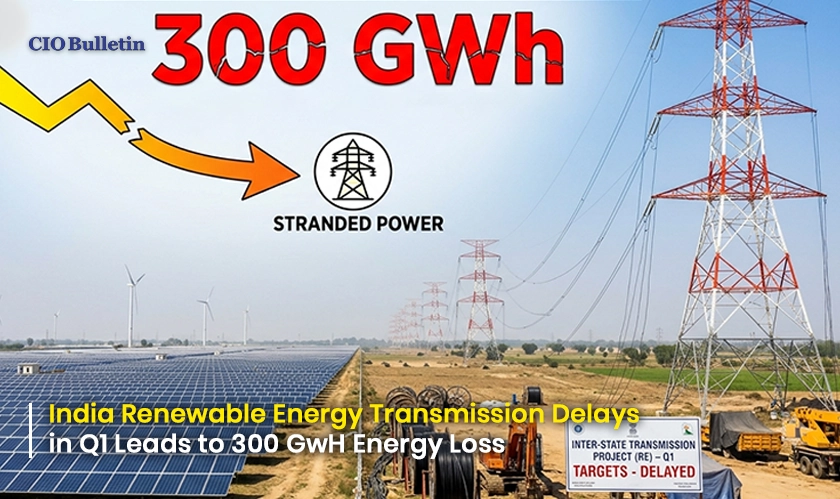
India's rapid push toward green energy is running into a massive concrete wall of underprepared grid infrastructure. A new study by energy think tank Ember reveals that the country wasted roughly 300 gigawatt-hours (GWh) of clean electricity during the first three months of 2026. This massive loss, which accounts for nearly two-thirds of all power cuts across the network, points directly to severe India renewable energy transmission delays as solar and wind farms are built much faster than the heavy cables needed to carry their power.
The grid bottlenecks are hitting specific areas incredibly hard, turning parts of the country into clean energy dead zones. According to the data, the national grid has only managed to meet about 80 percent of its layout targets over the last five years, leaving a deep trail of unfinished projects. The real-world breakdown of these lost units includes:
The Northern Region Bottleneck: Wasting 178 GWh of solar and wind energy due to overcrowded pooling stations.
The Western Region Backlog: Losing 122 GWh of power because local lines simply could not handle the peak afternoon generation.
The Single-Day Peak Crash: Wasting a whopping 34 GWh of clean energy on March 30, 2026, alone - enough to power five million urban households for an entire day.
The core problem is a deep mismatch in construction timelines across the energy sector. While a private developer can set up a massive solar park in less than a year, building the high-voltage transmission lines to connect it often takes several years due to land disputes and forest clearances. Right now, one out of every four major inter-state grid projects is running at least a year behind schedule, threatening India’s grand goal of reaching 500 gigawatts of non-fossil capacity by 2030.
Energy experts argue that the quickest way to stop this waste is to install massive battery storage systems directly at the regional collection centers. The report notes that setting up just 3 to 4 gigawatts of two-hour battery capacity could have absorbed almost all of the wasted energy during the quarter. To fix this sustainably, analysts believe the country must stop planning power lines as an afterthought. Highlighting this shift, Duttatreya Das, Energy Analyst at Ember, stated, “Over time, the system will need to move away from generation-led transmission planning towards a model where generation and transmission are co-optimally planned and executed.”
This massive waste of green electricity comes at a terrible time for Indian utilities, which are currently wrestling with sky-high global natural gas prices. Because of ongoing conflicts in the Middle East, the spot price for imported gas has nearly doubled, forcing states to pay exorbitant rates for peak evening electricity. According to CIO Bulletin, this critical bottleneck shows that building thousands of solar panels is only half the battle, meaning India must rapidly fix its grid connections and deploy large-scale battery storage to ensure its clean energy future doesn't vanish into thin air.




















 consultants ltd.jpg)


