
Home Technology Microsoft Microsoft’s AI Strategy Reas...
CIO Bulletin
,
23 May, 2026
Author:
Sambhrant Das
Satya Nadella Dismantles Decades Old Senior Leadership Structure to Inject Flatter Startup Agility and Direct Engineering Communication Loops into the Corporate Core
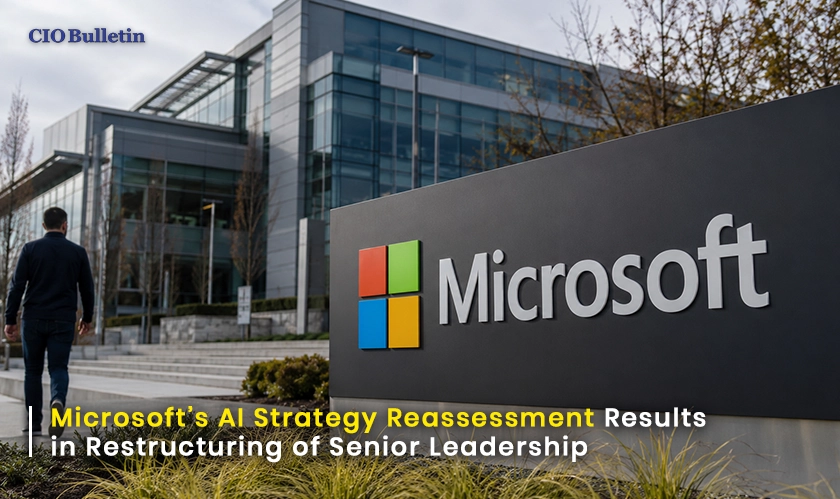
Corporate tech structures are getting a big shakeup as the top industry players try to maintain their edge vis-à-vis leaner, hyper-focused rivals. They are moving fast as well to cut through the old bureaucratic red tape that usually slows down huge operations, and a lot of software giants are rewriting the way they run their leadership. Microsoft Chief Executive Satya Nadella has reportedly quietly dismantled the classic Senior Leadership Team setup that ran the enterprise for decades, and in its place, he has built smaller agile nodes meant to speed up decision-making and guide Microsoft’s AI Strategy. The entire cultural overhaul is meant to slip a high-velocity startup mindset right into the center of the 220,000-person organization.
The traditional managerial chains are being bypassed in favor of direct communication loops that connect top strategists with frontline engineers. By removing excessive layers of middle management, the corporate office can evaluate system-wide metrics and user-interface updates on a weekly basis. This flatter organizational design relies on distinct, high-impact groups to drive daily operations:
The Corporate Core: A tight weekly governance unit consisting of Nadella, Brad Smith, Amy Hood, Amy Coleman, and Judson Althoff, focusing strictly on firm-wide policy and finance.
The Copilot Triad: A specialized engineering team featuring Charles Lamanna, Jacob Andreou, and Ryan Roslansky tasked with scaling the company's core AI assistant software.
The Frontline Accelerator: Regular cross-functional workshops where rank-and-file workers bypass executives entirely to pitch raw ideas straight to the top.
This structural shift has paved the way for a new generation of agile leaders to step into major operational roles, frequently displacing long-tenured industry veterans. The reorganization has prioritized adaptive engineering skills and modern consumer-facing experience over institutional tenure. Reflecting on the intense competitive pressures demanding this rapid corporate evolution, an internal source close to the executive suite explained, “The pace of this platform shift is happening faster than anything we've seen.”
The leadership reset extends deeply into individual business verticals, including massive branches like cloud computing, security, and interactive entertainment. Newer executives, such as newly appointed gaming chief Asha Sharma and security head Hayete Gallot, are being handed full operational control to modernize legacy portfolios. Meanwhile, older power brokers are transitioning into temporary advisory roles to ensure that crucial institutional knowledge isn't abruptly lost during the aggressive handoff phase.
Forcing a legacy enterprise to operate with the speed of a young startup is an incredibly difficult task, but keeping fingers on the local pulse is vital for survival. When decision-makers sit too far from actual technical engineering, they risk missing critical market pivots until it is far too late to adapt. CIO Bulletin views this development as a bold blueprint for modern enterprise survival, proving that flattening traditional executive hierarchies is an absolute necessity for legacy corporations aiming to outpace smaller, faster rivals.


















































 consultants ltd.jpg)


