
Home Industry Space The hunt for hypothetical Plan...
CIO Bulletin
,
16 June, 2026
Author:
Ravathi Sunil
The planet nine hunts led to more discoveries about the solar system.
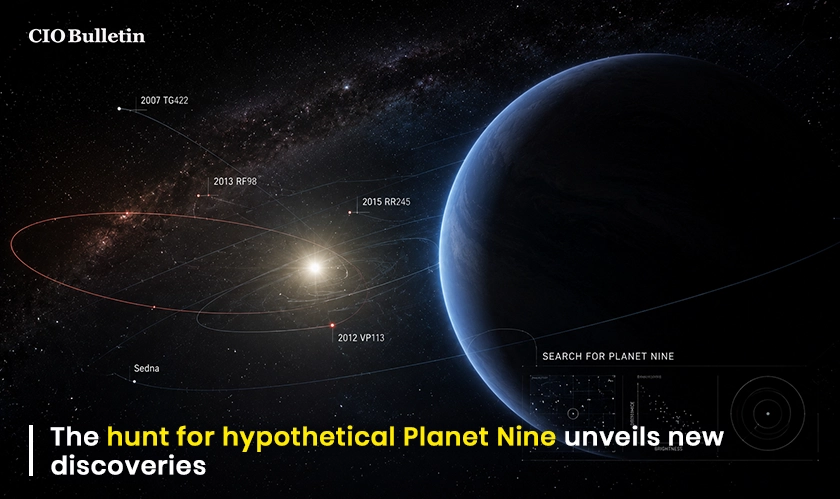
For a long time, astronomers have conjectured about the presence of a massive planet X, sometimes referred to as Planet Nine that has not yet been discovered.
Is there a huge unexplored planet in the Solar System's farthest regions? The concept dates back to before Pluto was discovered in the 1930s. Prominent scientists had proposed planet X as an explanation for Uranus's orbit, which deviates from the trajectory of orbital motion predicted by physics. The mismatch was thought to be caused by the gravitational attraction of an undiscovered planet that was several times larger than Earth.
Planet nine, which is believed to exist well beyond Neptune, is expected to be significantly larger than Earth. Even if planet Nine is merely a fictional planet, many astronomers are adamant that it exists in the solar system.
If Planet Nine is believed to be existing, then
It may reshape or question the theories and the evolutions of the solar system
Describe the peculiar orbits of numerous far-off trans-Neptunian objects.
As Caltech astronomer Mike Brown said in 2024,
“I think it is very unlikely that P9 does not exist. There are currently no other explanations for the effects that we see, nor for the myriad other P9-induced effects we see on the Solar System.”
Why is it controversial?
While some recently found far-off objects lend credence to the theory of an undetected huge planet, others cast doubt on it. Other hypotheses include historical occurrences in the Solar System or observational biases.
CIO Bulletin views this as one of the biggest mysteries in space. Scientists should be able to ascertain whether it actually exists with the aid of new telescopes and future observations. Our knowledge of the Solar System and its formation may change if Planet Nine is found. Until then, the search will go on, producing intriguing discoveries and deepening our understanding of the furthest limits of our cosmic neighborhood.




















































 consultants ltd.jpg)


