
Home Industry Nanotechnology New Microscopy Technique Revea...
CIO Bulletin
,
09 August, 2024
Author:
CIO Bulletin Team
Ultrafast electron microscopy discovers dynamics of charge density waves, advancing energy-efficient electronics and brain-like computing technologies.
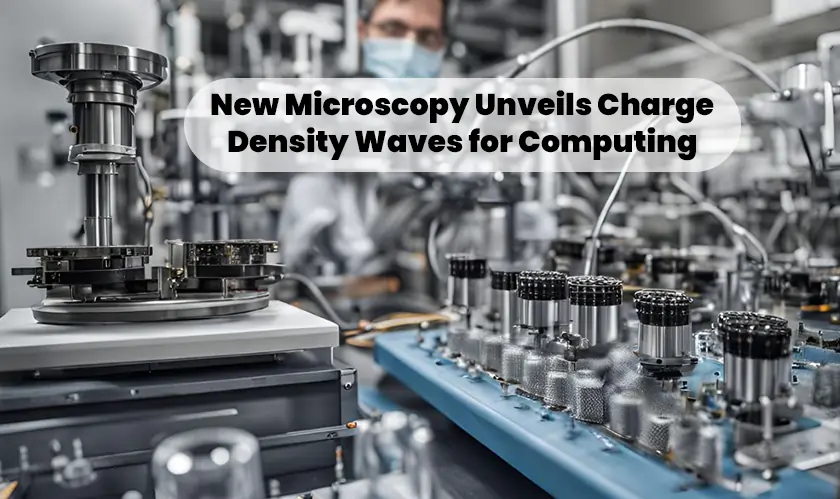
Researchers at the U.S. Department of Energy's Argonne National Laboratory have founded a innovative microscopy technique to study charge density waves with first-time detail. Using an ultrafast electron microscope, scientists observed nanosecond-scale dynamics within a material known as 1T-TaS2, a tantalum sulfide that forms these waves at room temperature.
This new technique involves applying electrical pulses to the material and capturing rapid changes in its behavior. The study revealed two key findings: the charge density waves in the material responded to heat generated by the current, rather than the current itself, and the electrical pulses induced vibrations that altered the wave arrangement.
These discoveries are crucial for developing energy-efficient electronics and brain-like computing systems. Charge density waves could enable faster and more efficient switching mechanisms, potentially leading to supercomputers that mimic neural processes and consume less energy. The melting and vibrational responses observed may offer insights into creating more precise and energy-efficient electronic devices.
The DOE Office of Science supports this research, which offers a fresh perspective on understanding and working with microelectronic materials. It may be possible to control charge density waves in nanoscale devices, which could lead to improvements in processing speed and energy efficiency.




















































 consultants ltd.jpg)


