
Home Platforms News Leading presentation design ag...

CIO Bulletin, 12 November, 2026
Author:
CIO Bulletin Team
A great deck doesn't just look good—it makes an argument. That's the gap most people discover too late, usually the night before a high-stakes investor meeting. Knowing which of the Best Presentation Design Agencies in 2026 can actually close that gap takes serious legwork, because not every studio understands both the visual design and the business logic behind a pitch. After reviewing dozens of agencies across portfolios, client feedback, and pricing structures, this guide narrows the field to five options worth your time.
The shortlist methodology
Each agency was assessed using publicly available information pulled from review platforms, official service pages, case studies, and directory listings. Only agencies with a documented track record in presentation design or closely adjacent creative services made the final cut. → See the full research breakdown
Whitepage Studio - Best for narrative-first investor pitch decks for pre-seed to Series A founders
Presentation Geeks - Best for teams needing reliable, deadline-driven presentation production
16\*9 Design - Best for visually polished decks built for enterprise and conference settings
Pitch Lift - Best for early-stage startups needing focused pitch coaching alongside design
Designity - Best for high-growth teams and enterprises needing unlimited design and marketing services
Picking the wrong agency costs more than money. It costs the room. When a deck is visually impressive but logically scattered, investors check their phones and founders wonder what went wrong. The challenge most clients face is finding a team that gets both sides, the aesthetic and the argument, without blowing a tight budget on revision cycles that never seem to end.
Specialized presentation agencies bring something a generalist shop rarely can. They know how slides build narrative momentum, how data needs room to breathe visually, and how brand consistency across a full deck signals professionalism before a word is spoken.
The right choice shows up in real, measurable ways. Faster turnaround means fewer late nights. Clear revision policies mean the project ends when it's supposed to. And when clients keep coming back, that repeat rate says everything about whether the work actually landed.
What Is Whitepage Studio's Business?
Whitepage Studio is a Boston-based agency that builds pitch decks, sales decks, and business presentations for startups and companies in growth mode. Their process starts with story, not slides. The team locks in the narrative structure and wireframe before any design work touches the page, so founders who visit https://www.whitepage.studio/services/presentation-design are getting a studio that argues the case first and decorates it second. Every project delivers fully editable PowerPoint or Keynote files, and the Premium tier adds financial modeling and go-to-market strategy.
What Makes Whitepage Studio a Strong Pick for Presentation Design Agencies?
Whitepage Studio solves the most expensive mistake in pitch preparation: building a beautiful deck that doesn't actually make the business case. The founder-led model means senior judgment goes into every project from the first discovery call through final delivery, which is rare at this price point (not cheap, but worth it for pre-seed founders).
What Clients Say:
Whitepage Studio holds a perfect 5.0 out of 5 on Clutch across 20 verified reviews, with consistent marks across quality, schedule, cost, and willingness to refer. Reviewers from companies like Reply, Elite Prep, and Central Casting AI point out the storytelling instinct, not just the visual output. Clients aren't just happy with how the deck looks. They're confident in how it performs.
What Is Presentation Geeks' Business?
Presentation Geeks is a presentation design agency focused on producing polished, professional decks at speed. They serve clients who need reliable creative output on tight timelines, covering corporate communications and conference presentations alike. The agency positions itself around consistency and turnaround, making them a practical fit for teams with recurring presentation needs rather than one-off projects.
What Makes Presentation Geeks a Strong Pick for Presentation Design Agencies?
Teams dealing with high-volume presentation requests and tight internal deadlines need a production partner that doesn't require extensive hand-holding, and that's the gap Presentation Geeks fills. Their model prioritizes repeatable quality, which matters more than most clients realize until the third deck of the quarter is due in 48 hours.
What Clients Say:
Public feedback on Presentation Geeks tends to highlight turnaround speed and ease of working with the team. Clients frequently mention that the process feels straightforward and that revisions don't drag on. For clients who've been burned by slow agencies before, that consistency is exactly what keeps them coming back.
What Is 16\*9 Design's Business?
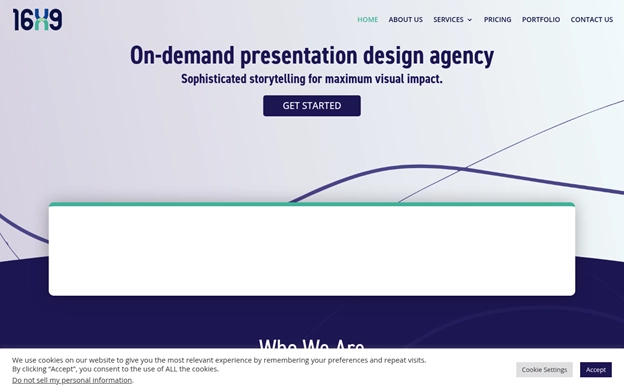
16\*9 Design is a presentation design studio built around the specific demands of high-production visual storytelling. The name itself signals their focus, the standard widescreen format used in virtually every boardroom and conference stage. They work with clients who need decks that project authority and visual precision, particularly for large-format presentations where low-quality design becomes immediately obvious.
What Makes 16\*9 Design a Strong Pick for Presentation Design Agencies?
The gap they fill is the difference between a deck that reads fine on a laptop screen and one that holds up under a 20-foot projector, which is a genuinely different design challenge. Agencies that specialize here understand grid systems, typographic scale, and color contrast in ways that generalist designers often don't (think enterprise pricing, but enterprise output to match).
What Clients Say:
Clients who work with 16\*9 Design tend to comment on the visual precision of the finished product. The polish that shows up in portfolio samples tends to match what clients actually receive, which isn't always the case with presentation agencies. Clients in conference and keynote settings particularly value the studio's attention to production-level detail.
What Is Pitch Lift's Business?
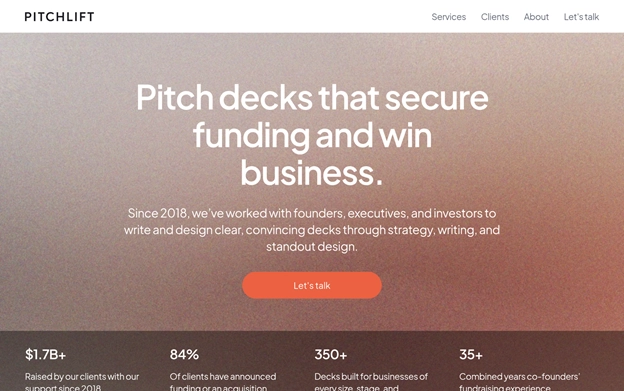
Pitch Lift sits at the intersection of pitch coaching and presentation design, which makes it a different kind of agency. Rather than handing founders a finished deck and wishing them luck, Pitch Lift builds in the communication strategy alongside the visual work. For early-stage startups where the founder is the presenter and the product is still being refined, that combination of coaching and design can close a lot of gaps that pure design shops leave open.
What Makes Pitch Lift a Strong Pick for Presentation Design Agencies?
Most design agencies hand off a beautiful file and consider the job done, but Pitch Lift accounts for what happens when the founder actually stands up and presents it. That added layer of pitch preparation is genuinely rare in a design agency context, and for founders who freeze under investor questions, it makes a real difference to the outcome.
What Clients Say:
Feedback on Pitch Lift reflects clients who came in needing more than a visual refresh and left with a clearer way to tell their story. The coaching element gets mentioned alongside the design quality, suggesting clients value both sides of the offering equally. Founders often describe the experience as confidence-building, not just deck-building.
What Is Designity's Business?
Designity runs as a Creative-as-a-Service platform, connecting clients with a dedicated Creative Director and a bench of vetted designers, copywriters, and strategists from the top 3% of US-based creatives. With 100-plus design and marketing services on offer, including branding, digital ads, video production, and social content, the platform suits teams that need consistent creative output without hiring in-house. Month-to-month pricing with no long-term commitments makes it accessible for teams at different growth stages (think scaling startup energy, but with 154 people behind the curtain).
What Makes Designity a Strong Pick for Presentation Design Agencies?
Designity removes the ceiling on project volume. Teams that run out of agency capacity mid-quarter don't have to scramble for a new vendor because unlimited requests and revisions are already built into the model. For high-growth teams where design needs spike unpredictably, that kind of flexibility is hard to match.
What Clients Say:
Clients highlight the value of having a Creative Director as a single point of contact rather than managing multiple freelancers. The breadth of services means teams can consolidate creative work in one place, which cuts down on coordination time. Clients who need ongoing volume consistently rate the managed model as their biggest reason for staying.
The research process started by building a wide longlist of presentation design agencies through multiple sourcing channels. Design-specific directories, freelance platform aggregators, B2B review sites, and editorial roundups were all used to surface names with meaningful presence in the space. From the outset, only agencies with documented service offerings in presentation design or closely adjacent creative disciplines were considered for further review. Generic creative studios with no clear specialization were filtered out at this stage to keep the list focused on the right kind of expertise.
Once the longlist was established, each candidate was checked against a set of consistent filters. Agencies without verifiable client reviews, case studies, or publicly accessible portfolio samples were removed. Rating patterns were examined across multiple review platforms rather than taken at face value from a single source. Agencies with thin review histories or patterns suggesting low engagement with client feedback were deprioritized. The goal was to keep only agencies with enough of a track record to draw meaningful conclusions about how they actually perform under real client conditions.
Claims made on agency websites were cross-referenced with what clients actually reported in published reviews. When an agency described its process or turnaround standards on its site, that was checked against recurring themes in client feedback to see whether the two aligned. Where website claims were vague or unverifiable and no client feedback supported them, those claims were noted but not treated as confirmed differentiators. Real-world project outcomes visible in case studies and client quotes carried more weight than self-reported metrics.
Signals of external recognition were factored into the final assessment. Industry award mentions, citations in design or business publications, and evidence of original research all added weight to an agency's standing. These signals matter because they reflect validation from outside the agency's own marketing, which is a genuinely different kind of proof point. Agencies with consistent external mention over time were viewed as more established regardless of team size.
The final filter focused on evidence that each agency actually performs presentation design work at a meaningful level. Dedicated service pages for pitch decks, investor presentations, or sales deck production were checked for specificity and depth. Verified client reviews mentioning presentation projects by name, along with case studies tied to real outcomes, were prioritized. Agencies that could point to relevant, specific work in this space consistently ranked above those with only general creative portfolios.
No single agency is the right fit for every project. The best choice depends on what the presentation actually needs to do, who's presenting it, and what success looks like on the other side of the meeting. Here are five criteria worth checking before you commit.
Industry/Domain Experience: Look for agencies that have worked in your sector before. A studio that understands healthcare fundraising decks or SaaS sales presentations brings assumptions that save time.
Features and Service Offerings: Some agencies do design only. Others add copywriting, financial modeling, or coaching. Know which combination your project needs before the brief goes out.
Pricing Structure: Per-slide, per-deck, and retainer models all exist in this space. Matching the pricing model to your project type protects the budget from scope creep.
Results Measurement: Ask agencies how they define a successful project. On-time delivery rate, revision count, and client satisfaction scores are all reasonable things to expect data on.
Industry Knowledge and Compliance: Certain sectors, finance, healthcare, and regulated industries, have specific brand guideline and presentation platform compatibility standards. Agencies without that context can create friction late in a project.
Choosing the right presentation design agency comes down to fit, not reputation alone. Narrative-first studios like Whitepage Studio suit founders who need their story to work, not just their slides to look polished. High-volume platforms like Designity fit teams with ongoing creative demands. Across all five options here, the clearest signal of a good match is an agency whose process asks the right questions before the first design file opens. That discipline is what separates a strong deck from a forgettable one.




















































 consultants ltd.jpg)


Comments