
Home Platforms News CIO Bulletin Showcases Top Fiv...
CIO Bulletin
,
09 November, 2026
Author:
Sambhrant Das
As AI models, space infrastructure, and next-gen digital platforms continue to proliferate around the world, access to the next wave of innovation has become a fundamental requirement for economic growth. The modern global marketplace doesn't see bold entrepreneurship as the exception anymore; it is now a core piece of infrastructure that is required for the very fabric of commerce, the pace of technological change, and the competitiveness of the global market.
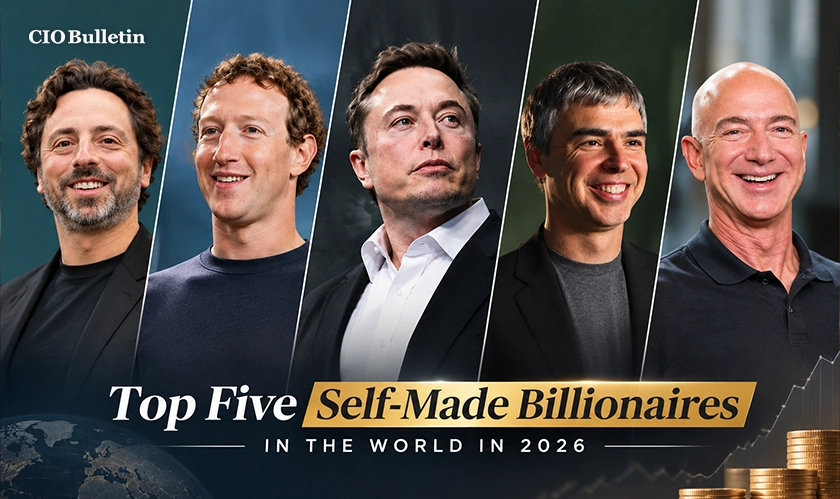
Today's business environment is full of operational challenges of all kinds: complicated supply chain issues, a tough regulatory regime across borders, a constant stream of new technology and market disruption, and market volatility to match. In order to keep their businesses growing and innovating without any interruption, the global visionaries have to have some bold operational strategies, innovative technology integrations, and high-performing business models that are designed specifically to meet the demands of the global consumer. If you look at the world's richest billionaires 2026 you can see that the self-made entrepreneurs are actually creating entire industries by building the platforms of the future from scratch. The following is CIO Bulletin’s list of the top 5 self-made billionaires in the world 2026, all of whom have built state-of-the-art technology platforms, disruptive energy platforms, and highly scalable business models.
Elon Musk as one among the leading self-made billionaires remains the benchmark for high-impact innovation, driving global change in the areas of autonomous transport, commercial spaceflight, and satellite connectivity via Tesla and SpaceX. He is at the heart of the global tech scene, and his businesses are effectively a combination of very advanced hardware and AI to solve some of the most difficult engineering problems.
Musk has turned a number of early-stage companies into massive, industry-defining corporations through a combination of visionary leadership and relentless execution. He's got a track record of scaling up in a very quiet, very engineering way. The enormous amount of engineering that happens at his firms permits them to maintain a leading position in the market while moving into new growth spaces such as satellite communication and robotics.
Ongoing experimentation and vertical integration are the essential elements of his approach to business. By having both the manufacturing and the software design in-house, he removes all the friction in the process and enables extremely rapid deployment cycles. Looking forward, his companies are continuing to expand their autonomous systems and their interplanetary logistics, allowing the global market to use the infrastructure of the future as a fundamental driver of the economy.
As the co-founder of Google and the previous CEO of Alphabet, Larry Page laid the technological basis for contemporary internet search, cloud computing, and the digital advertising infrastructure that supports the present web. His goal of gaining algorithmic scalability made it possible to convert huge volumes of online data into a format that could be used all over the world.
Co-founded Google with Larry Page and was instrumental in developing the fundamental data structures and web indexing algorithms that underpin today's global search engines. His commitment to deep tech research continues to be a major driver of the AI models and long-term innovation across the Alphabet portfolio.
Mark Zuckerberg revolutionized contemporary social communication by making Meta the largest social network and digital advertising firm in the world and continuing to do so by working on the algorithms of social media, open-source AI models, and immersive technologies.
Jeff Bezos built his retail empire globally and made AWS the basis of the modern internet. He achieved this by being obsessed with the customer and with long-term operational efficiency. Amazon and AWS have changed the face of retail and logistics all over the world.
Everyone from corporate analysts to VCs to economic strategists is asking the same question: What explains the increasing number of self-made billionaires compared to those who inherited their money?
In addition, modern self-made billionaires have complete command over their offerings and are highly maneuverable in their operations. Their original ideas, coupled with the smart use of capital, allow them to adapt to technological advances and generate wealth for customers as well as for the company.
Studying the strategies of successful self-made billionaires provides significant strategic insights for aspiring business leaders:
Product-led scalability: You can build your solution on a digital or cloud native platform and scale out to the world without any physical friction.
Founder-led Agility: The ability to make clear strategic decisions and to pivot continuously in the face of economic change.
Capital Efficiency Through Automation: Using the right software tools to reduce overhead and get the maximum revenue output per head.
Despite these clear wealth-building dynamics, building multi-billion-dollar enterprises involves notable operational hurdles:
Navigating the Complex Web of Regulatory Regimes: Managing cross-border compliance, data protection, anti-trust, etc. continues to be a source of legal friction.
Managing High Capital Intensity: Scaling up hardware, infrastructure, or AI research is extremely capital intensive, with huge upfront investment and ongoing cash burn.
Market Volatility and Disruption Risk: You have to be constantly evolving your product in order to maintain market leadership and avoid being disrupted by a nimble new startup.
Navigating these growth hurdles demands exceptional resilience. The founders who succeed at building scalable architecture and the ability to adapt strategically are the ones who are going to build businesses that are going to be around in the global market for decades.
Identify Scalable Market Inefficiencies: focus on building products and services that solve high-friction problems in large addressable markets.
Prioritize Continuous Innovation: massive investment in core technology, our proprietary systems and IP to build real and sustainable competitive moats.
Master Agile Capital Allocation: reinvest your cash flows into high-return initiatives, emerging technologies and top talent.
Build High-Performance Operational Cultures: Build the organization around a set of operational principles that drive rapid experimentation, operational accountability, and customer obsession.
Everything you need to know about this news
A self-made billionaire refers to someone who becomes a billionaire through their own endeavors, be it business, investing, or technology, instead of inheriting wealth.
It is technology (AI, enterprise software, cloud computing, and the green energy sector) that has, without any doubt, produced the most self-made fortunes.
Yes. Some 2/3rds of the world's billionaires are self-made (i.e. they have built their businesses rather than inherited them).
They are diversified across asset classes, have long positions in equities of high-growth companies, reinvest in the emerging technology sectors, and use structured wealth management vehicles.
Relentless execution combined with long-term strategic vision—allowing founders to navigate regulatory challenges, market downturns, and rapid technological transitions successfully.















































 consultants ltd.jpg)


Comments