
Home Platforms News CIO Bulletin Picks the Top Fiv...
CIO Bulletin
,
12 November, 2026
Author:
Ravathi Sunil
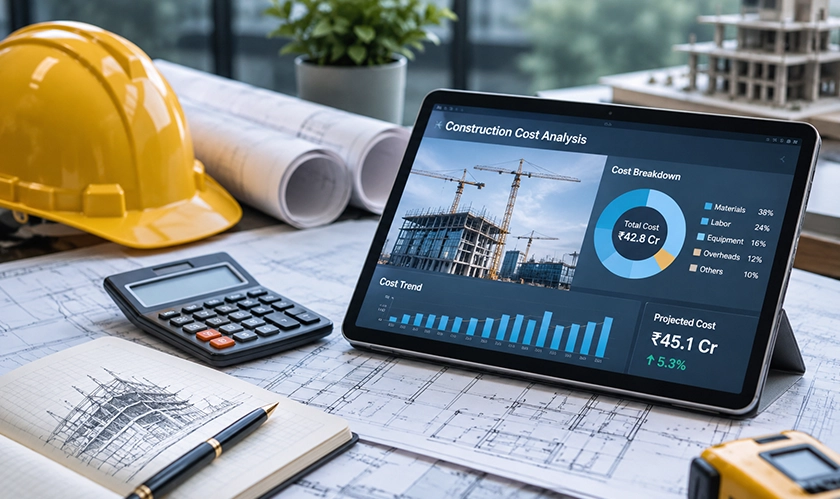
CIO Bulletin has been looking at how builders are using data to protect their margins, and the story is rapidly evolving. With input costs up, labor in short supply and tight timescales, the builders are looking beyond the spreadsheet. A number of new construction software ideas are enabling teams to get their estimates out faster, price more accurately, and spot any overspend before it becomes a problem.
Cost intelligence is that. It's about taking all that historical project data, the live market prices, and the drawing data and turning it into clear, actionable numbers that a team can trust. Which platforms are at the forefront, and which ones are worth watching? This list breaks each one down in simple terms.
A single wrong estimate and you've just wiped out the entire project profit. The traditional way of doing it is manual measuring, using old price lists and your own experience, which is slow and very prone to error. The modern way is to have the platform read the drawings, pull in the relevant cost data, and then compare the budget against actual spend. That's a whole lot faster, a whole lot fewer surprises, and a whole lot better decisions. When you're looking at tools to consider for construction software ideas, the team should be asking themselves three very simple questions: does it save you time on the measuring? Does it use good cost data? Does it integrate with the systems that you already have?
Here are five names that stand out in the construction platform in 2026 landscape, each for a different reason.
Gordian publishes RSMeans (widely regarded as the most used construction cost database in the US), which is updated annually and covers thousands of line items, price-adjusted for region. Their Flash tool takes it a stage further, taking uploaded construction documents and producing early estimates using the RSMeans data and a plain-language chat interface. It's a very good starting point for teams who want some level of confidence in their numbers prior to the drawings being final.
ProEst (part of Autodesk) is aimed at large commercial contractors and preconstruction teams. It's a tool that links cost estimates to BIM models (which are the 3d digital models of the building) so that design changes can be reflected in the budget. It has cloud collaboration, templates, and AI-driven cost forecasting. BuildingConnected (also from Autodesk) provides bid management and analytics to allow you to compare the various contractor bids. If you're already in the Autodesk ecosystem, then it's a very natural fit.
Measuring drawings by hand is a complete time-consuming process. Togal.AI uses computer vision to read the plans and produce takeoffs (the list of quantities required for pricing) in minutes. One review cited a takeoff time of approximately 12 minutes. It's ideal for the mid-sized general contractor and subcontractor who bids frequently and needs speed without having to hire any extra people.
Kreo’s Caddie AI agent can read the drawing scale and context to automatically measure and count items (both in 2D plans and 3D models). It also supports the full estimating workflow in the cloud, not just takeoff. Published plans are priced at a very modest monthly rate per user, which is very attractive for smaller firms and QS's who are looking to try AI for the first time.
Estimates are of little use if the budget then drifts after work has started. Procore is the go-to construction management software for documents, RFIs, daily logs, and project costs, so all the spending is visible in one place. Many of the larger firms will integrate it with their estimating tool to allow them to compare planned against actual. Pricing is normally quoted on request, so you'll need to ask for a demo prior to any commitment.
Not every team needs every tool. A short checklist can save months of regret:
Match the tool to your size, since enterprise suites can be heavy for small crews.
Check where the cost data comes from and how often it is updated.
Test with a real past project before signing a contract.
Confirm it connects with accounting and project tools you already use.
Look for clear support and training, because adoption fails without it.
Three shifts to watch. Firstly, AI is moving from simple measurement to full estimates derived from drawings and historical data. Secondly, the pricing tools are beginning to link to the design models so that as the design changes, the budget changes. Thirdly, the smaller contractors are getting in as the entry price drops. The early adopters are going to get the most out of this, as clean historical data gets more and more valuable every year. Is cost intelligence going to be as much a part of the building site as email? The trajectory suggests it may well be.
The five platforms highlighted above demonstrate just how far cost intelligence has come. Gordian provides the trusted data, Autodesk ProEst is able to link the estimate to the design, Togal.AI and Kreo are about speeding up the measuring process, and Procore keeps spend visible once the work's actually underway. CIO Bulletin feels that organisations with access to a top construction platform will be in a far better position to win the bids and protect their margins. The right platform for you will depend on your size, your budget, and what you already have in place, so let fresh construction software ideas inform a small pilot and then build from there. In a year of ever-rising costs, having the right numbers is a real advantage. Making the right decisions today will protect your profit tomorrow.
Ready to get your numbers sharp? Start by listing your biggest estimating headaches, then book demos with two or three of the platforms listed above. Take a real past project into the trial and compare the results against what actually happened. Share your findings with your team and keep looking at other construction software options that meet your needs. For more on the technology side, keep an eye on CIO Bulletin.
Everything you need to know about this news
It is the use of software to turn past project data, current market prices and drawing information into reliable cost numbers. Teams use it to estimate faster, track budgets and spot overspending early, instead of relying on spreadsheets and guesswork alone.
There is no single winner, but AI takeoff tools such as Kreo and Togal.AI are often worth a look because they cut measuring time and can suit lean teams without large estimating departments. Always test one on a real project first.
It depends on the platform. Gordian’s RSMeans is a widely used published database, while other tools combine your own historical project data with market prices. Always ask how often the data is refreshed.
No. AI speeds up measuring and first drafts, but experienced estimators still review quantities, judge site conditions and make the final call on risk and pricing. Think of it as a fast assistant, not a replacement.
Prices vary widely. Some AI takeoff tools publish monthly per-user plans, while enterprise suites such as Autodesk ProEst and Procore often require a custom quote. Request a demo and compare total yearly cost before deciding.


















































 consultants ltd.jpg)


Comments