
Home Technology Oracle Can Oracle 26ai Finally Make M...
CIO Bulletin
,
29 July, 2026
Author:
Gayathri Sr
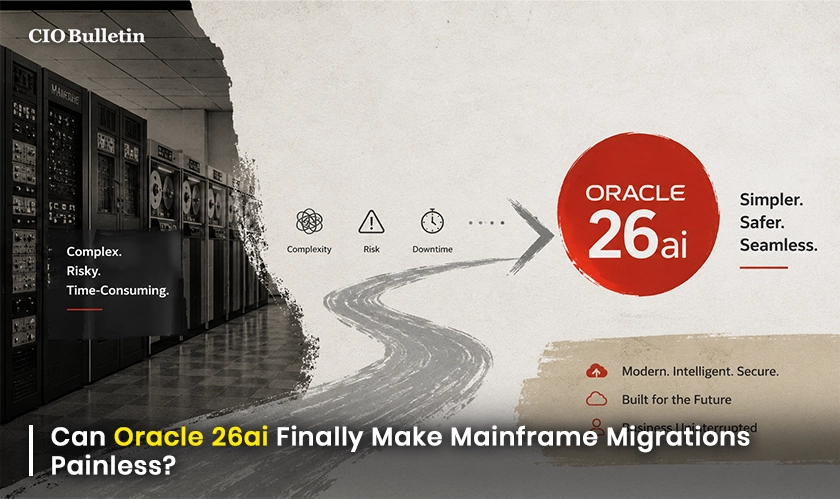
Unlocking mainframe modernization, Oracle 26ai native data compatibility changes the rules for enterprise re-platforming.
Moving away from legacy mainframes has long felt like navigating a minefield, but the arrival of Oracle 26ai is changing how engineering teams think about old-school infrastructure.
For decades, organizations trapped in the legacy ecosystem wanted to migrate their proven EBCDIC-based applications to modern, ASCII-compatible cloud and on-premises environments without rewriting core software. Until recently, doing so meant risking broken sort orders, corrupted text encoding, and sluggish custom linguistic indexes. Oracle's latest update addresses this architectural headache head-on by introducing built-in CDRA-compatible EBCDIC client character sets alongside emulated binary collations and Data-Bound Collation capabilities.
By handling mainframe data sorting and character conversions natively within the database engine, enterprises can modernize critical workloads while maintaining exact application behavior. Commenting on the breakthrough, Michael Yau, Vice President of Oracle Database Globalization Engineering, noted:
“Whether the destination is an on-premises deployment or one of Oracle AI Database’s cloud deployment models, organizations can modernize mission-critical workloads while preserving EBCDIC compatibility.”
As detailed in industry analyses by CIO Bulletin, bridging this traditional gap allows technical teams to run high-performance transactions and cloud migrations smoothly. Instead of relying on clumsy workarounds, databases can now natively understand and process vintage mainframe logic at scale.
Native CDRA Support: Accurate, predictable character encoding mapping straight out of the box.
Emulated Binary Collations: Preserves legacy COBOL and SQL sorting rules without custom linguistic overhead.
Data-Bound Efficiency: B-tree indexes and schemas inherit rules cleanly without heavy application refactoring.
Everything you need to know about this news
The biggest obstacle is translating legacy EBCDIC data into ASCII systems while keeping exact character accuracy and sequence sorting behavior intact for old applications.
It uses built-in, emulated EBCDIC binary collations that directly mimic IBM code page orders without forcing developers to build oversized linguistic indexes.
Yes, these built-in capabilities function seamlessly across cloud, Exadata, and multicloud setups where custom locale files are traditionally restricted.
No. Thanks to the Data-Bound Collation feature, existing SQL statements can adopt correct EBCDIC ordering rules automatically without manual code adjustments.
Comprehensive deployment steps and utilities like SQL*Loader or PL/SQL conversion APIs are documented in the official Oracle AI Database Globalization Support Guide.





















































 consultants ltd.jpg)


Comments