
Home Platforms Others Are Modern Mega-Cities Powerle...
CIO Bulletin,
11 July, 2026
Author:
Gayathri Sr
As consecutive natural disasters breach modern defense systems, tech leaders urge a rapid shift toward automated predictive intelligence.
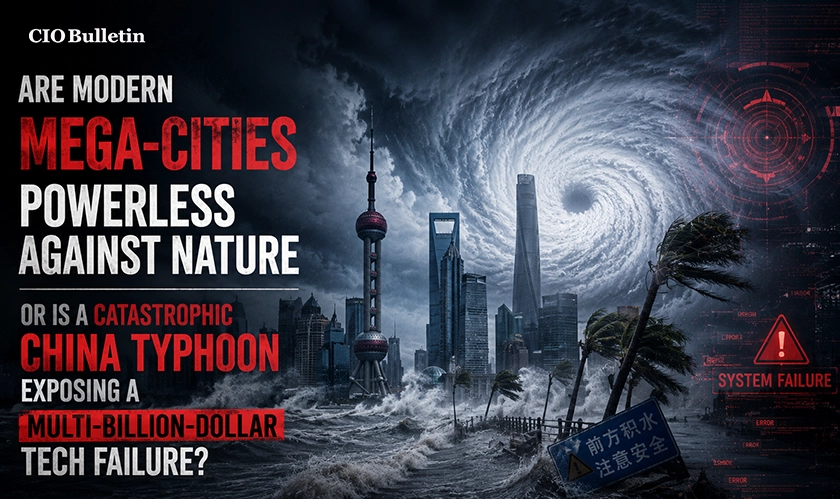
A dramatic climate crisis is unfolding as a relentless China typhoon season exposes severe vulnerabilities in modern infrastructure, forcing global tech and enterprise leaders to re-examine legacy defense models. Following the catastrophic landfall of Typhoon Maysak, which breached major reservoir dams and caused widespread flooding in the southern regions, the country is now bracing for the immediate impact of an approaching severe storm, Typhoon Bavi. With over 900,000 residents evacuated in major hubs ahead of this next wave, the sheer scale of the disruption has caught the attention of global risk analysts.
According to strategic tech insights tracker CIO Bulletin, the overlapping nature of these atmospheric disruptions is highlighting a critical reality: traditional, reactive disaster recovery plans are no longer sufficient against compound weather anomalies.
As rescue teams struggle against rising waters, the integration of emerging technology has transitioned from a future luxury to an immediate necessity.
Drone Fleets: Over a dozen advanced unmanned aerial vehicles are actively deploying critical supplies to isolated zones.
AI Analytics: Municipalities are scrambling to implement real-time hydrological modeling to forecast rapid reservoir overtoppings.
Autonomous Evacuations: First responders have successfully utilized remotely operated ropes and crafts to pull stranded individuals from hazardous zones.
The escalating crisis has sparked intense debate regarding how major supply chains and data hubs prepare for sudden regional shutdowns. Commenting on the logistical strain, Ding Wei, Vice Mayor of Nanning city, stated”
“The difficulty of the rescue effort and relocating affected residents means that the disaster could still worsen.”
For enterprise leaders tracking systemic risks, the ongoing events serve as a loud wake-up call. The dependency on manual infrastructure checks is rapidly giving way to a demand for automated, predictive tech frameworks capable of protecting both human lives and global operational continuity.
Everything you need to know about this news
The initial storm dumped record-breaking rainfall that overwhelmed regional reservoirs, leading to a major dam breach in Hengzhou and widespread power and transport suspensions across multiple provinces.
When a second storm follows immediately behind the first, it creates "overlapping hazards." Emergency teams must conduct rescue operations on already saturated ground and compromised infrastructure, compounding the humanitarian risk.
Emergency teams are heavily utilizing industrial drones for airdropping vital supplies and lifting stranded individuals, alongside satellite mapping to track shifting floodwaters in real time.
Major weather anomalies cause immediate shutdowns of international rail, port, and flight paths, illustrating why global organizations must integrate predictive climate intelligence into their supply chain strategies.
Platforms like CIO Bulletin frequently analyze how cutting-edge technologies, such as predictive AI and autonomous robotics, are being deployed to future-proof critical infrastructure against extreme macro events.



















 consultants ltd.jpg)


Comments