
Home Platforms Others Will Institutional Readiness F...
CIO Bulletin,
09 July, 2026
Author:
Sambhrant Das
Emergency response networks across East Asia initiate wide-scale harbor closures and coastal evacuations as an immense, historically oversized typhoon bears down on primary industrial ports.
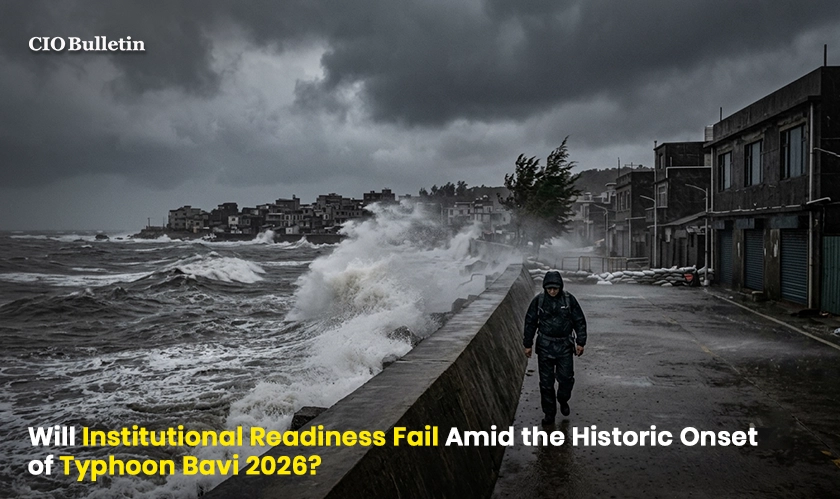
A massive meteorological disturbance is forcing emergency management agencies all over East Asia to rework their coastal protection setups, comprehensively and quickly. Churning across the open Pacific Ocean, Typhoon Bavi 2026 is ballooning into a phenomenon that officials say poses unprecedented danger, with sustained winds that reach near 200 kilometers per hour. The system is roughly 1,000 kilometers across at its widest, and it is almost matching the geographic scale of continental France. Along the sea lanes, shipping groups are preparing for harsh logistical stoppages, as weather bureaus follow the storm’s linear trajectory toward highly industrialized coastlines.
Meteorological agencies have issued comprehensive safety directives to insulate agricultural assets from catastrophic water damage. Predictive models track the storm skirting northern Taiwan before initiating coastal landfall:
Complete suspension of commercial ferry lines servicing remote outermost territorial islands.
Immediate enforcement of mandatory deep-sea fishing fleet recalls to mainland harbors.
The extraordinary scale of this atmospheric disruption highlights a sharp departure from typical seasonal behaviors.
"Storms of this size have been fairly rare in recent years," - Jason Chang, an atmospheric forecaster with Taiwan’s Central Weather Administration.
Public officials are working alongside neighborhood leaders to arrange local emergency shelters and to safeguard utility grids before conditions become worse. Administrative orders demand that municipal districts solidify structural flood barriers and rapidly distribute emergency survival rations to families. Teams remain stationed at major sea locks to prevent dangerous river overflows from swamping residential sectors.
Corporate logistics systems face enduring infrastructure delays as extreme seasonal weather patterns jeopardize vital global shipping lanes. Supply chain managers must build permanent operational redundancies to survive compounding impacts. CIO Bulletin views this development as a clear warning that multinational corporations must invest heavily in resilient asset management systems to safeguard international distribution routes against long-term climate volatility across global networks.
Everything you need to know about this news
This storm system covers a width on the scale of continental France, which means it’s among the largest physical typhoons to threaten the region in decades.
Current tracking models predict the storm center will bypass northern Taiwan before charting a direct course toward China's eastern Fujian province.
Local transportation departments have grounded major ferry networks, suspended seaside tourist attractions, and ordered deep-sea fishing vessels back to secure ports.
Unseasonably high ocean temperatures, paired with El Niño–type atmospheric patterns, are supplying an aggressive power source that rapidly boosts active tropical storms.
People near the shoreline are being told to put together emergency grab bags that include about three days of food, drinking water, flashlights, and crucial medical items.



















 consultants ltd.jpg)


Comments