
Home Services & Solutions Payment and card How Fintech is Reshaping Corpa...
CIO Bulletin
,
25 June, 2026
Author:
Sambhrant Das
How a Corporate-Payments Workflow Engine eliminates legacy operational bottlenecks to safeguard enterprise profit margins
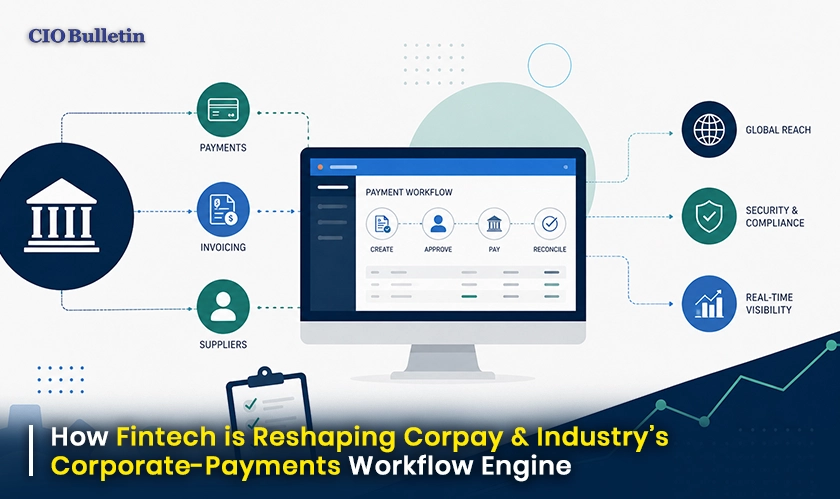
A deeper look at recent quarterly earnings shows that Corpay is aggressively diversifying away from its historical reliance on fuel card transactions. The global S&P 500 company generated over 1.26 billion dollars in total revenue, driven heavily by an advanced Corporate-Payments Workflow Engine that handles recurring financial software processes. Rather than relying on highly volatile energy price spreads, the vendor has strategically embedded its software modules deep within the day-to-day accounts payable operations of modern enterprises.
The corporate shift toward integrated transaction hubs highlights the limitations of treating modern fintech vendors as simple card issuers. Finance leaders are rapidly adopting unified systems to capture complex invoices, enforce compliance rules, and manage multi-currency international vendor payments from a centralized console. According to corporate financial statements, this software-driven ecosystem now controls a massive share of the company's baseline earnings:
Corporate payments contributed a staggering 503.9 million dollars to the latest quarterly revenue mix.
Vehicle and traditional mobility services accounted for 563.9 million dollars of the overall total.
By linking directly with legacy enterprise resource planning systems, the platform makes its software incredibly difficult for corporate clients to displace once fully deployed. Finance departments value the automated validation layers that match incoming invoices against active purchase orders before executing cash outlays.
Sophisticated tools used by large enterprises are now directly integrated within the spend management workflow that customers already rely on every day.
The broader fintech industry continues to innovate around automated supplier enrollment and managed exception handling to eradicate the systemic fraud risks associated with physical checks. Centralizing domestic payables alongside international foreign exchange hedging mechanisms allows growing mid-market firms to scale operations without dramatically increasing internal back-office headcount. These automated cross-border tools provide transparent transaction tracking while shielding corporate profit margins from sudden, unpredictable swings in international currency valuations.
This clear transition into recurring software-led ecosystems positions automated payment vendors to capture higher lifetime customer value while insulating core margins from macroeconomic variables. As distributed workforces become permanent fixtures, the demand for enterprise-grade spending transparency will continue to push traditional financial institutions out of the specialized corporate transaction market. CIO Bulletin views this development as a clear indicator that the future of business-to-business commerce belongs exclusively to highly specialized, workflow-integrated software platforms that eliminate manual intervention entirely.
Everything you need to know about this news
Corpay is shifting from its traditional focus on fuel cards to automated, software-driven corporate payment solutions. This protects their revenue from volatile energy prices and embeds their tech directly into enterprise workflows.
The company generated over $1.26 billion in quarterly revenue, fueled by its Corporate-Payments Workflow Engine. Corporate payments brought in $503.9 million, closely rivaling the $563.9 million from vehicle and mobility services.
Once it is integrated with a company's legacy ERP system, the platform becomes the heart of day-to-day work. Features like automated invoice matching and compliance checks make it really disruptive, as it is hard for a business to switch vendors after that point.
They reduce fraud risks tied to paper checks via automated supplier enrollment. Moreover, the integrated cross-border tools help safeguard profit margins by keeping firms shielded from sudden currency swings.
As businesses demand deeper spending transparency and automation, traditional financial institutions are losing ground to specialized software platforms that completely remove manual data entry.





















































 consultants ltd.jpg)


Comments