
Home Technology Regtech Financial Institutions Sink Bi...
CIO Bulletin
,
05 June, 2026
Author:
Gayathri Sr
The quiet crisis costing banks more than regulatory fines.
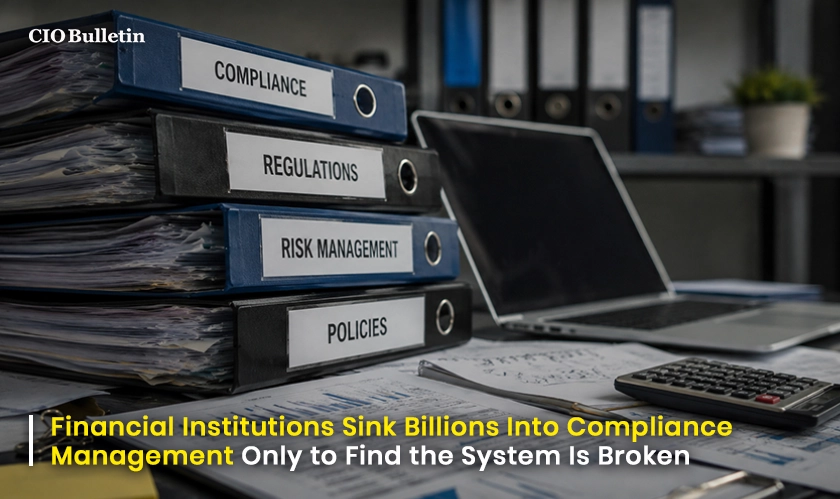
Global financial institutions are collectively pouring over $300 billion annually into compliance management, yet the entire system is failing to keep pace with modern regulatory demands. Despite this staggering financial investment, over ten million compliance professionals worldwide are still forced to rely on outdated, manual processes that haven't evolved in two decades.
According to recent insights shared by data intelligence pioneers and highlighted by CIO Bulletin, the core issue plaguing the financial sector isn't a lack of rules, but a severe shortage of actionable intelligence. Modern businesses desperately need the capacity to rapidly find, interpret, and connect regulatory updates. This critical gap has birthed a revolutionary new tech category in 2026: Regulatory Intelligence AI.
The current RegTech market has focused heavily on simple monitoring tools that merely alert teams when a new rule is published. However, they fail to explain what the change actually means for the business. This leaves expensive, highly trained compliance teams drowning in alert overload, manually sorting through data across multiple jurisdictions.
“Compliance is not a domain where ‘trust the model’ is acceptable. Every conclusion must be explainable to a regulator, a board, or a court.”
An AI-native system changes the paradigm by reasoning exactly like an experienced compliance professional, just at a superhuman speed. Rather than acting as a simple search engine, this new technology serves as a real-time navigation system for corporate governance.
Early adopters of these AI platforms are already gaining a massive structural advantage by achieving:
Continuous Horizon Scanning: Tracking hundreds of global regulatory bodies simultaneously.
Automated Gap Analysis: Instantly mapping new requirements against existing internal corporate policies.
Traceable Reasoning: Delivering fully auditable logs that satisfy strict regulatory scrutiny.
As enforcement timelines compress globally, the divide between companies equipped with advanced compliance management infrastructure and those left behind is widening. The modern compliance function can no longer operate effectively without intelligent automation.



















































 consultants ltd.jpg)


