
Home Industry Renewable energy Historic Sustainable Maritime ...
CIO Bulletin
,
28 September, 2026
Author:
Ravathi Sunil
APSEZ achieves groundbreaking net-zero milestone by running eastern maritime logistics entirely on clean power.
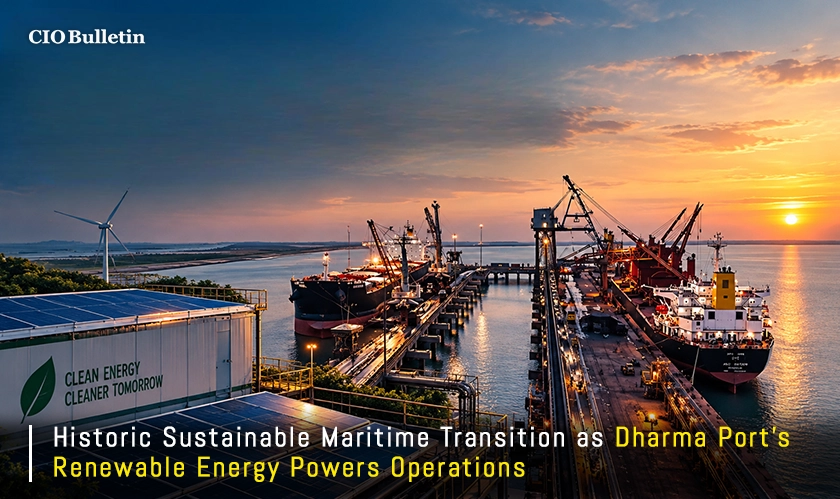
Dharma Port's renewable energy adoption has made history as the major multi-cargo facility transitioned its entire operational electricity demand to clean power. Handled under the maritime portfolio of Adani Ports and Special Economic Zone, the eastern deep-draft port now fulfills its complete monthly requirement of over nine million electricity units exclusively through green sources. By securing an annual clean energy supply exceeding 108 gigawatt-hours, this green milestone drastically reduces indirect carbon emissions tied to purchased electricity while elevating environmental standards across industrial supply chains.
Can large-scale industrial shipping hubs effectively maintain continuous heavy commercial operations while depending entirely on clean power networks? Port management achieved this transformation by blending captive green power, third-party power access, and regional utility agreements.
Highlighting the strategic significance of this milestone for corporate decarbonization goals, company officials stated:
"The shift, effective August 2026, is part of APSEZ's long-term Net-Zero strategy and is expected to reduce emissions associated with purchased electricity."
Field assessments reviewed by CIO Bulletin indicate that sustainable electricity currently drives continuous cargo handling, mechanized storage yards, rapid-loading silos, and rail logistics. Nearly one-quarter of the green power comes from the captive hybrid power plants in Gujarat, with any residual demand being met by green consumer arrangements in the region. In light of increasing pressures on industries to become carbon-free, this shift sets up a realistic framework for green shipping operations.
Key Maritime Energy Transition Takeaways
Eastern multi-cargo hub transitions completely to clean power to meet full operational demands.
Comprehensive green power supply eliminates substantial indirect emissions across heavy logistical operations.
Strategic energy procurement combines captive hybrid generation plants with regional green utility frameworks.
Transforming Industrial Port Infrastructure for Global Decarbonization Leadership
As reported by CIO Bulletin, the recent achievement of this kind at the eastern maritime gateway acts as strong proof of concept for the sustainable transformation of international logistics systems. In light of the increasing volumes of cargo transported in tandem with the increasing global scrutiny of corporate sustainability metrics, it becomes imperative for ports and supply chain leaders to adopt sustainable grid connection, advanced energy storage systems, and captive hybrid power generation.
News Source: NDTV, https://www.ndtv.com/
Everything you need to know about this news
The facility became India's first large private multi-cargo port to power all operational electricity from green energy.
Annual renewable electricity consumption exceeds 108 gigawatt-hours, fulfilling a monthly demand of over nine million units.
Power is secured via captive hybrid generation in Gujarat, third-party power agreements, and regional green utility deals.
All round-the-clock activities, including mechanized cargo handling, storage yards, rapid silos, and rail logistics, run on green power.
Yes, combining hybrid generation with local green power tariffs offers a practical roadmap for decarbonizing global maritime hubs.

















































 consultants ltd.jpg)


Comments