
Home Technology Salesforce Salesforce France CEO Says Lea...
CIO Bulletin
,
19 June, 2026
Author:
Ravathi Sunil
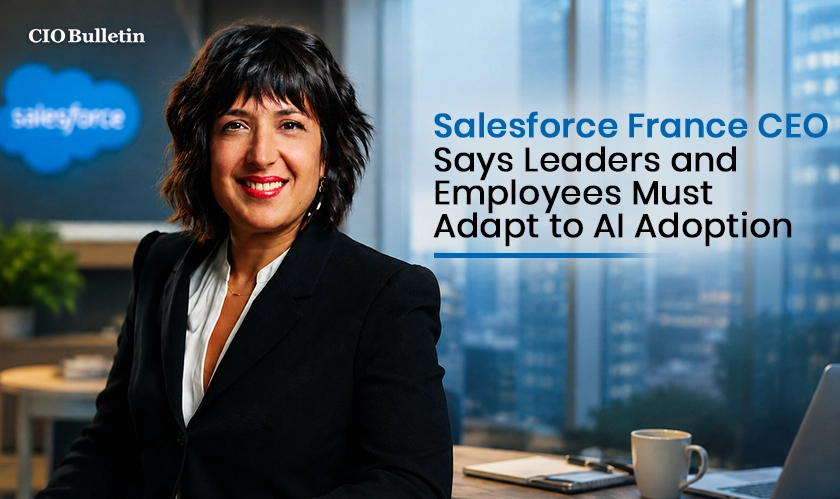
The CEO of Salesforce France highlights that as AI transforms workplace skills, culture, and business operations, both leaders and people must adjust to its adoption.
Salesforce, which was formerly most well-known for its customer, sales lead, and service request tracking software, claims to be delving further into AI adoption measures.
The US Company has been advocating for what it refers to as the "agentic enterprise," a paradigm in which AI agents collaborate with human workers in a variety of commercial operations.
"Our positioning is to reinvent the way all enterprises need to embrace the AI revolution." – Emilie Sidiqian, Salesforce France CEO.
According to the CEO, the goal is to use AI as a "cockpit" to organize work with the appropriate permissions and data rather than switching between multiple tools. She also promotes the use of AI by her teams, contending that adoption must be spearheaded at the top.
AI adoption helps job transformation by reshaping how work is done rather than just replacing roles. It automates repetitive and routine tasks, allowing employees to focus more on decision-making, creativity, and problem-solving.
This leads to the creation of new roles such as AI supervisors, data analysts, and prompt engineers, while also upgrading existing jobs with AI-assisted tools. For leaders, it improves productivity tracking and strategic planning, while for employees, it enhances efficiency and skill development.
Overall, AI drives a shift toward more digital, skill-intensive, and adaptive job functions.
While AI adoption is reshaping jobs, it also comes with several limitations. One major challenge is job displacement risk, especially for routine and low-skill roles that can be easily automated. This can create short-term unemployment and require large-scale reskilling programs.
CIO Bulletin views another limitation in the skills gap: many workers may not have the technical knowledge needed to work alongside AI systems. This can widen inequality between highly skilled and low-skilled employees.
AI systems can also introduce bias and errors, which may affect decision-making in areas like hiring, customer service, or performance evaluation if not properly monitored.
Finally, cost and infrastructure barriers can slow adoption, especially for small and medium-sized businesses that may struggle to implement advanced AI systems at scale.




















































 consultants ltd.jpg)


Comments