
Home Industry Automobile Will the Ambitious Pivot to Te...
CIO Bulletin
,
15 July, 2026
Author:
Ravathi Sunil
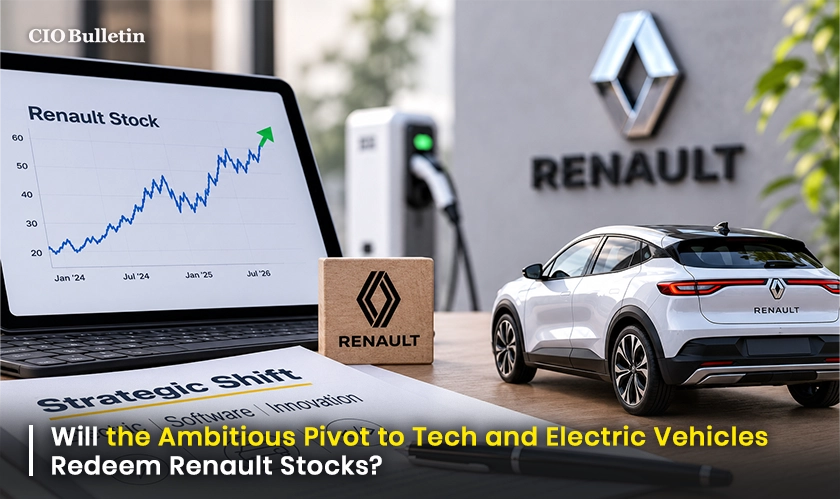
As the automotive landscape undergoes its most radical transformation in a century, Renault stock emerges as a fascinating testing ground for legacy carmakers pivoting to a zero-emission future.
Renault, an iconic carmaker from France that has served as a symbol of practical, elegant, and affordable cars in Europe for more than a century, is now at an extremely crucial juncture in its history. With the tightening of climate goals globally and changes in customer preferences, Renault stocks serve as an indicator of how well a company built around conventional internal combustion engines manages to transition to the era of electrification and technology. This high-stakes transformation is catching the attention of global analysts, tech visionaries, and market observers at CIO Bulletin alike.
The true test for legacy automakers isn’t just building an electric car; it’s rewriting the software of their entire business model without stalling the engines that fund them today.
Rather than abandoning its roots overnight, the automaker is employing a clever "dual-engine" strategy. To fund its multi-billion-dollar leap into the future, the group continues to leverage its highly profitable legacy Internal Combustion Engine (ICE) and hybrid vehicles. These traditional models generate the vital cash flow needed to fuel ambitious research into next-generation battery architectures and software-defined platforms.
To win this race, the company is executing several key shifts:
EV Dedicated Architectures: Straying from the modification of the existing internal combustion car structures by building dedicated electric vehicle platforms, which optimize cabin and battery efficiencies.
Software-Defined Car: Creating computing architectures within cars for receiving over-the-air updates that enable the creation of high-margin digital subscription services.
Smart Partnerships: Partnering with technology pioneers and battery suppliers around the world to ensure that there is supply chain security and lower development costs.
By balancing legacy manufacturing with cutting-edge software engineering, Renault isn't just trying to survive the EV revolution; it is attempting to rewrite the playbook for how a legacy giant successfully reinvents itself.
Everything you need to know about this news
It serves as a prime test case of whether a traditional, mass-market European automaker can successfully restructure its massive legacy operations into an agile, tech-first EV and software company.
It is a vehicle where the hardware is managed primarily by software. This allows the manufacturer to update features, improve battery range, and fix bugs remotely via internet updates; unlocking continuous, subscription-style revenue after the car is sold.
The transition is largely self-funded by continuing to sell popular internal combustion engine and hybrid models in global regions where EV infrastructure is still developing, utilizing legacy profits to build tomorrow's technology.
Key risks include intense competition from low-cost EV manufacturers, supply chain vulnerabilities for raw battery materials, and the complex challenge of managing shifting environmental regulations across different global markets.
By partnering with other industrial, battery, and tech firms, the company can share massive development costs, secure stable battery supplies, and achieve the scale needed to make electric vehicles affordable for the mass market.


















































 consultants ltd.jpg)


Comments