
Home Technology Security Russia Drone Strike Shatters M...
CIO Bulletin
,
11 July, 2026
Author:
Ravathi Sunil
A devastating low-cost remote air incursion disables multiple fleet targets in crucial coastal shipping channels and paralyzes vital fleet movements.
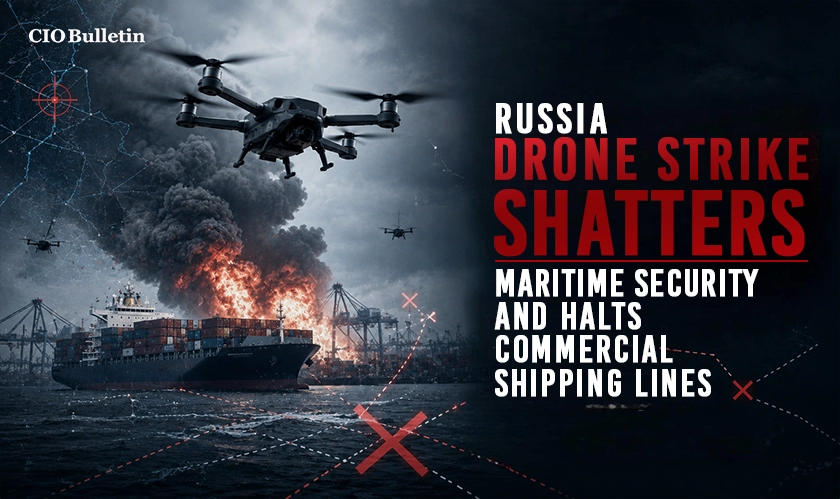
A highly sophisticated Russia drone strike has violently disrupted major maritime shipping lanes in Taganrog Bay, damaging four commercial vessels and claiming the life of a merchant sailor. The unexpected aerial assault intercepted a diverse fleet corridor, which included a specialized industrial tanker transporting volatile methanol cargo. For enterprise risk strategists monitoring vulnerable commercial trade routes on global platforms like CIO Bulletin, this sudden hit to standard shipping channels proves that low-cost automated air power can instantly disrupt physical corporate assets and freeze entire corporate logistics networks without warning.
The precision air raid struck multiple targets simultaneously, putting local emergency infrastructure on immediate high alert. While defensive security forces scrambled to manage the immediate threat, the mechanical impacts crippled standard fleet operations across the coastal region.
Target Density: The dynamic attack targeted four distinct vessels operating within the highly active trade corridor.
Fatal Impact: Shrapnel from the explosion killed a merchant crew member working aboard an active technical service vessel.
Industrial Hazards: One struck target was identified as an active chemical carrier laden with industrial methanol, though local emergency teams confirmed no chemical leaks occurred.
Defensive Barrage: Regional anti-air units reportedly intercepted over 15 uncrewed aerial vehicles during the height of the intense engagement.
"Russia used more than 120 drones and 12 missiles during the night, half of them ballistic." – Volodymyr Zelenskyy, President of Ukraine.
This recent maritime disruption highlights a severe challenge for modern global business networks. As traditional overland supply lines face persistent blockages, global corporations are leaning heavily on vulnerable marine alternatives that are now directly vulnerable to low-cost remote incursions.
The escalating maritime conflict has pushed logistics managers to actively redesign automated threat mitigation systems. Commenting on the rising operational friction, Rostov Oblast Governor Yuri Slyusar stated on Telegram that "drone danger remained active" across the entire maritime district, urging personnel to maintain extreme situational awareness. Ultimately, surviving this era of asymmetric disruption requires companies to establish flexible, adaptive freight networks capable of routing around sudden kinetic blind spots.
Everything you need to know about this news
Drones allow operators to execute highly precise, asymmetrical strikes from great distances without risking human pilots. Their small radar cross-section and coordinated swarm tactics make them incredibly difficult for standard shipboard radar systems to intercept before impact.
Industrial maritime routes carry critical raw materials, such as methanol, which are vital for manufacturing everything from circuit boards to vehicle components. When these specific shipping corridors are threatened, it causes an immediate spike in insurance premiums and forces extensive cargo rerouting, stalling global production lines.
Enterprises are forced to shift from passive monitoring to active, data-driven security. This involves integrating AI-powered risk analytics to track live conflict zones, utilizing automated satellite tracking, and instantly rerouting shipments long before cargo enters volatile waters.
Even if a strike causes minor physical damage, the threat of secondary explosions or hidden chemical leaks forces immediate safety protocols. Port authorities must completely halt traffic to clear the airspace, scan for unexploded ordnance, and ensure safe navigation.
When a physical shipping channel freezes, a decentralized cloud network allows logistics teams to immediately re-allocate inventory across unaffected routes. Real-time digital supply chain visibility ensures that a localized crisis does not cause a total systemic failure for global corporate networks.
















































 consultants ltd.jpg)


Comments