
Home Industry Space NASA Unveils Roadmap for Lunar...
CIO Bulletin
,
26 March, 2026
Author:
CIO Bulletin Team
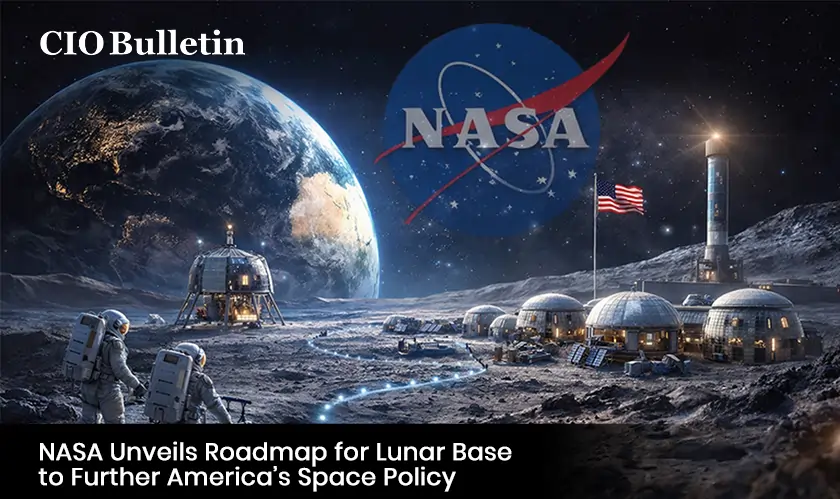
NASA's "Ignition" strategy shifts focus to a permanent lunar base and the launch of the first nuclear-powered spacecraft to Mars by 2028.
On March 24, NASA, as part of its “Ignition” event, announced a broad set of initiatives to meet US President Trump’s National Space Policy and advance America’s leadership in space. Among the initiatives are plans to speed up its return to the moon, build a long-term lunar presence, shape the future of low Earth orbit, expand science missions, and move nuclear propulsion to flight. The agency described the urgency of the moment and the opportunities to transform science and humanity as necessitating its new initiatives.
Arguably, the most important announcement was the plans to return to the moon. NASA stated that moving beyond the previously announced Artemis V project, it would, in a phased approach, incorporate hardware that is commercially procured and reusable to enable more frequent and affordable crewed missions to the Moon’s surface. Biannual landings are planned initially, with a later increase corresponding to the maturing of capabilities. It would build the moon base in three steps: Building, Testing, and Learning in Phase 1, Establishing Early Infrastructure in Phase 2, and Enabling Long-Duration Human Presence in Phase 3.
Furthermore, NASA reaffirmed its commitment to low Earth orbit (LEO), with the International Space Station (ISS) not being able to serve as a world-class orbital laboratory forever. The agency is adopting an alternate LEO strategy of preserving all current pathways while adding a phased ISS-supported approach to ensure US human presence aligns perfectly with a mature commercial ecosystem. Also, NASA announced initiatives to advance its stated goal of advancing world-changing discovery. These include the launch of Nancy Grace Roman Space Telescope in Fall 2026, launch of a nuclear-powered octocoper by Dragonfly in 2028 that would reach Saturn’s moon Titan on an exploratory mission in 2034, delivery of European Space Agency (ESA)’s Rosalind Franklin to Mars, and a New Earth science mission scheduled for 2028 that would help predict extreme weather events six hours before a storm occurs.
Moreover, NASA would also demonstrate capabilities in advanced nuclear electric propulsion in deep space by launching the first nuclear-powered interplanetary spacecraft, “Space Reactor-1 Freedom,” to Mars before the end of 2028. According to CIO Bulletin, NASA’s wide-ranging initiatives would firmly cement the US’s position as a leader in space and cumulatively amount to “one giant leap for mankind.”


















































 consultants ltd.jpg)


