
Home Services & Solutions Translation software T-Mobile’s New Live Language...
CIO Bulletin
,
22 May, 2026
Author:
Sambhrant Das
Telecom Giant Bypasses Third Party App Ecosystems by Embedding Native Network Level AI Translators Directly Into Real Time Cellular Phone Connections
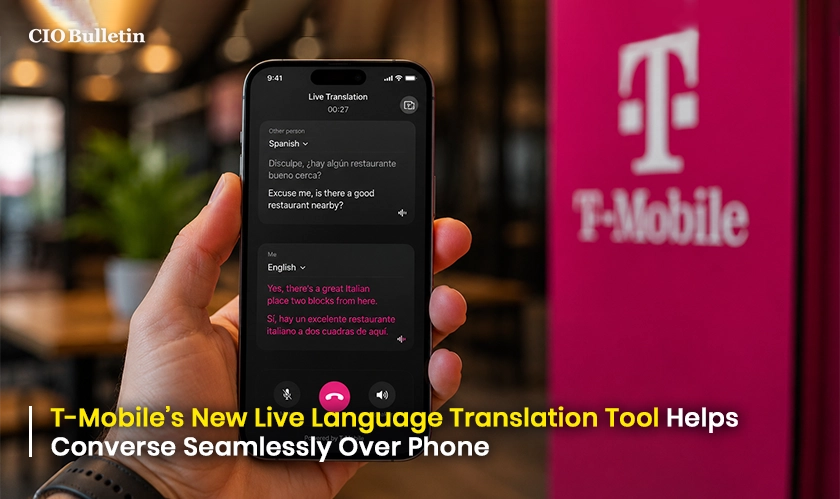
Wireless carriers are moving past basic cellular signals to transform their networks into intelligent, real-time utilities. Breaking away from the old translation apps that usually need lots of smartphone storage and provide constant updates, T-Mobile has now officially pushed out a native carrier-level option, powered by agentic AI that “works on its own” in the background. The roll-out of T-Mobile’s new Live Language Translation tool marks a significant change in how people talk on mobile, because it lets a user translate speech on the spot across more than eighty languages, while still on the same live phone call.
The true innovation of this new telecom utility is how it entirely bypasses the need to download third-party software from an app store. Instead of processing the language translation locally on an expensive smartphone, the computation happens directly within the carrier's core 5G network infrastructure. Since this is set up at the network level, it brings a few obvious benefits for daily communication via phone:
Universal Phone Compatibility: It’s designed to work smoothly on almost any device that connects to the network, so it should perform well on the newest flagship phones, and also on older classic flip phones.
Instant Star Code Activation: No more messing around with accounts or digging through complicated menus. The translation engine turns on fast when a subscriber presses or dials 87 during the live conversation.
Preserving Original Voice Tone: The underlying AI doesn't just convert text to speech using a robotic, automated narrator; it actively translates the dialogue while matching the user's natural vocal pitch.
Because this tool operates by having an AI engine actively listen to every spoken sentence on a live line, data privacy has quickly become a central topic of conversation for early beta testers. Mobile carriers do not have a spotless record when it comes to safeguarding consumer data trails, leading many users to question where their intimate chats end up. Defending the brand's security protocol, T-Mobile spokesperson Mason Miller explained, “The service is designed to translate conversations in real time and then move on, without storing the content of those calls.”
This aggressive push into software utility signals a broader industry trend where mobile network operators are desperate to prove they are more than just a mere pipe for raw data signals. By baking sophisticated AI tools right into their core cell tower infrastructure, telecom operators are attempting to build unique, sticky features that keep subscribers from jumping to rival networks. T-Mobile executives believe that by handling the heavy computational lifting at the network level, they can establish a massive competitive advantage over apps that rely purely on high-end device hardware.
Even though early reactions about the speed sound incredibly encouraging, the translation engine still has a tough climb ahead, especially once it begins navigating real-world speech. It has to handle thick regional accents, loud city background noise, and sudden interruptions, all without interfering with the call flow. CIO Bulletin frames this as a bold rethinking of telecommunications infrastructure, showing that the “future” might be less about standalone apps and more about putting intelligent, cloud-based services directly into the cellular connection itself.




















































 consultants ltd.jpg)


