
Home Industry Startups Will Sourcing Outside Innovati...
CIO Bulletin
,
08 July, 2026
Author:
Sambhrant Das
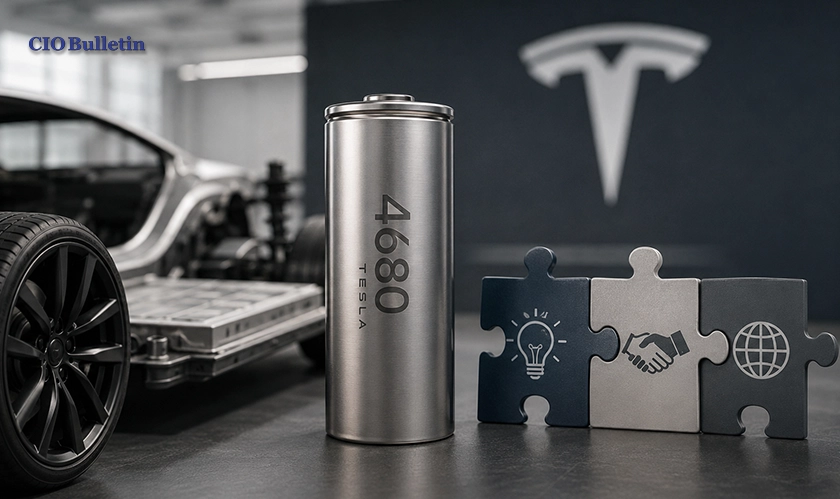
Tesla launches an open innovation challenge at Giga Berlin to crowdsource startup solutions for its complex 4680 battery cell manufacturing line.
Scaling next-generation battery cell chemistry continues to be the most challenging technical hurdle facing modern electric vehicle manufacturing lines. To rapidly bypass lingering bottleneck issues at its advanced European manufacturing facility in Grünheide, automotive giant Tesla has officially broken tradition by launching the "Cell Giga Challenge". This structural shift leverages the technical agility of external startups to directly repair and scale the company's proprietary Tesla 4680 battery production lines. Rather than keeping its highly proprietary cell architecture hidden behind standard corporate security protocols, the company is actively inviting pre-seed tech firms to run active pilot programs inside its live European factory floor. This move signals an industry-wide realization that solving complex mass-production variables requires rapid crowdsourcing over solitary internal development.
The newly deployed German pilot framework acts as a highly structured pipeline designed to fast-track external hardware and software solutions directly into real-time heavy manufacturing. To rapidly filter through international submissions, the joint venture with local startup platform JUNI prioritizes five foundational optimization categories:
Automotive engineers recognize that creating a larger cylindrical layout is much easier on a laboratory workbench than maintaining consistent yield rates across a multi-gigawatt facility. By offering paid industrial contracts to early-stage engineering firms, the company aims to resolve lingering execution bottlenecks that have delayed its domestic vehicle programs.
“We are getting ready for 18GWh of cell production, and you can be part of it,” - André Thierig, Giga Berlin plant manager.
The baseline financial stakes surrounding this localized European operational pivot are incredibly immense, following a massive quarterly commitment to double cell targets. Reaching the planned 18-gigawatt-hour milestone is going to mean pushing through a bunch of tricky thermal management problems along with figuring out dry-electrode manufacturing methods. Full-scale cell output that’s cost-efficient and under one factory roof must be achieved if nearby vehicle assembly lines are to keep running. Otherwise, the whole process would rely on inconvenient long-distance cargo shipments. By building an open testing ecosystem on the factory floor, the company hopes to secure a highly resilient local supply chain that can insulate its regional profit margins from shifting trade regulations.
The overarching operational strategies and resource distribution models governing global electric car production are facing intense restructuring pressures. Clean-energy automotive conglomerates must systematically dismantle rigid, siloed research structures to prevent prolonged factory delays and counter the rapid commercial expansion of rival manufacturing networks. CIO Bulletin views this development as a strong sign for major electric vehicle players needing to adopt open innovation structures to work around deep material science bottlenecks, safeguard their heavy capital investments, and maintain their long-term dominance in an evolving automotive industry.
Everything you need to know about this news
The company is crowdsourcing outside engineering talent to optimize production speed, improve cell yields, and eliminate persistent bottlenecks on its European manufacturing line.
The factory initiative actively reviews outside innovations across five specific operational sectors: materials science, production equipment, plant operations, industrial automation, and artificial intelligence.
Right now, the factory is expanding its infrastructure to reach 18 gigawatt-hours of annual output, which is enough to power more than two hundred thousand electric vehicles.
Selected companies that make it through the technical screening step then receive direct in-person pitching time with executive stakeholders , and if they do well, they can also win fully funded paid pilot projects taking place right on the factory floor.
International engineering teams and hardware startups must submit their technical proposals through the online platform before the formal deadline on July 24, 2026.
















































 consultants ltd.jpg)


Comments