
Home Industry Supply chain management On-Demand Metal Parts: How WAA...
CIO Bulletin
,
07 September, 2026
Author:
Guest
Picture a container ship idling at a commercial port, an offshore platform stalled in the North Sea, or a factory line standing still, all because one metal component has failed. In heavy industry, downtime is not an inconvenience. It carries penalties that run into tens of thousands of euros a day. For decades the standard insurance policy against that risk has been a combination of large physical stockpiles and a heavy reliance on casting foundries.
Recent years have exposed how fragile that model is. Operations leaders are moving away from capital-intensive stockpiling and toward producing large on-demand metal parts. The technology behind that shift is Wire Arc Additive Manufacturing (WAAM), a robotic additive process that is changing how heavy industry thinks about supply-chain resilience.
When a large structural component fails, ordering a replacement through conventional casting or forging triggers a lead time measured in months rather than weeks, depending on size and complexity. That timeline stretches further for low-volume orders, which rarely get priority in a busy foundry schedule.
To absorb that risk, companies have historically warehoused collections of backup structural parts. It is an expensive policy: holding spares for components that seldom fail ties up capital and consumes warehouse space that earns nothing.
Legacy infrastructure adds a third problem. Many operators depend on components whose original manufacturer no longer exists, or whose patterns and molds were scrapped years ago. When those parts degrade, procurement teams face a genuine dead end. Global logistics disruption and material scarcity have made all three of these weaknesses visible and expensive at the same time.
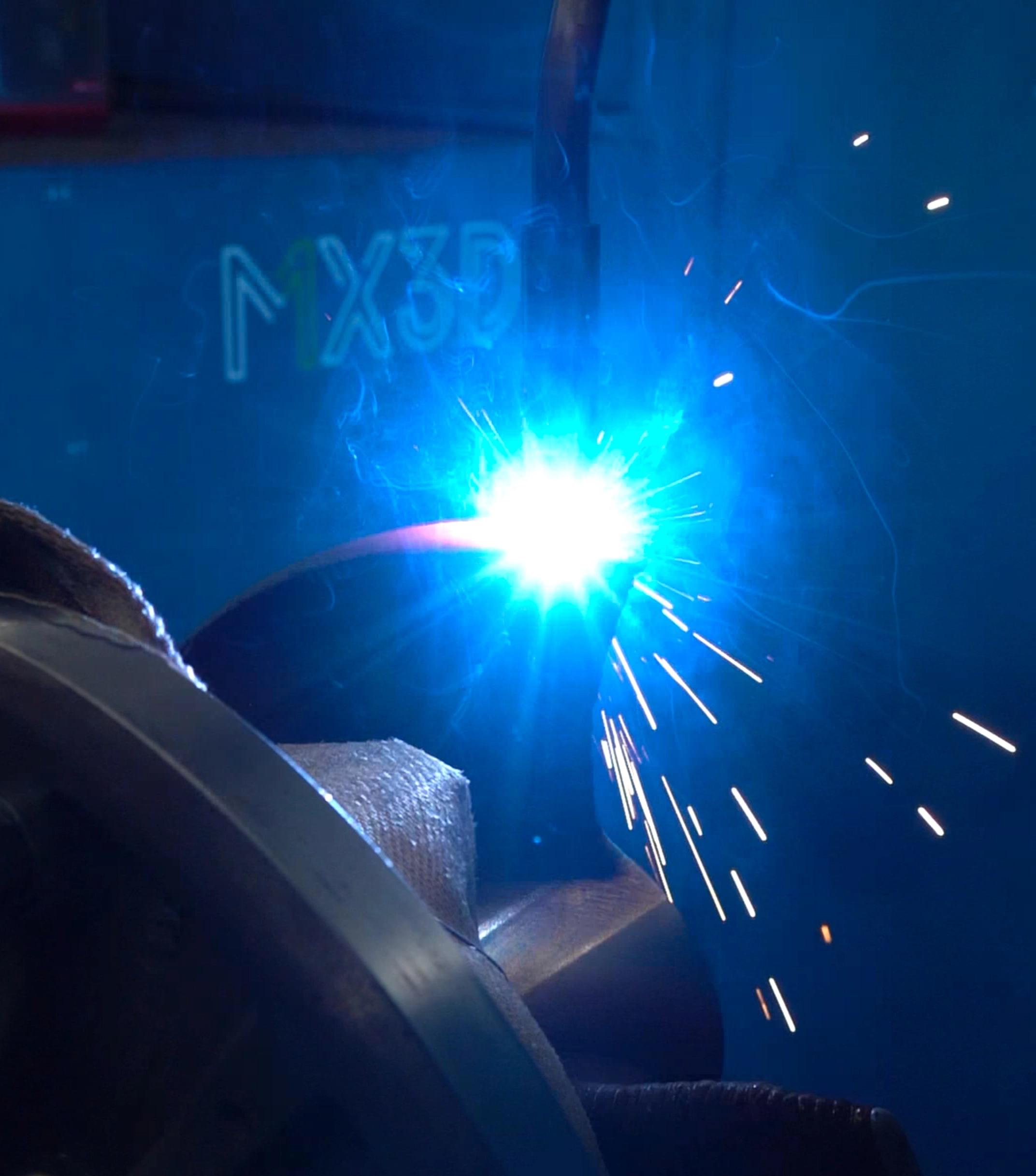
Alt text: "A metal propeller being printed layer by layer inside an MX3D robotic WAAM cell"
Caption: "A propeller taking shape layer by layer inside a robotic printing cell. Image: MX3D."
WAAM shifts production from a semi-analogue process to a digital one. A multi-axis industrial robot carries a standard electric welding torch. Instead of pouring molten alloy into a custom mold, the system melts solid welding wire and deposits it layer by layer along software-guided coordinates, building a near-net-shape part that is then machined to final tolerances. Deposition runs at roughly 2 to 8 kilograms an hour, which is what makes parts weighing hundreds of kilograms practical rather than theoretical.
That mechanism unlocks the idea of a digital inventory. Instead of storing thousands of kilograms of steel on a shelf, an entire library of spare components lives as digital files. When a part is needed, the file is retrieved and printed close to the point of use.
Because the robot is driven entirely by code, custom tooling, patterns and molds disappear from the cost equation. That single change makes one-off fabrication and low-volume runs economically viable, which is precisely the profile of the industrial spare-parts market. It also cuts material waste by more than 80 percent compared with subtractive routes, because metal is added where it is needed rather than machined away.
And because the setup uses standard industrial robots rather than large enclosed vacuum chambers, production can be localised or even containerised, operating at maintenance hubs, remote sites or coastal ports. Keeping that process repeatable and compliant with industrial engineering codes is a software problem, which is why companies such as MX3D run purpose-built platforms like MetalXL to monitor deposition parameters in real time and validate structural properties layer by layer.
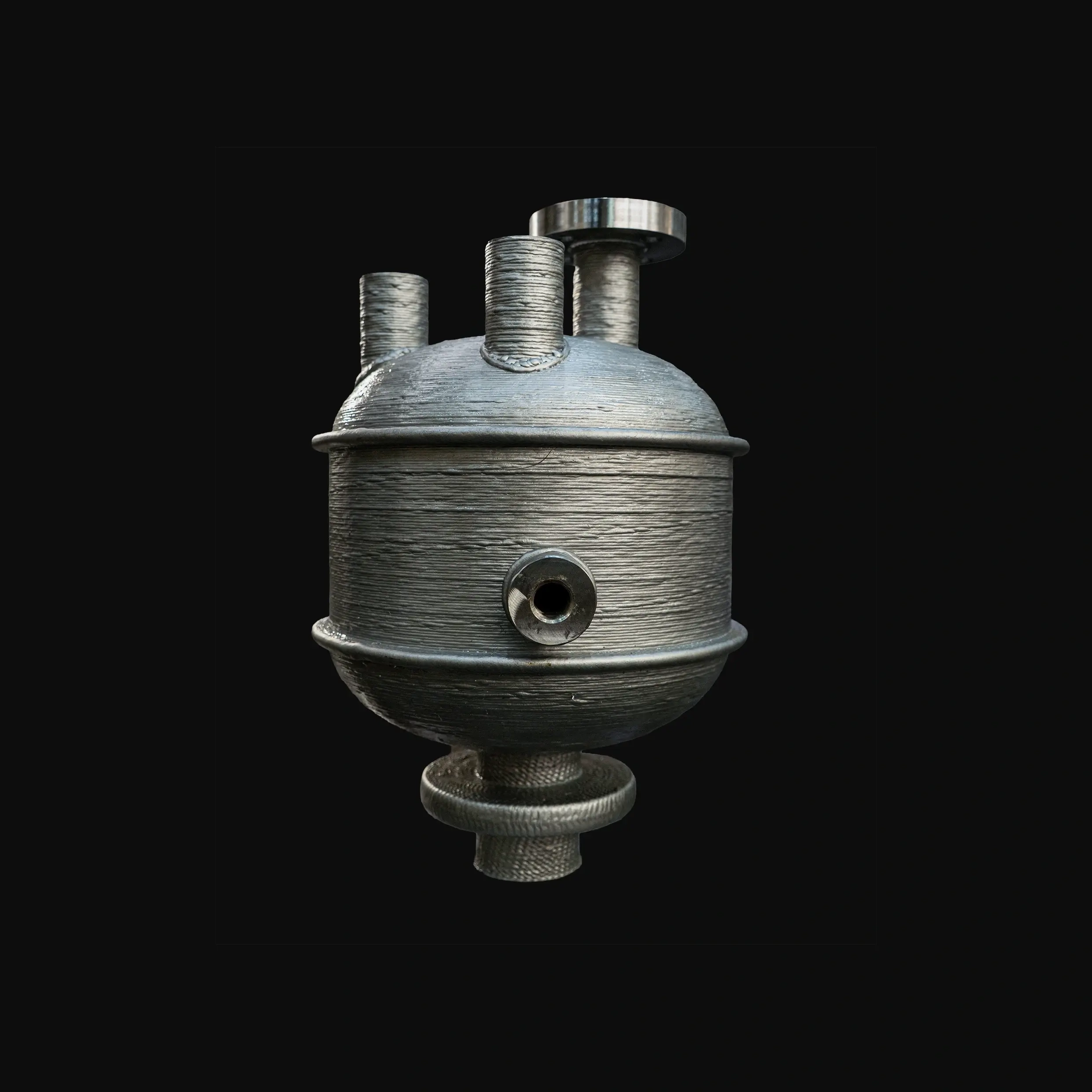
Alt text: "A large stainless steel pressure vessel component printed with WAAM by MX3D"
Caption: "A printed pressure vessel component for energy applications. Image: MX3D."
This is no longer confined to laboratories. It is deployed in sectors where asset downtime carries extreme financial consequences.
Maritime: ship owners and port operators use WAAM to fabricate replacement hardware and repair parts on demand. By bypassing foundry backlogs they cut vessel turnaround times and keep logistics moving instead of waiting out a multi-month delay.
Energy: upstream oil and gas and power generation equipment has to survive high pressure and corrosive fluids. Large-format robotic systems let operators produce corrosion-resistant valve bodies, manifolds and structural pipeline clamps far closer to the installation site, which removes a layer of international transport from the critical path.
Manufacturing: plant operators use the same approach for tooling, jigs and heavy machine components, printing legacy parts directly from a digital file when the original supplier is long gone.
The common thread is straightforward. Large, high-consequence metal parts are being made faster, with far less waste, and much closer to where they are used.
Robotic Wire Arc Additive Manufacturing has crossed from experimental research into verified commercial production. The era of printing demonstration shapes is over. Today's market is characterised by certified structural components produced under controlled processes and real regulatory scrutiny. Third-party testing and quality certifications, including ISO 9001 and classification work with maritime and energy bodies, give procurement managers the evidence that printed alloys match or exceed the mechanical properties of conventional forgings. Printing a series of parts has also become economically attractive, which removes casting from the equation for a growing set of projects.
Adoption is expanding, supported by corporate and venture investment aimed at building distributed manufacturing networks. The direction of travel is toward more automation, a broader set of qualified alloys and multi-material printing.
WAAM is not going to replace foundries for high-volume repetitive production, and it does not claim to. It has earned a permanent, complementary place next to conventional methods, solving exactly the low-volume, long-lead-time bottlenecks that traditional production lines handle badly.
WAAM reframes industrial procurement by turning the spare-parts bottleneck from a physical logistics problem into a digital workflow. Replacing warehouses and unpredictable lead times with agile, localised robotic cells insulates heavy industry against the next supply shock. For asset managers and procurement directors trying to future-proof their operations, understanding the mechanics of that shift is the first step toward building genuine supply-chain resilience on demand.


















































 consultants ltd.jpg)


Comments