
Home Industry Supply chain management North Dakota State Mill Supply...
CIO Bulletin
,
28 October, 2026
Author:
Ravathi Sunil
Century-old state-owned milling institution demonstrates enduring operational resilience and strategic supply chain management through technological innovation and agricultural integration.
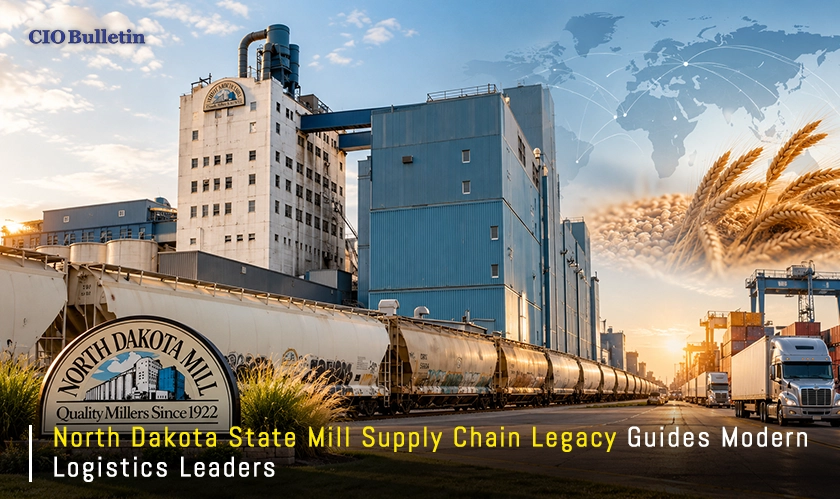
CIO Bulletin explores operational longevity as the North Dakota State Mill supply chain architecture offers vital strategic lessons for modern enterprise logistics executives. The century-old company operates as the biggest state-owned flour milling plant in all of North America, processing millions of bushels of spring wheat per year, without breaking the chains of its supply chain in the international market. Established in 1922 to help regional agricultural farmers, the plant uses both modern automatic mill machinery and traditional grain storage equipment. Highlighting the organization's enduring commitment to operational excellence, President and Chief Executive Officer Vance Taylor emphasized, "Our success relies on consistent quality, operational discipline, and long-term relationships with local producers." This steadfast focus allows the enterprise to navigate modern market volatility smoothly.
The efficiency of the plant in operation is achieved through the constant incorporation of logistics technology innovations into its traditional infrastructure. Through using innovations like real-time inventory management, automated rail loadouts, and equipment prediction, the plant maintains efficient and constant operation through any kind of bad weather and variable freight capabilities. The location of the plant near the railways makes it possible to distribute across North America to commercial bakers and other international customers. Also, the plant’s cooperation with local grain elevators ensures smooth operation even in case of sudden bottlenecks in the world's logistics network.
Can traditional agricultural processing centers introduce modern technologies into their existing legacy equipment quickly enough in order to cope with the changing climate and transportation expenses? Supply chain managers consider the use of innovations like automated grain sorting and rail prediction as ways to ensure stable delivery schedules.
How would the international logistics networks manage sustainable sourcing practices and increased demands in food processing in the next ten years?
Century-Old Resilience: North Dakota State Mill maintains continuous milling operations and reliable agricultural distribution networks after a century of operation.
Modern Integration: Advanced automated rail loading and real-time inventory tracking systems enhance legacy processing infrastructure significantly.
Producer Collaboration: Direct integration with regional grain elevators secures high-quality wheat supply pipelines against unexpected global supply disruptions.
Logistics Dominance: Strategic rail connections ensure rapid, cost-effective flour transport to major commercial baking facilities across North America.
While increasing disruptions continue to pose challenges to global business network operations, past operational models can be used as guidance to create sustainability. Will conventional factories turn to hybrid technology models to ensure stability of supply chains? CIO Bulletin keeps monitoring the latest logistics developments in the agriculture industry.
News Source: Supply Chain Management Review, https://www.scmr.com/
Everything you need to know about this news
It is the largest state-owned agricultural flour mill in North America, operating successfully for over a century while processing millions of bushels of spring wheat annually.
The institution continuously integrates modern digital logistics, automated rail loading systems, and real-time inventory tracking with historical grain storage infrastructure.
Direct rail line integrations enable immediate, bulk distribution of flour and grain products to commercial bakeries and industrial food manufacturers nationwide.
Building direct partnerships with regional agricultural elevators ensures consistent raw material access, stabilizing supply pipelines during global trade bottlenecks.
Combining operational discipline, strong vendor relationships, and strategic technology upgrades enables manufacturing facilities to build multi-decade supply chain resilience.
















































 consultants ltd.jpg)


Comments