
Home Industry Supply chain management CIO Bulletin Spotlights the To...
CIO Bulletin
,
22 October, 2026
Author:
Sambhrant Das
For American enterprise managers, maintaining strict temperature integrity throughout modern distribution supply chains has now become one of the most challenging operational priorities. Whether its life-saving biopharmaceuticals and vaccines or perishable food products, the shipping networks used by companies need intelligent systems that can monitor environmental conditions in real time. If specialized logistics software solutions are introduced, corporate operations teams will achieve full end-to-end control over refrigerated fleets, cold storage facilities, and the complicated distribution routes throughout the United States.
By using IoT temperature sensors, real-time GPS tracking, and predictive analytics, today's cold chain solutions prevent unexpected thermal excursions before the cargo is damaged. When logistics software platforms are assessed, enterprise supply chain executives and operations directors are given a clear plan for improving their temperature-controlled shipping infrastructure in 2026.
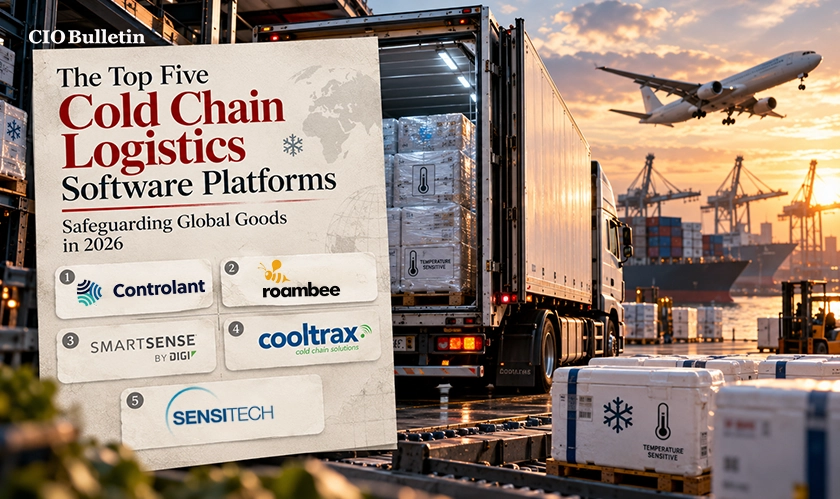
By adopting automated cold chain monitoring systems, large-scale distributors are able to comply with the strict FDA regulations, decrease the amount of expensive product waste, and ensure consumer safety across all of North America. Here is CIO Bulletin’s guide to the five best cold chain logistics software platforms redefining industry standards in 2026.
Five Premier Technology Platforms Safeguarding Cold Chain Operations
A more detailed examination of the current state of cold chain technology shows that there are five notable solutions that provide American distribution networks with real-time visibility, automated compliance reporting, and sensor-driven intelligence.
Controlant has its main office in San Francisco, California, for its operations in the US and provides an enterprise-level cloud platform designed to ensure real-time visibility throughout the cold chains of pharmaceuticals and perishable food. The Aurora platform combines reusable IoT data loggers with automated telemetry so that ambient temperature, location, and light exposure can all be monitored in real time. It achieves this by automatically generating the necessary compliance documentation and by sending immediate alerts whenever thermal limits are exceeded, thus allowing global life sciences companies to keep the entire chain-of-custody intact during transport.
Roambee, which is based in Santa Clara, California, offers sensor-based supply chain intelligence for complicated temperature-sensitive freight. The company's platform uses AI-powered signal processing to turn the sensor data from shipments by sea, air, and road into real-time alerts for quality control. By predicting possible thermal breaches according to the performance of the carrier route and weather forecasts for the area, Roambee enables large-scale shippers to take action proactively before sensitive goods are damaged.
SmartSense by Digi, which is based in Boston, Massachusetts, focuses on providing IoT-driven temperature monitoring and automated digital task management for the healthcare, pharmacy, and food service sectors regarding logistics. The system constantly gathers environmental data from wireless sensors that are placed in refrigerated trailers, distribution hubs, and retail storage units. Instead of using manual temperature logs, SmartSense uses automated digital records, which not only simplifies regulatory reporting but also lowers operational risk within the entire network of nationwide deliveries.
Cooltrax, which is based in Roswell, Georgia, provides telematics and asset management solutions that are particularly designed for operators of refrigerated fleets. Its FreshTrax platform enables real-time monitoring of multi-compartment reefer trailers by simultaneously tracking return-air temperatures, door openings, and the engine's operating status. Because it is integrated directly with the refrigeration units on board and with transportation management systems, Cooltrax assists commercial carriers in maintaining accurate thermal zones for a variety of cargo types.
Sensitech, which is based in Beverly, Massachusetts, has long been a leading company in the field of cold chain telematics and environmental monitoring. Its TempTale Geo platform provides real-time tracking of location, temperature, and humidity throughout both domestic and international distribution channels. The company uses strong hardware devices together with sophisticated analytics software so that enterprise supply chain teams can carry out comprehensive post-trip thermal evaluations and improve the performance of long-haul carriers.
Why Are US Enterprise Networks Investing Heavily in Cold Chain Technology?
Supply chain executives frequently ask: Why does specialized temperature monitoring software figure as the top IT investment in American distribution networks nowadays?
The increase is due to more stringent federal regulatory requirements together with the fast growth in the e-commerce of temperature-sensitive pharmaceuticals and fresh food. Regulations at the federal level, for example, the FDA's Food Safety Modernization Act and the strict Good Distribution Practice rules applicable to biopharmaceuticals, mandate that proof must be provided showing that perishable goods stayed within the required thermal limits during the whole of their transport. If these standards are not met, then there are expensive rejections of shipments and heavy regulatory fines.
Apart from meeting legal requirements, modern enterprise shippers cannot afford the financial losses caused by spoiled cargo. By using continuous top cold chain logistics software, fleet operators are able to pick up refrigeration unit faults at an early stage. Moreover, by incorporating the best logistics software 2026 features into their core enterprise resource systems, dispatch teams are given automated route scheduling, which avoids delays due to extreme weather. In the end, the use of sophisticated logistics software systems makes it possible for enterprise distributors to maintain product quality and at the same time reduce operational losses.
Balancing Thermal Quality and System Integration Overhead
Key Operational Advantages
The use of modern logistics software provides valuable operational benefits in temperature-sensitive supply chains. Logistics managers are given at once a clear view of all current shipments and receive automatic alerts as soon as a reefer unit moves outside its desired temperature range. Instead of relying on error-prone paper records, automated digital logging removes this problem and makes compliance audits for medical and food products easier to carry out. Moreover, predictive thermal analytics assist fleet managers in optimizing the use of refrigeration units and thus reduce total fuel consumption over transport routes.
Critical Implementation Challenges
Despite these clear operational benefits, scaling enterprise cold chain software introduces distinct integration hurdles:
Hardware Deployment and Sensor Maintenance: The deployment, calibration, and management of thousands of wireless IoT sensors and data loggers within active fleets must follow well-established operational procedures.
Hardware Deployment and Sensor Maintenance: The integration of cloud-native temperature analytics software with older transportation management systems usually requires the development of custom data pipelines.
Hardware Deployment and Sensor Maintenance: Transmitting continuous real-time telemetry via remote transit corridors where there is poor cellular connectivity can result in temporary data blind spots.
Despite these operational difficulties, the long-term value of automated cold chain management is without any doubt. Businesses that adopt modern logistics software are able to establish resilient distribution networks that can deliver fresh goods to consumers each time.
Strategic Action Plan for Logistics Leaders
Conduct a Temperature Risk Audit: Assess the existing distribution routes, storage facilities, and the fleet equipment to identify the areas that are at high risk of thermal exposure.
Standardize IoT Sensor Networks: Make the IoT sensor networks standard by installing standardized and calibrated wireless temperature loggers in all refrigerated trailers and in all warehouse cold storage rooms.
Automate Compliance Data Pipelines: Integrate sensor platforms directly with enterprise software so that automated thermal history reports capable of passing an audit can be produced.
Implement Real-Time Exception Protocols: Set up clear operational procedures for dispatch teams in the event that real-time alerts indicate a temperature breach during transit.
Deploy Advanced Logistics Software Solutions: Deploy advanced logistics software solutions by working with leading specialized technology providers in order to achieve full real-time visibility throughout all temperature-controlled supply chain operations.
Everything you need to know about this news
Temperature sensors associated with the IoT use cellular gateways, satellite links, or Bluetooth data loggers to send real-time telemetry to cloud monitoring dashboards during the entire cargo journey.
A thermal excursion happens when temperature-sensitive goods are exposed to ambient temperatures that are outside the strictly required storage range for a long time, putting the effectiveness or safety of the product at risk.
The software for maintaining the cold chain produces automated, tamper-evident electronic records and continuous temperature logs, which are required by regulatory authorities to confirm compliance with Good Distribution Practice.
Yes, modern platforms are able to connect with multi-zone temperature sensors in order to keep an eye on the different thermal zones—for example, the frozen, chilled, and ambient areas—within one trailer at the same time.
Predictive analytics are used to monitor ambient weather forecasts, the level of traffic congestion, and the past performance of refrigeration units so as to warn dispatch teams before thermal deviations take place.

















































 consultants ltd.jpg)


Comments