
Home Industry Telecom Pakistan’s Senate Panel to D...
CIO Bulletin
,
02 June, 2026
Author:
Sambhrant Das
Coordinated Fuel Theft Rings and Severe Power Grid Outages Disrupt Essential Cellular Services Across Regional Infrastructure Footprints Just Ahead of Modernized 5G Deployments
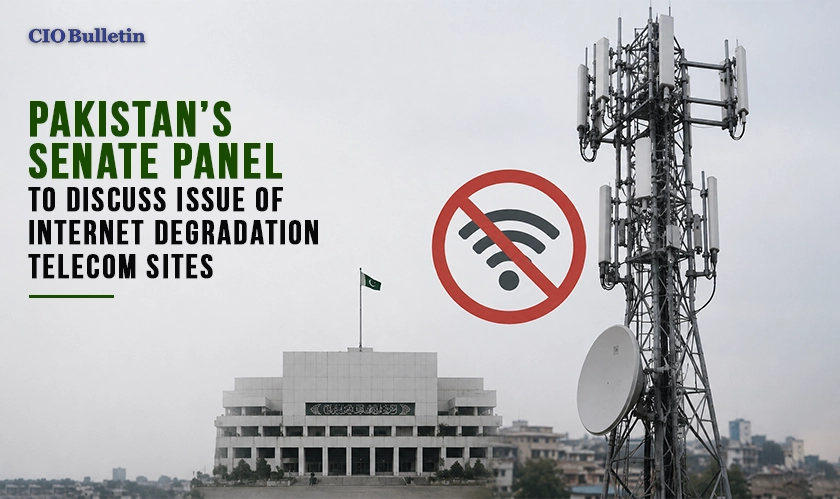
Pakistan’s digital framework is stuck in a serious operational crisis, and it’s not just small connectivity hiccups anymore. It has moved into wider, structural network breakdowns. For months, smartphone users as well as companies across the country have been reporting slow download rates, plus sudden drop-offs where mobile data disappears abruptly. At first, a lot of people pointed to “technical upgrades” or suspected state-led throttling. But official findings suggest something far more tangible and criminal happening out of sight that is affecting the system, with internet degradation telecom sites becoming a commonly reported occurrence nationwide.
A specialized Senate subcommittee recently pulled back the curtain on the sheer scale of the damage, revealing that coordinated criminal rings have managed to compromise roughly 16% of the country’s entire cellular network footprint over the span of just 11 months. Organized thieves have targeted remote cell towers, treating them as free fueling stations by draining their backup diesel generators and stripping valuable components. The raw data presented to lawmakers outlines a massive geographical crisis:
Sindh Province, Taking the Hardest Hit: This area recorded around 3,938 incidents of fuel theft across 31 separate districts.
Central Punjab Impact: Industrial clusters and even outlying rural pockets suffered too, with 2,827 separate vandalism cases across 38 districts.
Frontier Outliers: The more remote stretches of Khyber Pakhtunkhwa saw 1,668 generator raids, while Balochistan, with its difficult terrain, logged 716 highly focused attacks.
The problem is being compounded significantly by the country's ongoing utility crisis, which leaves major regions without standard electrical power for hours on end. When the main power grid basically goes dark, cell towers can’t do much except depend on nearby battery reserves and diesel backup units to keep mobile signals working. Since these generators end up running for long hours , they burn fuel very quickly. That means they become an obvious, high-visibility target for local thieves who are organized. Highlighting the extreme urgency of these interconnected utility and security failures, the committee stated, “Internet access must be classified under essential services criteria.”
In a bid to save the fracturing network, the national telecommunication authority is shifting away from standard private security guards to implement highly technical grid alterations. The regulator has initiated high-level talks with power divisions to secure priority, dedicated utility lines for major telecom hubs, effectively eliminating their reliance on vulnerable diesel backups. Additionally, district police teams are being told to catalog prior theft hotspots, then set up ongoing patrol paths so critical tower sites are shielded from episodes of coordinated, late-night strikes.
The region’s longer-term economic stability depends on whether mobile providers can actually satisfy new, strict downtime requirements, where local network outages must be held to only very small, fractional percentages. Transitioning toward a secure, modernized 5G framework is virtually impossible when the foundational 4G towers are constantly being stripped of their power sources. CIO Bulletin views this development as a stark warning for global infrastructure managers, proving that even the most advanced digital networks remain entirely dependent on basic, physical security and a stable local utility grid to survive.












































 consultants ltd.jpg)


