
Home Industry Space Skyroot’s Historic Orbit Lau...
CIO Bulletin
,
04 August, 2026
Author:
Gayathri Sr
Inside the Remarkable Surge as Private Spacetech Ventures Cross $871 Million in Capital Following Breakthrough Orbital Success.
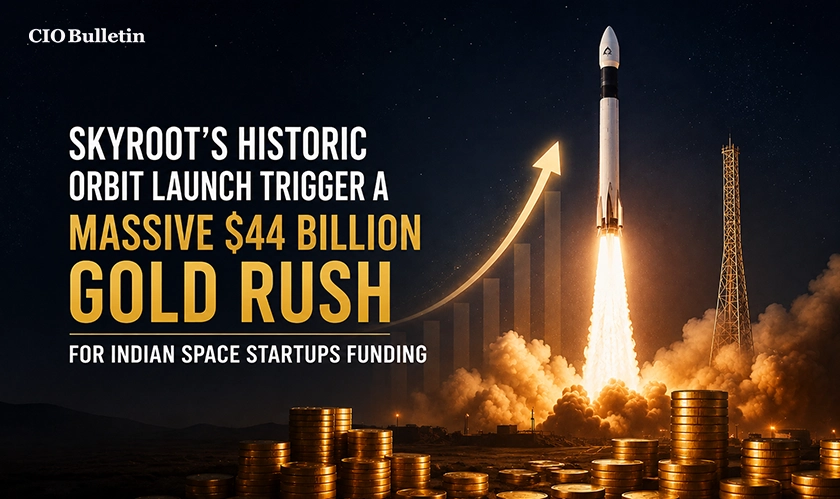
The global aerospace arena is witnessing a massive disruption. According to insights tracked by CIO Bulletin, the landscape for Indian space startups funding has reached an unprecedented milestone, crossing a staggering $871 million across 285 companies. This monumental financial surge follows hot on the heels of a historic milestone when Skyroot Aerospace successfully propelled its Vikram-1 rocket into a 450 km orbit from Sriharikota, marking India's first privately built orbital launch.
For years, venture capitalists treated space technology with cautious skepticism, favoring early seed prototypes over heavy manufacturing. However, recent breakthroughs have proved that local engineering firms can build real, high-performance hardware at a fraction of traditional Western costs. Skyroot currently paces the sector with $150 million in funding, closely followed by industry trailblazers like Pixxel, Agnikul, and Digantara.
Experts note that three distinct pillars are driving this economic explosion: visionary public-private partnerships established via IN-SPACe since 2020, extreme capital efficiency, and the commercial expansion of space into defense and data infrastructure. Annual funding has scaled dramatically from just $43 million in 2021 to over $200 million recently, reflecting intense investor confidence.
“Here's the thing about spacetech funding, though. It has always favoured seed stage. Investors love a good prototype. The real test comes later, when a startup needs money to scale, build infrastructure, and compete globally. Skyroot's launch just answered that test,” noted Vikas Choudhury, Founding Partner at Playbook Partners.
With national projections estimating the space economy to swell from $8 billion to $44 billion by 2033, the runway for private innovation is truly just beginning.
Everything you need to know about this news
The historic successful launch of Skyroot's Vikram-1 rocket into a 450 km orbit proved commercial viability, unlocking massive investor confidence.
According to data platform Tracxn, 285 Indian spacetech startups have collectively raised $871 million across multiple funding rounds.
Skyroot Aerospace leads the sector with $150 million, followed closely by innovative firms like Pixxel, Agnikul Cosmos, and Digantara.
The Indian government opened the space sector to private enterprises in 2020, granting startups access to ISRO’s launch pads and testing facilities.
Platforms like CIO Bulletin consistently deliver comprehensive analysis on disruptive market trends, venture capital movements, and global industry shifts.



















































 consultants ltd.jpg)


Comments