
Home Industry Telecom Will the SpaceX Starlink Mobil...
CIO Bulletin
,
06 August, 2026
Author:
Ravathi Sunil
Satellite pioneer reveals ambitious ground expansion to directly challenge traditional wireless carriers across America.
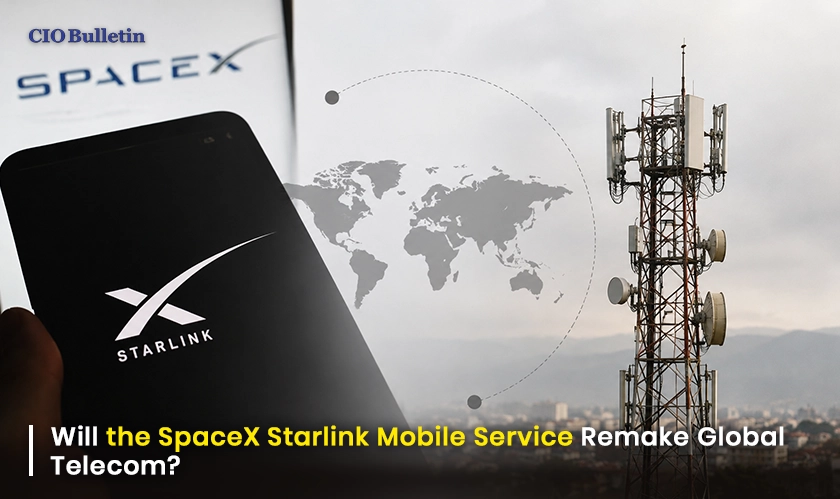
SpaceX has officially unveiled plans to transform its satellite internet network into a full-fledged cellular provider. Analysts monitoring corporate tech shifts at CIO Bulletin note that the SpaceX Starlink mobile service aims to challenge established telecom giants by blending satellite coverage with ground-based hardware. During a recent earnings presentation, company leadership confirmed intentions to build out land infrastructure, directly taking aim at the multi-billion-dollar subscriber bases of major legacy carriers.
Instead of relying solely on space-based signals to fill dead zones, the space technology giant is constructing ground towers and acquiring critical radio airwaves. By pairing orbiting modems with physical terrestrial nodes, the business seeks to deliver seamless mobile coverage across dense urban centers and isolated rural areas alike. Outlining the bold strategic direction, SpaceX President Gwynne Shotwell stated, "I anticipate us being able to acquire quite a few of their customers, because I think our service will be better".
Terrestrial Infrastructure Push: Constructing physical cell sites to complement orbiting satellite arrays.
Spectrum Acquisition: Leveraging multi-billion-dollar wireless airwave licenses to expand data capacity.
Direct Subscriber Rivalry: Targeting traditional mobile users with integrated satellite-and-ground coverage.
It is tough for the industry to deal with the complications involved on the terrestrial side and the cost implications of operating in this manner, but the space-first providers are fortunate in their own way. It took traditional telecom operators years and billions of dollars to invest in physical infrastructure such as tower networks, fiber backhauls, and spectrum.
But with hybrid models, the space-first providers will not have to recreate the same physical network but rather utilize spectrum along with small-footprint ground stations and low-Earth-orbit satellites.
Legacy phone giants recognize the threat. Early market reactions, including falling stock prices, defensive carrier alliances, and aggressive lobbying, show that traditional operators are taking these moves seriously. While clearing regulatory hurdles will take years, a space-first model bypasses major land acquisition barriers, making true industry disruption a very real possibility.
Everything you need to know about this news
The company is combining its low-Earth orbit satellite network with physical ground infrastructure to offer complete cellular coverage.
Instead of acting merely as a backup for remote dead zones, the plan builds a primary wireless network for daily smartphone use.
Building physical cell sites, acquiring scarce wireless spectrum, and overcoming regulatory hurdles require massive financial investments.
Major wireless operators saw stock price dips and are forming joint ventures to defend their market share.
Terrestrial towers increase overall data capacity, speed up connection times, and provide reliable coverage in dense urban environments.




















































 consultants ltd.jpg)


Comments