
Home Services & Solutions Translation software Devnagri AI Builds Sovereign M...
CIO Bulletin
,
30 October, 2026
Author:
Ravathi Sunil
Next-generation artificial intelligence architecture transitions corporate workflows from simple translation tasks to deeply contextual language processing and automated regional communication.
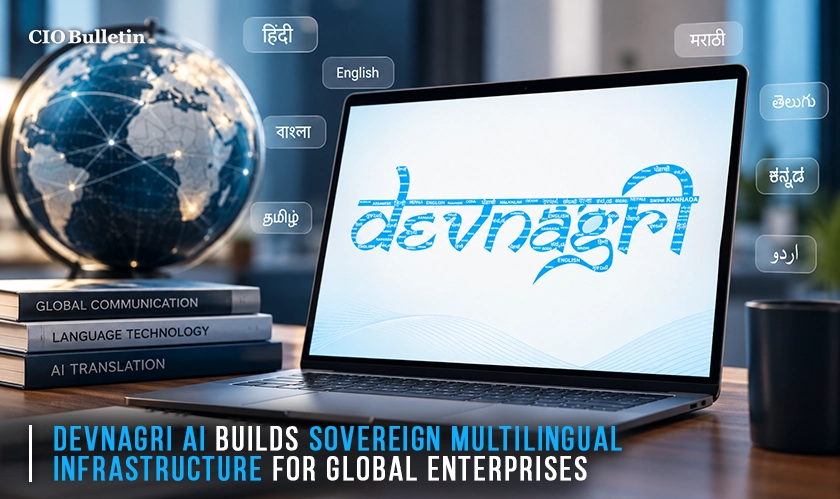
CIO Bulletin monitors critical enterprise software transformations as the latest expansion of Devnagri AI establishes a sovereign language intelligence infrastructure layer for global organizations. Beyond translation, the platform utilizes mini-language models, automatic document processors, voice agents, and OCR technology. The platform provides the ability to connect multi-channel customer interactions to complex corporate databases while adhering to data residency compliance standards. Through contextual nuances and regional terminologies in twenty-two languages in India, the platform allows for automation of regional processes by financial institutions, retail platforms, and government services. Reflecting on this strategic evolution, Devnagri Co-Founder Himanshu Sharma noted, "When language becomes part of the infrastructure, every form, document and call feels local, accurate and compliant."
The transition to embedded linguistic intelligence is changing the way multinational companies deal with digital expansion in their regions. Can the IT system of the company ensure absolute data security along with real-time voice and text translation on localized platforms? It is clear to many CEOs that a simple translation API does not always provide the necessary industry-related terminology or compliance with regulations. Sovereign platform addresses these concerns by being deployed on-premises, inside a virtual private cloud, or using a dedicated software environment.
Are enterprise software architectures going to treat native languages as critical infrastructure and not just additional interfaces?
Unified Language Architecture: Combines customer experience interfaces, document processing engines, and localized domain intelligence within one platform.
Sovereign Enterprise Security: Provides zero external dependency deployments aligned with strict regional data privacy and financial governance mandates.
Domain-Adapted Intelligence: Uses tiny language models that have been trained with specific industry jargon to guarantee proper contextual translation.
Conversational Voice Workflows: Includes real-time speech processing and voice-based conversation agents via regional digital service lines.
In line with the increased pace of digital transformation in non-English-speaking areas, strong linguistic engineering is required for sustainable enterprise development. CIO Bulletin highlights important advancements in artificial intelligence that drive global software ecosystems.
News Source: CXOToday, https://cxotoday.com/
Everything you need to know about this news
It operates as a comprehensive intelligence infrastructure, automating complex workflows, speech recognition, and domain-specific terminology rather than performing simple text-for-text translation.
Banking, financial services, insurance, e-commerce platforms, government institutions, and healthcare providers use the platform to power secure regional interactions.
The system supports on-premises and private cloud deployments, ensuring customer data remains isolated and compliant with regional data privacy laws.
Yes, integrated optical character recognition and document engines convert unstructured physical files and PDFs into standardized, multilingual enterprise data.
Small language models are specifically trained on industry data, offering higher accuracy, reduced hallucination, and faster processing speeds for specialized corporate tasks.



















































 consultants ltd.jpg)


Comments