
Home Services & Solutions Translation software Will Indosat and Huawei’s Re...
CIO Bulletin
,
28 August, 2026
Author:
Sambhrant Das
indosat and huawei pioneer real time ai translator technology to bridge global language barriers across mobile networks
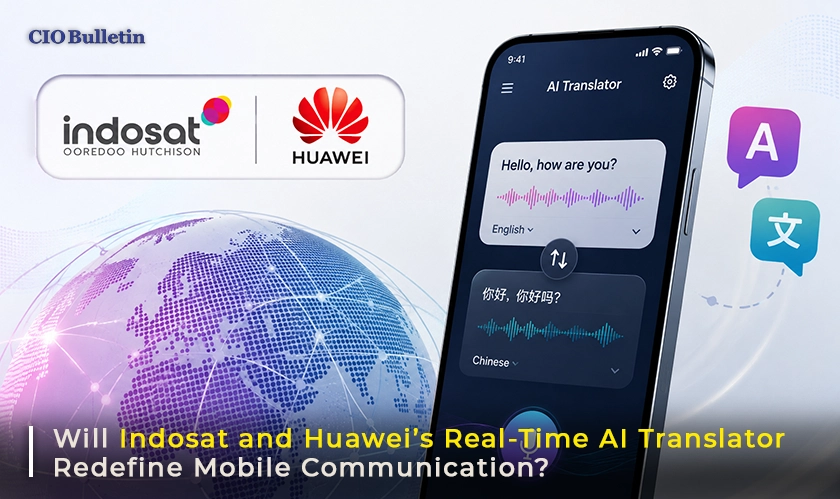
The global telecommunications landscape is experiencing a massive shift as mobile operators move beyond basic voice connectivity. In a major joint move, Indosat Ooredoo Hutchison and tech giant Huawei unveiled their new real-time AI translator feature built directly into mobile voice networks. Revealed during the Agentic Technology Partnership event in Jakarta, this technology translates live spoken conversations back and forth instantly during standard calls.
Integrated Network Intelligence Drives Seamless Speech Processing
Rather than forcing subscribers to launch external translation applications, this framework processes speech straight over the 5G network core. The architecture translates live speech into target spoken audio alongside real-time text captions.
“Our ambition is to make AI more accessible through the connectivity that people use every day.” - Desmond Cheung, Indosat CTO.
Next-Gen Mobile Calling Unlocks Multimodal Interactive Capabilities
This live translation tool represents one part of a larger suite called AI New Calling. The overall package includes several practical communications upgrades:
AI Noise-Reduction Calling: Filters intense background noise to ensure pristine voice clarity.
Interactive Visualized Voice Calling: Enables real-time visual media sharing for commercial activities like hotel bookings.
IDOLCALL Digital Avatars: Brings interactive visual avatars directly onto phone screens during call sessions.
Privacy Safeguards and Commercial Delivery Timeline
Despite the successful live demonstrations, both companies have kept the commercial launch dates and supported language lists quiet for now. Key operational questions—including data retention policies, processing latency, and user consent protocols—remain under active review to guarantee robust data privacy before public rollout.
Transforming Everyday Connectivity into Intelligent Digital Experiences
Integrating deep learning algorithms directly into infrastructure highlights how telecommunications providers are shifting into fully AI-native networks. When deployed smoothly, network-level speech translation will transform international travel, cross-border commerce, and daily communications. CIO Bulletin views this development as a decisive step toward eliminating linguistic friction across global telecommunication networks.
Everything you need to know about this news
It acts as a live voice call translator that translates dual-language phone conversations instantly in both voice and on-screen text formats.
No, the translation capability is embedded directly in the 5G mobile calling network, so no extra translation apps are needed.
The suite includes AI noise reduction, visual interactive calling for business bookings, and customized digital avatars on call screens.
Not yet; the technology has been officially demonstrated, but specific commercial release dates and supported languages are still being finalized internally.
Both companies are finalizing comprehensive security frameworks and data processing protocols to protect user privacy before making the service public.















































 consultants ltd.jpg)


Comments