
Home Services & Solutions Translation software OpenAI Upgrades ChatGPT Voice ...
CIO Bulletin
,
10 July, 2026
Author:
Ravathi Sunil
OpenAI's latest voice models enable more natural, real-time conversations by processing speech and responding simultaneously with fewer interruptions.
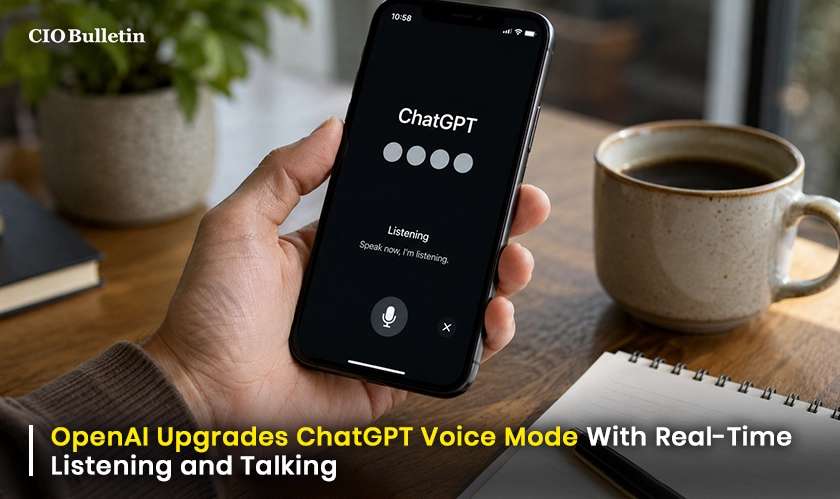
OpenAI is enhancing its AI voice technology to align with its text-based AI. Two fresh models, namely GPT-Live-1 and a smaller variant, are currently being introduced to all ChatGPT users. The new pair of models is based on OpenAI's most recent cutting-edge models. Users have the option to choose from three varying levels of smartness, based on the depth desired for responses. The most significant improvement is that the voice now sounds more human and engaging in conversations, as explained by Atty Eleti, the Head of Product for ChatGPT voice mode.
According to the reports tracked by CIO Bulletin, one major update is the introduction of a new system known as continuous interaction. This structure enables the AI to receive data and generate responses concurrently. For instance, in voice applications, it can now both "hear" and "respond" simultaneously. This contrasts with earlier voice systems that could only react once the user had finished speaking.
"When GPT-Live have to think hard for a question, it can delegate its reasoning and complex tasks to GPT-5.5, which can do things in parallel and this GPT-Live can still remain in conversation with the user." - Kundan Kumar, Research Lead of the GPT Live model.
If the user needs to perform real-time translation, it can be beneficial. Users can converse in English and let ChatGPT interpret the words into Spanish, Hindi, or any other language with minimal latency. Part of the fresh design can also assign or transfer tasks to OpenAI's cutting-edge models.
Developing artificial intelligence that exhibits more human-like qualities carries potential dangers. There have been many instances highlighting the negative impacts of attributing human characteristics to AI, especially for individuals dealing with mental health issues. OpenAI reports that the latest models have enhanced protective measures and outperformed earlier versions in crucial safety aspects like self-injury, mental illness, aggressive behavior, and explicit material.
Everything you need to know about this news
An AI voice assistant is a program powered by artificial intelligence that comprehends spoken language, provides answers, carries out tasks, and engages in natural dialogues with users.
AI voice technology merges speech recognition, natural language processing (NLP), and speech production to grasp verbal instructions and create responses that resemble human speech.
AI voice assistants enable users to accomplish tasks without using hands, interpret languages, respond to queries, set reminders, manage smart devices, and enhance accessibility.
Numerous contemporary AI voice assistants facilitate real-time language translation, enabling users to communicate in different languages with minimal time lag.
Prominent AI developers incorporate security measures to minimize harmful feedback, safeguard user privacy, and enhance content regulation, although users should still be cautious when sharing confidential information.



















































 consultants ltd.jpg)


Comments